Showing posts with label Van der Weyden. Show all posts

Sunday, 8 December 2019

The many variations of an Early Netherlandish "Throne of Mercy"

Bernaerts, from Belgium, sells on 9 December 2019 a "Flemish, anonymous, late 16th century" Trinity, estimated at 2,000 to 3,000 Euro.

They describe it as a version of a much-copied painting from the National Gallery by the Master of the Prodigal Son.

In fact it is much closer to a composition which I already described in a blog post from November 2018, and which goes back to a (lost?) Rogier van der Weyden work. The image shows the Trinity in a specific pose usually called a Throne of Mercy.

That post contained a few images of such compositions, but there are many further versions of this composition around, many of them quite elaborate, and attributed to a wide variety of artists. Most of these I found through the BALat / Kik-Irpa phototeque search.

A somewhat less close copy, as the center piece for a triptych, is attributed to Jean Bellegambe and kept in the Museum of Fine Arts in Lille (a museum, by the way, with a fairly good collection of Early Netherlandish paintings, including works by Dirk Bouts).

Colijn de Coter, Louvre


Joos van Cleve


Copy after Robert Campin


Another copy after Campin


Master of the Holy Blood? (Brussels)
 
Antwerp School, 1525 (Christie's 2014)


But the actual original work is most closely followed in a few very nice copies. Apart from the one in Museum M in Leuven (given in the earlier blog post), these included one by Colijn de Coter from the Louvre, one attributed to Joos van Cleve (location unknown), a copy after Robert Campin from the Fanch collection, another very similar copy after Campin (location unknown), and one tentatively attributed to the Master of the Holy Blood (from the Brussels Museum of Fine Arts). Another version of this, given to "Antwerp School, ca. 1525" was sold at Christie's in 2014 for £50,000.

At some point another major version evolved, only showing the trinity (Father, son, and Holy Ghost as a dove) without the angels or the background. The one for sale now, and the one for sale in the previous post, are examples of this, but other ones are known. The main variations are the Father either looking straight ahead (closer to the examples above), or to the side (showing more grief and less majesty).

Northern French artist


Follower of Hugo Van der Goes (Verviers)
 
Unknown painter, Brussels

Unknown painter, Marke


Examples include one from an unknown Northern French artist (location unknown), a Follower of Hugo van der Goes from the Verviers City Museum, which is actually very close to the work for sale (but better executed), an unknown painter (Brussels, Social Services Museum) (even closer to the one for sale), and an unknown painter from the De Béthune collection in Marke, Flanders.

1504 triptych, Lessines
Follower of Campin, Berlin 
 
Jean Bellegambe, Douai
 
Master of the Virgo inter Virgines (Zagreb)
  
Further variations can be seen in a rather naive triptych from 1504, now in the Hospital Museum in Lessines, a follower of Campin in the Museum of Berlin (an intermediate form between the two major versions), the central painting from a major polyptych by Jean Bellegambe, from the Museum of Douai, and even a "Master of the Virgo inter Virgines" from the Strossmayer Gallery in Zagreb.

The original version of this intermediate form (Father frontal, background, but no angels) may be found in a Robert Campin from the Hermitage. Note that this is one of the very few in the long list of images where the left hand of Christ (right from our point of view) is hanging down instead of being open, to show the stigmata. But in essence it clearly is the same composition.


Related to this is a work supposed to be by Robert Campin as well, from the Kunsthistorisches Museum in Vienna. It is not a painting but a kind of bejeweled embroidery, which I only found through sites selling art reproductions, not directly, so I give the information for what it's worth.

Like I said, one of the most often copied or reinterpreted Early Netherlandish paintings you can find, with many great names associated.


Wednesday, 23 October 2019

1508 dated Flemish Virgin and Child is copy after Van der Weyden

Neumeister, from Germany, sells on 24 October 2019 a "Flemish(?)" Virgin and Child, dated 1508, estimated at 4,000 to 4,500 Euro.

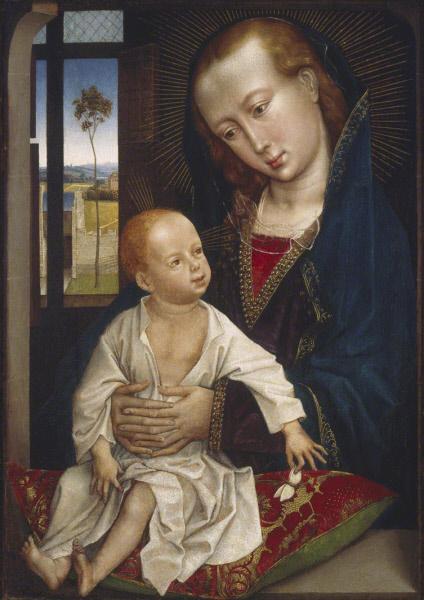
Despite the old attribution on the back to Lucas Cranach, it is a copy after Rogier Van der Weyden, the Virgin and Child from the Museum of Fine Arts, Houston.

Although well painted, it is less attractive than the original, both because of the condition and because Mary looks rather unhappy instead of loving. Even so, it should have no problem making the estimate, also because this specific Van der Weyden composition has rather few known copies compared to some of his more popular works.

UPDATE: sold for 38,100 Euro (costs included)! 

Tuesday, 2 April 2019

"Flemish, ca. 1520" was previously sold as "Style of Van der Goes", is copy after Van der Weyden

Schlosser, from Germany, sells on 5 April 2019 a "Flemish Master, ca. 1520" Descent from the Cross, estimated at 15,000 Euro.

It is a work I previously discussed in 2016 when it was for sale (repeatedly) at Hampel as a Circle of (or later Style of) Hugo van der Goes. The first sale had an estimate of 40,000 to 60,000 Euro, and sold for 36,000 Euro. It then was offered again for 20,000 to 25,000 Euro, and I presume failed to sell.

And now it appears again with an even lower estimate, which is actually a very interesting price for a high quality copy after Van der Weyden, in a style reminiscent of Quentin Massys.

UPDATE: sold for 17,000 Euro. 

Monday, 19 November 2018

"17th century Flemish School" goes back to a Rogier Van der Weyden composition

Mercier, from France, sells on 25 November 2018 a "Flemish School, 17th century" "Christ with the stigmata and saint", estimated at 1,500 to 3,000 Euro.

First off, it is a trinity, with God (not a saint) holding Jesus while the Holy Ghost flies above them. God is often represented with a papal tiara.

The work is probably 16th, not 17th century, and goes back to a composition by Rogier Van der Weyden. One version is kept in the Museum M in Leuven, Belgium (said to be by Van der Weyden, but seems like a good copy to me instead).

But it is unlikely that the version for sale is based directly on this one, which is known through other copies as well. For example the above one, listed at the RKD, is attributed to Marcel Koffermans. It stays closer to the original. In the version for sale, the way God holds Jesus has been changed (not improved though), and his head is turned.

As a 16th century reinterpretation of a Van der Weyden composition (there is also a similar composition claimed to be by Robert Campin), it should fetch the estimate quite easily.

Friday, 9 November 2018

"Attributed to Van der Weyden": can this be a youth work by Bouts?

Deutsch, from Austria, sells on 4 December 2018 an "Attributed to Rogier Van der Weyden" Virgin and Child, an oil on panel estimated at 2,800 to 5,500 Euro. The combination of "attributed to Van der Weyden" and a 2,800 Euro estimate makes me believe that one or the other is wrong...

The composition is by Van der Weyden, as can be seen in this workshop version in the Art Institute of Chicago. The one for sale is, apart from the background, an extremely close copy of the Chicago one. Only the face of the virgin is less well executed, and the condition of the work (while still remarkably well preserved for a 500 years old painting) is somewhat lacking, although a removal of the yellowed varnish may solve most of this.

I can't find any examples of Van der Weyden himself using such a background in a Virgin and Child. A similar window and landscape is used by a Follower of van der Weyden in the Saint Louis Art Museum.


Even more remarkable are the similarities with a Dirk Bouts Virgin and Child in the National Gallery.Not only does the window have the same general appearance as the other two examples, the crisscrossed windows at the top seem to have the exact same pattern of coloured elements round the border.

Which leaves me rather puzzled. Is this an early Dirk Bouts, who is supposed to have been a pupil of Van der Weyden? A version from the workshop of Van Der Weyden executed by Bouts, who later in his own work reused elements he invented then, like the window? The work isn't good enough to be a mature Bouts (or a Van der Weyden), but it is close enough in quality to be a work of Bouts as an apprentice, a pupil.

Or is it a work by someone who copied a Van der Weyden composition but added a Bouts window to it? That seems strange, certainly if it is contemporary (late 19th and 20th century forgers are more known to combine elements to create "new" works or new copies). Of course, it may also be a copy after a lost (or to me unknown) Van der Weyden or Bouts.

I would love it to be by Bouts, but I know that I sometimes get carried away when I am duped by a good fake. It certainly seems to be worth the gamble at the very low estimate. If it turns out to be the best-case scenario, the value is immense. If it is a good follower of Van der Weyden and Bouts, from around 1500, then it still is worth 25,000 Euro (well, the value depends also on what the cleaning would reveal, if the painting is even better below the yellowing, it only gets more valuable).


Thursday, 8 December 2016

... But "Copy after Rubens" is copy after Van der Weyden instead!

While my previous post was about an unrecognised copy after Rubens (which happens fairly often, though rarely so spectacular as with that one), this post is about the much rarer opposite.

Sceaux, from France, sells on 11 December 2016 a "Flemish School, 17th century" descent from the cross, "After the painting by Rubens from the Antwerp Cathedral", estimated at 1,500 to 2,500 Euro.

The Rubens looks like this. Not really similar...

The origin of the work for sale is of course the Van der Weyden I have already highlighted multiple times (perhaps the most often copied of the 15th century Flemish Primitive paintings?). This one is a very late and colourful copy, with some variations compared to the original. It will struggle to fetch the lower estimate.But the description made me smile :-)


Thursday, 3 November 2016

Van der Weyden still copied 100 years later


Van Ham, Germany, sells on 18 Oktober 2016 an "Antwerp Master, ca. 1550" Descent from the cross triptych, etimated at 20,000 to 30,000 Euro.

It is a fine example of how long the influence of the major Early Netherlandish painters like Van Eyck and in this case Van der Weyden continued. I already discussed copies of this work in multiple posts, the most recent one in September; but the triptych here is somewhat later and further removed from the original, which makes it worthwhile to post about it again. Plus, as in many of these, the auction house doesn't know or doesn't mention the origin, which is a pity.

The work for sale changes the positions somewhat, and abandons the old-fashioned golden background, but is clearly in essence the same composition. While it is a nice work as a whole, it is very rudimentary when looked at in detail (faces, hands, folds in clothing), and is not worth the estimate, no matter how much I like triptychs. The painting doesn't even look very old to me, but weak copies have a tendency to look more modern often, which is confusing.

UPDATE: not sold, as expected.

Tuesday, 13 September 2016

A later copy of a Rogier van der Weyden

Rhône-Alpes auctions, from France, sells on 15 October 2016 an "Antwerp School, 16th century, follower of Van der Weyden" Descent of the Cross, estimated at 12,000 to 15,000 Euro.

It is yet another copy of the work I discussed more extensively in a post from March this year. The way the flesh and colours are represented in the version for sale now indeed points to a somewhat later version, which makes it a very interesting example of how long a few famous works of the early 15th century Flemish painters continued to be copied by skilled artists. This is especially clear in the face of John the Evangelist to the left. One wonders whether painters from the school of Massys were responsible for these copies.

The estimate would normally be too steep for a copy, but this is an iconic, early work, and a very good copy, done by a skilled master, so I guess the price is about right. With some cleaning (if it needs cleaning) or some restoration (if it has been slightly overcleaned already, hard to tell from the picture), one would get a very good looking, well-preserved work in return.

Note that in what is on the one hand a remarkable coincidence, and on the other hand evidence of the number of times this work wsa copied, there are now two other versions of this work at auction. One is the above shown version which was sold in March already, but somehow is again for sale already on 22 September 2016 at Hampel with a 20,000 to 25,000 Euro estimate.

The other comes on the market at Ruef (lot 129), another German auction house I haven't encountered yet. It is a somewhat more amateuristic copy than the other two, but still fairly close to the original and reasonably well executed. Estimated at 3,500 Euro, it is an affordable way to get a presumably 16th c. copy of a Van der Weyden at your wall.

UPDATE: the French version went for 24,000 Euro, double the estimate: the Hampel and Ruef ones were unsold.

Update 2: the Ruef one is again for sale on 28 April 2017 with the same 3,500 Euro estimate.

Tuesday, 29 March 2016

"Circle of Hugo Van der Goes" is a copy after Rogier Van der Weyden

Hampel sells on 7 April 2016 a "Circle of Hugo Van der Goes" Descent from the cross, estimated at 40,000 to 60,000 Euro.

It is actually a copy after a lost panel by Rogier Van der Weyden, and closer in style to him than to Van der Goes. The Museum of Modern Art (!) in Le Havre has a very good copy of the same work.

Compared to the one at Christie's, which fetched $20,000 and had the wings, but was of somewhat lower quality, I guess the estimate here is about right, but the attribution isn't.

UPDATE: sold for 36,000 Euro, so the estimate was indeed about right.

UPDATE 2: strangely enough, again for sale at  Hampel on 22 september 2016 with now a 20,000 to 25,000 Euro estimate! Either the buyer realised that he didn't have gold in his hands after all, or the sale eentually didn't happen for some reason?

Wednesday, 17 June 2015

"Style of Flemish School ca. 1500" is a copy after Van der Weyden

Boisgirard, in Nice, sells a "In the style of the Flemish School, ca. 1500" Crucifixion, a small (26 by 18) painting in a Gothic frame, estimated at 600 to 1,000 Euro.

It is a copy after the central panel of Rogier Van der Weyden's "Crucifixion" from the Museum of Vienna. It looks like it is fairly recent (the last 200 years) though, not really 15th or 16th century. Just a gut feeling, the ageing seems artificial. It seems to be a reasonably well painted work, certainly considering the small scale, so if it is really old it certainly is worth its money and then some.

Monday, 25 May 2015

Copy of Van der Weyden

At Alcala, in Spain, they sell a small (30 by 41) "16th century Hispano-Flemish School" Lamentation, estimated at 1,500 Euro. UPDATE: sold for 1,700 Euro.

It is again evidence of the huge influence the Early Netherlandish painters (especially Van Eyck and Van der Weyden) had on early painting in Spain; in this case, it is a crude adaptation of Van der Weyden's "Lamentation" (multiple copies, the above is from the Brussels Museum). I don't know any other examples where the grail was added to the image though.

Tuesday, 27 January 2015

Rogier Van der Weyden: "While nursing your child, regularly switch sides!"


In the current batch of Christie's Old Masters sales, two paintings caught my eye. The topmost picture is of a "Follower of van der Weyden, ca. 1500" and estimated at $40,000 to $60,000. The bottom one is from the "Brussels School, ca. 1500" and estimated at $70,000 to $100,000. It is slightly larger than the first one (36 by 27 compared to 29 by 20).

Looking at them in detail, it is clear that Van der Weyden has been a bit lazy here. The pictures have simply been switched, but the Virgin is identical, with the same hair, falling down exactly the same but on the other side(!), same clothes (though a slightly more decorative border in the Brussels School copy), same lace around the neck, and so on. The background as well is executed with the exact same system. The Child holds a different attribute (a lily vs. a bird), but essentially these are two copies of the same picture. The different estimate may be caused by the different format, there isn't otherwise much to chose between the two. But it is interesting to see how these old masters re-used ideas and motives.