Showing posts with label Van Ham. Show all posts

Monday, 14 January 2019

"Circle of Thomas Willeboirts Bosschaert" is by or close by Erasmus Quellinus II

Van Ham, from Germany, sells on 30 January 2019 a "Circle of Thomas Willeboirts Bosschaert" Virgin and Child with John the Baptist, estimated at 1,500 to 2,000 Euro.

The work is a typical Antwerp work from around 1650, strongly inspired by Rubens and especially Van Dyck, and clearly made by a talented painter.

It doesn't really look like Bosschaert to me, but I have found another artist with a similar style and with some elements in other works which are very close to the one for sale: Erasmus Quellinus II (1607-1678) (I know, it would have been more of a surprise if I hadn't put it in the title of this post, but this make searching for it easier afterwards 😊)

The above work is from the Museo de la Fundación Lázaro Galdiano in Madrid, and dated to about 1640. Especially the child is nearly identical, but also many other aspects in the work for sale remind me of the Quellinus. The condition is a lot worse, and makes it harder to judge if it may really be by him, or by a good follower: my gut instinct tells me that it probably is a real Quellinus II though.

Even in this condition, it should probably be worth 5,000 Euro; and it seems likely that the work will reappear, beautifully restored, at auction or at an art fair next year.

UPDATE: sold for 7,000 Euro!

Monday, 7 January 2019

"Style of Van Reymerswael" is a copy after Quinten Massys (or Van Eyck?)

Van Ham, from Germany, sells on 30 January 2019 an "In the style of Martin van Reymerswaele" Money changers, estimated at 1,500 to 2,000 Euro.

While one of the well-known compositions by van Reymerswaele is a similar work, this actual composition is not by him but by Quinten Massys, from 1514, now in the Louvre. The work for sale is clearly not of the same quality, but it has some interesting differences. Most noticeable is the Eyckian mirror, which is no longer placed on the table but now hangs on the wall, and shows the two main characters instead of a third figure (the artist?). The remainder of the background has become a lot more bland as well, and the woman now has a ledger instead of a beautiful prayer book, which is perhaps more realistic but less appealing.

The work by Reymerswaele (here shown in the version of the Prado) is also based on the Massys, but diverges on many points not copied by the version for sale. A copy of the Massys seems to be much rarer than one of Reymerswael, and the changes in this version may point to a lost Massys original, as they seem beyond the grasp of the copiist. As there is speculation that the Massys is a copy after a lost Van Eyck, it might even be that the work for sale is based on the Van Eyck, but now I'm being very optimistic.

The estimate is probably about right, but the work is more interesting than the description indicates.

UPDATE: sold for 3,800 Euro!

Monday, 22 January 2018

"Cardinal Howard" is Lord High Admiral Charles Howard

Van Ham, from Germany, sells on 31 January 2018 an "English Master, 17th/18th century" portrait of Cardinal Howard, estimated at 200 to 400 Euro.

The portrait shows someone with the Order of the Garter with the Great George (the image of George slaying the Drgaon), which facilitates the identification of the sitter, as this is a very exclusive club.

Some searching, helped by the fact that the sitter indeed was a Howard, led me to Charles Howard, 1st Earl of Nottingham (1536-1624), the English commander at the time of the Armada, so a major figure in English history of the period. 

The painting for sale is a poor partial copy of a portrait by Daniel Mytens (the major portrait painter in England before the arrival of Anthiny Van Dyck), from ca. 1620. It is now housed in the Greenwich Museum. Some colours have been changed, so perhaps it is based on an engraving, but it seeems more likely to be a copy of the painting with some artistic license added. 

The value of the work is probably about the estimate, but having the correct identification may help attract the bidders: I wiould guess there are more marine history buffs wanting this, than people interested in a portrait of some Cardinal Howard.

Monday, 8 May 2017

Grisaille annunciation

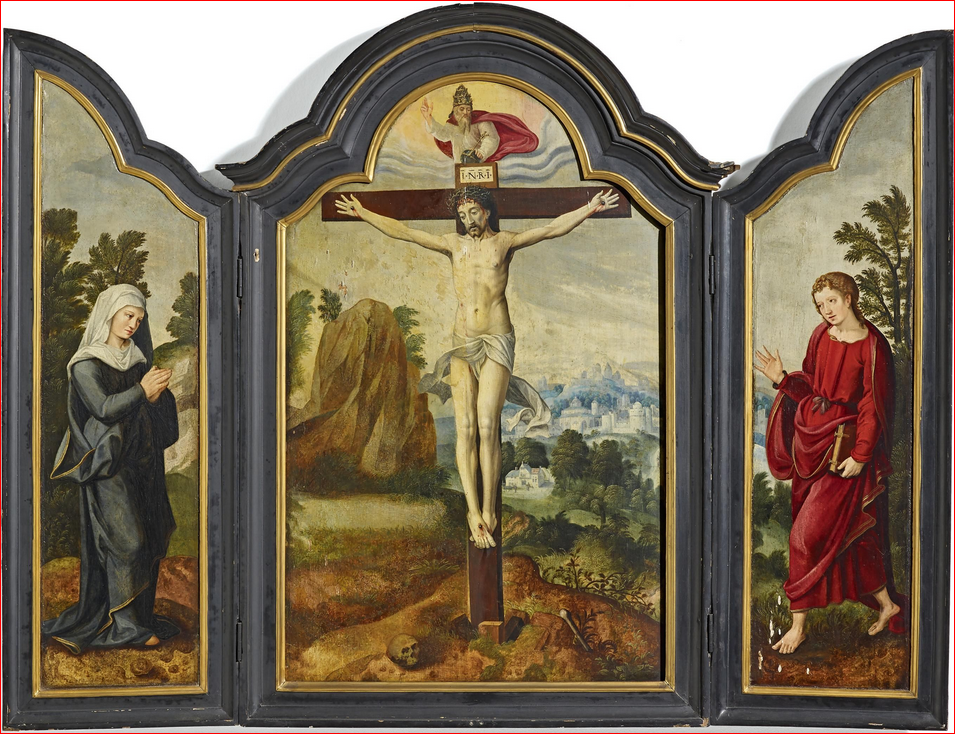
Van Ham, from Germany, sells on 19 May 2017 an "Antwerp Master, ca. 1520" crucifixion triptych estimated at 10,000 to 15,000 Euro.

It is a very nice, complete triptych, and what caught my eye were the reverse of the wings. They display an Annunciation in grisaille (or near-grisaille, flesh and hair are coloured but the remainder is black and white). Searching for "Flemish painting grisaille annunciation" gives only a few results, but these are from the very, very best 15th century painters. This of course is selection bias, you have much more chance to find works by the best known artists on the internet than works by lesser gods, but I have rarely seen this effect at work in such an extreme fashion.

The examples above are by Hans Memling (who also colours the flesh and hair), Hugo van der Goes, Gerard David (again coloured), and Van Eyck.

Of course, looking a bit further, e.g. at the RKD, reveals many other examples, some a lot closer to the one for sale, e.g. by Joos van Cleve, the Master of the Ursula Legend, or the Master of Frankfurt.

One of the closest to the one for sale is by Barend van Orley, from the Museums of Fine Arts of Belgium (here from the RKD, the link at the Museum gives a Bad Gateway error...). The central of the triptych here is a deposition: it is usual for these to contrast the annunciation on the outside with the death of Christ in some form on the inside. It is from ca. 1521 (so the same date), and also has the angel Gabriel barefooted and in a similar pose. The painting style of the work for sale is somewhat different though, so while perhaps Orley was an inspiration, he wasn't the author of this work.


Back to the actual work, the triptych of the crucifixion. It has a lot of resemblances to another anonym work which was, according to the RKD, earlier attributed to Van Orley as well. Once is coincidence, twice is something of a pattern. The position of the virgin, christ, and especially Saint John, with his left feet front and outwards facing.

But in the end it will remain an anonymous work, from the circle of Van Orley but not by his studio. It is firmly rooted in the Flemish tradition, and especially the reverse of the wings is very well achieved. A complete triptych of reasonable proportions (probably intended for a smallish church or a castle chapel, not for more private devotion) in good condition is becoming rare on the market, and this is reflected in the estimate, which seems reasonable.

UPDATE: sold for 10,000 Euro.

Thursday, 4 May 2017

Interesting German predella

Van Ham, from Germany, sells on 19 May 2017 a "Southern Germany, ca. 1500" Christ and the Apostles, estimated at 10,000 to 15,000 Euro.

It is a predella (the rectangular bit beneath a triptych or polyptych, a relatively rare element either because many have been lost or because many polyptychs didn't have one to start with). This specific type seems to be typical for the region and period, just like at other times you can find realistic depictions of the dead Christ there.


They all share some characteristics, with the same nearly Byzantine look, the apostles with their attributes (like Saint John the Apostle putting a miniature snake in a glass), the same position along a table (the depiction is closely related to that of the Last Supper, but is more a depiction of the main characters than the depiction of a story, a moment in time).

One example comes from Bernhard Strigel (1461-1528), main painter of the Swabian School (Swabia meaning South-West Germany). It was for sale at Christie's in 2016 but apparently remained unsold.

Another example (for which I only have this poor picture) is now housed in a museum in Warsaw.

 
The Cincinnati Art Museum also has one, which according to the RKD should be placed in the circle of the Master of the Bartolomew Altar.

A final anonymous but very good example is housed in Russia (picture via GettyImages, hence the annoying text on the image).

It would be wonderful to find the triptych to which this work belonged, or to be able to put a name to the artist. Still, it is an interesting example of a shortlived type of work of which only a few examples have survived.

UPDATE: sold for 10,000 Euro.
Wednesday, 3 May 2017

Antwerp Master, ca. 1500 "Virgin and Child" at Van Ham: Master of the Gold Brocade

Van Ham, from Germany, sells on 19 May 2017 an "Antwerp Master, ca. 1500" Virgin and Child against a gold background, a private devotional panel (31 by 21 cm) estimated at 14,000 to 18,000 Euro.

It is a composition which appears in many minor variations and by many, mostly anonymous hands around 1480, and which has fetched remarkable prices at auction sometimes.

The original or at least most commonly known and probably best version of the composition is by Quinten Massys (1466-1530), although the actual original is considered to be lost.

Christie's sold this rather weak or dubious version, attributed to "Studio of Metsys", for $31,000 in 2015.

Sotheby's attributes the composition to Joos van Cleve (1485-1540) instead. This nice version from his circle sold for $100,000 in 2013.

This composition was also used by the Master of the Parrots.

Another version, closer to the one for sale, was offered at Koller in 2014 and sold for about 40,000 Euro. This one was attributed to the Master of the Brocade Background (active 1480-1500). While it is slightly better, and slightly older, it is very close to the one for sale in most aspects, although the hands and the heads are somewhat different.
It is now, after restoration, for sale at Mullany. The restoration has made the difference in quality with the work at auction now much clearer.


The painting for sale seems to be a copy after another work "After the Master of the Brocade", which can be seen at RKD and was sold in 1938.

Works from the Brocade Master often used such a calligraphic border and a golden background. A similar work by the Master fetched £37,000 at Christie's in 2009.

Depending on whether you think the work for sale is a work by or after the Master of the Brocade, the value of it will vary. To me, it seems somewhat too weak, too stiff, and it looks more like a "follower" or "circle" work. It should be worth around the estimate in that case.

UPDATE: not sold.

Monday, 7 November 2016

An unrecognised Maurice Denis?

Van Ham, Germany, sells on 18 November a "French Master, 19th / 20th century" "Bathers at the lake", estimated at 6,000 to 8,000 Euro. It has a partial signature "Mau D."

Rather a high estimate for an anonymous work.

The signature is one used by Maurice Denis (1870-1943), an influential French painter of the late 19th century. His later work is less interesting, though still fairly good. The signature reads "Mav. D" with a faded "en..." after it (the last character seems to be a 1, so perhaps 91?).

Turns out that the work, in an uncleaned state, was sold as by Maurice Denis somewhere in the past (I haven't found the actual auction nor the year or the result). It was then dated to 1890-1894, which would put it right in the most interesting period of Denis. Has the attribution been lost since then? Doesn't the auction house believe it to be by Denis? Or are they trying to lure the bidders by "not knowing" who the artist is?

The work for sale is influenced by pointillism and looks almost like a design for a tapestry. If it is an actual work from the early 20th century but with an apocryphal signature, it should be worth the estimate. If it is real Maurice Denis from the late 19th century, and this can in some way be authenticated, then it should be worth around 200,000 Euro instead!

UPDATE: sold for 6,000 Euro, either no one recognised the signature or no one believed it to be real!

Thursday, 3 November 2016

Van der Weyden still copied 100 years later


Van Ham, Germany, sells on 18 Oktober 2016 an "Antwerp Master, ca. 1550" Descent from the cross triptych, etimated at 20,000 to 30,000 Euro.

It is a fine example of how long the influence of the major Early Netherlandish painters like Van Eyck and in this case Van der Weyden continued. I already discussed copies of this work in multiple posts, the most recent one in September; but the triptych here is somewhat later and further removed from the original, which makes it worthwhile to post about it again. Plus, as in many of these, the auction house doesn't know or doesn't mention the origin, which is a pity.

The work for sale changes the positions somewhat, and abandons the old-fashioned golden background, but is clearly in essence the same composition. While it is a nice work as a whole, it is very rudimentary when looked at in detail (faces, hands, folds in clothing), and is not worth the estimate, no matter how much I like triptychs. The painting doesn't even look very old to me, but weak copies have a tendency to look more modern often, which is confusing.

UPDATE: not sold, as expected.

Tuesday, 1 November 2016

A "Memento Mori" for 1 November

Van Ham, Germany, sells on 18 November 2016 a "School of Nuremberg" Memento Mori, estimated at 3,000 to 4,000 Euro.

It is an example of the perhaps most depressing type of memento mori paintings, the "Nascendo morimur" or "Being born, we die" (as seen on the text panel in the painting). But while these works were popular in Germany, they were also often made in the Netherlands (no coincidence that they were two of the leading Protestant or Refomation countries of the period probably), and this one is a good copy of a work by Marten van Heemskerck. The original is in the Museum of Koblenz.

Being a copy, and in somewhat poor condition, it will struggle to fetch the estimate probably.

Saturday, 25 April 2015

School of Gerard David, Coronation of the Virgin

At Van Ham in Cologne, they sell on 15 May 2015 a Netherlandish Master, about 1460/1470, Coronation of the Virgin, estimated at 25,000 to 28,000 Euro.

It is a good example of a subject that gets a few other similar renditions in the same period. More common is the simpler version where Mary is coronated by two angels, not by God and Jesus like here.

The example for sale has some clear characteristics of the work of Gerard David, but probably isn't good enough to be by him. It may be a copy after a (to me) unknown work by David, or a new composition by someone from his school or environment.


The most striking similarity is the Christ figur on the right. It can easily be compared with the Christ from Gerard David's "Resurrection" (right wing of a diptych) from the Met Museum. (A similar figure can also be seen in the work of Juan de Flandes, but the David seems more closely related)


But also the God figure resembles works by David, like the above from the Louvre. The crown is nearly identical.

I would date the panel for sale slightly later than 1470, perhaps 1490-1500. Similar works like the anonymous panel from the Louvre shown here are also dated at around 1500. 1470 seems way too early when compared to the work by David. The estimation seems to be reasonable, perhaps a bit high; it is a very interesting work, but not top quality and probably slightly later than indicated.

Wednesday, 14 January 2015

Edouard Quitton

Another painting for sale at Van Ham on 28 January is this very nice genre piece by 19th century Belgian painter Edouard Quitton. Exhibited at the 1890 Exposition des Beaux Arts in Antwerp, it is only valued at 1,000 Euro. Smaller similar paintings sold in the past for 4,000 Euro (Antwerp, 2000) to 7,000 Euro (in Lokeren, Belgium in 2005), so either his appeal is not what it used to be, or this one is seriously underestimated. If the Belgians that bidded on the earlier pictures notice this one, I wouldn't be surprised to see this soar to 5,000 Euro or thereabouts. (UPDATE: ended nicely between the estimate and my guesses, at 2,304 Euro)

Edouard, or Edward, or even Edovard Quitton, is not the most well-known or best documented artist. His birth year is given as 1841 or 1842, his year of death is given as 1913 (e.g. at Bonham's), 1921 (Mutualart) or 1934. Born in Péruwelz, died in Laeken, perhaps from an artistic family (an ancestor seems to have worked on the altar of the church of Péruwelz).  Student at the academies of Tournai (near Péruwelz) and Antwerp, pupil of Joseph Stallaert, he then worked for most of his career in Antwerp, and specialized in three genres: small trompe-l'oeuils of dead birds hanging from a thread (popular in their day, now selling for around a 1,000 Euro), larger paintings of idealized farm life, poultry, ... like the one for sale here (selling for around 5,000 Euro), and large paintings of children in conservatories (selling for 5,000 to more than 50,000 Euro). He was one of the painters catering for the nouveau riches with enough money to buy nice pictures but not enough dare to buy more avant-garde works like the Tervuren School or later the likes of Ensor. Not quite up to the standards of the best Alfred Stevens works (who served an even richer audience), more comparable to Florent Willems and the like, the artists of the Belgian Realist School. I could find no works after ca. 1892, but he is very badly documented online anyway.

Tuesday, 13 January 2015

Adoration of the Magi, after Rubens

For sale at Van Ham Auktionen on 28 January, and described as "Flemish Master 17th century". It actually is a reversed copy of Rubens' famous "Adoration of the Magi" (picture below) from 1626-1627, now in the Louvre. The version for sale is in a more Italienate, subdued style, lacking the flamboyance and inner light (and pure genius) of the original. But it has, despite its rather poor condition, a charm and quality all of its own. I often prefer such a copy in its own style to a more strict but less original one. Still, an estimate of 2,000 Euro seems to be more than enough, as copies of major works by Rubens are fairly common after all. (UPDATE: and indeed, it sold for a reasonable 1,800 Euro).