Showing posts with label Neumeister. Show all posts

Wednesday, 23 October 2019

1508 dated Flemish Virgin and Child is copy after Van der Weyden

Neumeister, from Germany, sells on 24 October 2019 a "Flemish(?)" Virgin and Child, dated 1508, estimated at 4,000 to 4,500 Euro.

Despite the old attribution on the back to Lucas Cranach, it is a copy after Rogier Van der Weyden, the Virgin and Child from the Museum of Fine Arts, Houston.

Although well painted, it is less attractive than the original, both because of the condition and because Mary looks rather unhappy instead of loving. Even so, it should have no problem making the estimate, also because this specific Van der Weyden composition has rather few known copies compared to some of his more popular works.

UPDATE: sold for 38,100 Euro (costs included)! 

Thursday, 19 September 2019

Nice auction at Neumeister, including a Brueghel the Younger which is a Grimmer instead

Neumeister, from Germany, sells on 25 September 2019 a fine collection of Old Master paintings.

Lot 94 is an "Antwerp, Early 16th century" Man of Sorrows (or Christ and the Instruments of the Passion), estimated at 4,000 to 6,000 Euro. It is painted by an accomplished artist, even though it may be based on an engraving (though I haven't found one with this composition).

On the middle left, next to his shoulder, I think I have found a monogram, "PA". It is cleverly hidden in the decoration, but as these are the only letters anywhere, and they clearly aren't "PAX" or some such, I wonder if they may be a monogram for the artist? But it doesn't really look like Pieter Aertsen I think, and I doubt that Pieter Coecke van Aelst would use PA. Others may have a better idea (e.g. the way the flesh of the left arm is painted seems to be very artist-specific). It should easily sell at the estimate, and may go a lot higher if some people have an idea of the actual artist.


Lot 109, Saint Paul with the viper by "Dutch school, 17th century" (est. 2,500 to 3,000 Euro) is a copy after an engraving by Harmen Jansz Muller from ca. 1590, after a design by Dirck Barendsz, as found at the Rijksmuseum site. Considering that the charm of the painting is all derived from the composition of the engraving, and the actual artistic merits of the painting are very small, it might struggle to reach the estimate.

Lot 119 is the most interesting of these, a "Workshop of Pieter Brueghel the Younger" allegory of Spring, estimated at 25,000 to 30,000 Euro.

Other versions of this work are known, and in 2013 one was sold at Sotheby's for $2,285,000!

A full set of the four seasons was sold at Christie's in 2016 for £6,466,500.

But the description of that version brings the cat out of the bag: the one for sale here is most likely not from the workshop of Pieter Brueghel the Younger, but from the workshop of Abel Grimmer. The Brueghel versions all have some characteristics not found in the Grimmer ones, and vice versa.

Private collection


In the Brueghel ones, you can see that they are planting flowers, there are two sheep close to the river, and there is a row of houses across the river.

The Grimmer ones, on the other hand, follow the original engraving after Pieter Brueghel the Elder much closer. This was made in 1570 by Pieter Van der Heyden (example from the Met Museum).


A signed 1607 copy (i.e. older than the Pieter Brueghel the Younger versions) is kept in the Royal Museum of Fine Arts in Antwerp (together with the remainder of the series). It is clearly a lot closer to the one for sale than the Brueghel ones: no flowers are planted, no loose sheep, but on the other hand you get a small boat on the water, the houses behind the river are replaced with some stand, the gate behind the workers (smack in the middle of the painting) is longer to the left, the large pigeon tower isn't red at the bottom but yellowish white, ...

A full set of the four seasons by Grimmer was sold at Lempertz in 2018 for 285,000 Euro. This one seems to be a bit further removed from the original, as some details become weird or are missing (the boat on the river, which will pass the stand in some festive manner, is replaced with a swan; the shovel in the front gets a strange angle; the pigeon tower becomes a generic tower...) suggesting that this may be the work of a follower of Grimmer and not directly a work by Grimmer; the work for sale seems closer to his original though.

As such, I would estimate it at 50,000 Euro.


Thursday, 9 March 2017

"Venetian, 18th century" is (follower of?) Nicola Grassi

Neumeister, from Germany, sells on 29 March 2017 a "Venetian, 18th century" Rachel and Jacob at the Well, estimated at 5,000 to 6,000 Euro.

It is a work in the style of and possibly by Nicola (or Nicolo) Grassi (1682-1748), a Venetian artist who also worked in Bavaria around 1725. As Neumeister is located in Munich, the capital of Bavaria, it becomes even more likely that this is a work by him.


Rachel and the Well was one of the most popular topics of Grassi. Looking at e.g. FonzazioneZeri, an Italian art database, they list some 60 works by or associated with Grassi, incuding the following related works: an Eliezer, a Jacob, another Eliezer (pictured), an unclear sketch, yet another Eliezer, a very nice Rebecca (also pictured). Recurring elements include the sculpted base of the well, the white dress with blue or black shirt of Rebecca / Rachel, the background girl with the vase on her head, and elements like the sheep and the background. The main girl is also always clearly of the same type and posture, even though the hairdo varies.

Sotheby's sold in 2015 a Rachel and Jacob at the Well, estimated at $15,000 but unsold. This one is probably the closest to the one for sale. All these works have Rachel with the same clothes and the same or similar hair and figure, this one adds Jacob, who also has the same clothes and colour scheme. The well is also comparable (down to the square stone for the round well), as are the two women close to the well, the sheep, and the girl with the amphora on her head in the right background.

In 2006 Christie's sold a comparable work (a different scene from the same story) for £20,000.

The painting for sale is weaker in execution though than most certain Grassi works, both in the force the figures radiate and in the colouring. Comparing the Sotheby's one with the Zeri one above, such differences seem to be normal for Grassi though, and perhaps his German paintings cater to a somewhat different taste? I don't know enough about Grassi to attribute this one definitely to him, but it is clearly by at least a close follower. As an anonymous work, it should be worth the estimate: if it really is a Grassi, it is probably worth closer to 15,000 Euro.

Thursday, 22 September 2016

"Style of Pieter Coecke" compared to an original by Master of 1518


Neumeister, from Germany, sells on 28 September 2016 two wings of a triptych "in the style of Pieter Coecke", estimated at 3,000 to 4,000 Eur.

The panels are 77 cm high . Possibly they were a lot higher and not square originally: other triptych with the same or similar wings usually have sculpted, gothical frames.

These may be the work of the so-called Master of 1518 (who is probably Jan van Dornicke), the father-in-law of Pieter Coecke van Aelst.

The center of the triptych was probably an adoration of the magi (which fits chronologically nicely between the nativity/adoration of the shepherds on the left, and the flight to Egypt on the right). Other comparable works have the same iconography, or replace the Flight to Egypt with a Circumcision.

In 2010, Sotheby's New York sold a great triptych by the Master of 1518 (exceeding the estimate at nearly $700,000). The wings of that triptych are slightly larger than the ones here (43 cm wide instead of 25 cm), but the composition is identical. This gives a good idea what kind of central panel you have to find to complete this triptych again...


The left wing (Sothebys left, for sale right). It varies in details (the poor child has no cloth beneath it in the version for sale), but is otherwise clearly the same. The new version seems to be slightly more modern (the flesh tones in the faces) and painted a bit less precise, but is still a work of high quality and looks to be authentic.

The right wing (again Sotheby's left, version for sale right) as well is clearly the same work: here though the new version seems to have made more accommodations for the smaller format, slightly turning the ass to the spectator. This shows the skill of the copyist and indicates that he was an artist in his own right. This also indicates clearly that the smaller format is not due to cutting down the panels, but was the intention from the start.

In the background, and more visible in the new version, one can see a  decapitated statue (in the new version one can identify the other half lying on the ground). The exact meaning is unclear to me, but presumably this is either evil or the devil defeated by the birth of Christ, or a symbolic representation of the death of the innocent children (the immediate cause for the flight to Egypt).

Other versions of these wings have been attributed to Circle of Master of 1518 (RKD). This one is even smaller than the one for sale, and less well painted or preserved. It was coupled with an annunciation in this case.

Most versions attributed to Coecke or his studio have some differences (e.g. at the Nativity Maria and Joseph sit on the same side of the child), but a few are clearly the same composition. The top one (Circle of Coecke, RKD) is a smaller and simplified version, missing e.g. the angel above the Nativity. The second picture is from a better painting, attributed to the Studio of Coecke (RKD). Again, the angel flying above the Nativity is missing. Both versions also have a different monument in the background of the Flight to Egypt. In that image, Maria hasa whote cloak instead of a blue one. Other differences also connect the two above triptychs but somewhat distance them from the one for sale.

The one for sale seems to be the closest to the original of the Master of 1518, and probably painted directly from it. Copies from Pieter Coecke and his studio, even the most faithful ones (like the ones displayed here), tend to have more differences already, staying less close to the original.

The two wings for sale are clearly by the same hand (as could be expected). Whether they are copies by the Master of 1518, copies by Pieter Coecke, or made by someone else in that circle, is hard to tell. But they are very cheap and should easily fetch 10,000 Euro.

UPDATE: sold for 8,255 Euro, more than double the estimate, so they were indeed very cheap.


Friday, 1 July 2016

How to turn a "Parable of the Wedding Banquet" into a "Wedding at Cana"

Neumeister, from Germany, sells on 6 July 2016 a "Parable of the Wedding banquet" by Simon de Vos and the Francken Workshop, estimated at 8,000 to 10,000 Euro.

Van Ham sold the above "Wedding at Cana" by Francken for 9,500 Euro.

So, what does one have to do? Change Christ to some king, and change the people in the garden to a man being dropped in a well. Add or remove some details at random, and you have a new painting with a new subject!

The one for sale now is in a worse condition than the Van Ham example. It is in parts by a different hand, but it's hard to tell which one is better.

This clearly better version is unlikely to hit the market soon as it is safe in the collection of the Hermitage. it is by Frans Francken II and may be the base composition all these other ones are copied from. The one for sale is one of the more original ones though, the Cana version is much more common than the Parable version.

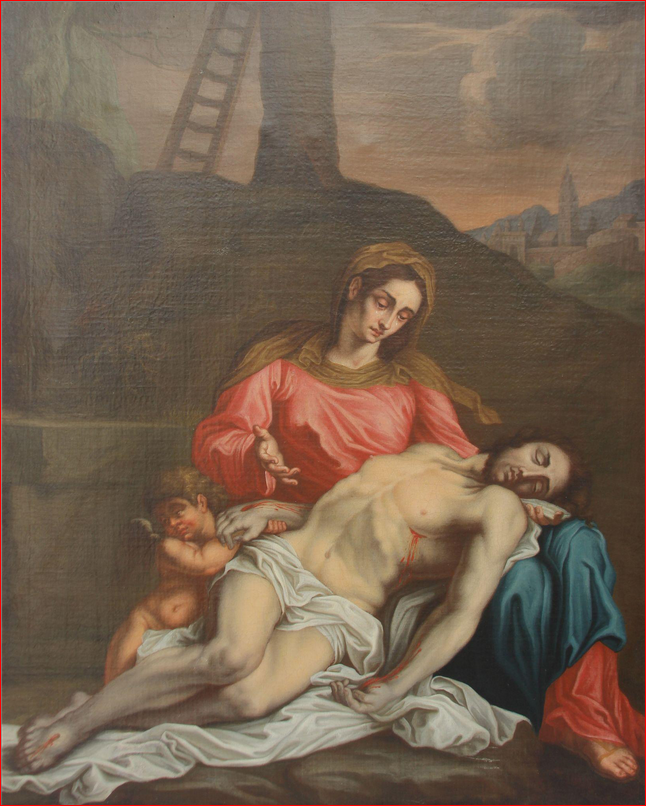
Italian 16th c. pietà is copy after Carracci

Neumeister, from Germany, sells on 6 July 2016 an "Italy, 2nd half 16th c." Pieta, estimated at 2,000 to 3,000 Euro.

It's a powerful painting, but dirty and damaged and perhaps painted somewhat simplistic. It looks later than the 16th c., I would guess 17th c.

Searching for an artist or origin, I came across art shop Rubylane.com, which sells an "18th c. Baroque" pieta with the same composition, but with differences (e.g. a putto instead of John the Baptist).

Both turn out to be adapted reversed copies of a Pietà by Annibale Carracci from ca. 1600, which makes it clear that auction dating is some 100 years (or more) off. The copies, reversed and with different colours, are likely based off an engraving and not from the original painting. Whether that makes it worth more or less than the estimate depends on how much you like it, it certainly won't be worth much more. I do wonder how much the Rubylane site charges for their copy though!

Sunday, 21 June 2015

School of Bronzino

Neumeister, auction house from Munich, sells on 1 July 2015 a "Tuscany, mid 16th century" painting of a Holy Family with John the Baptist. A smallish oil on panel of 60 by 46 cm, it is estimated at 5,000 to 6,000 Euro.

The bad news for the seller is that the same painting was bought in Munich in July 2008 for 67,500 Euro (against the same estimate of 6,000 Euro, described as Italian School, 16th century).

Presumably the buyer (and at least one other bidder) thought it to be the work of a well-known painter and worth a lot more. Equally presumably, it turned out to be a bad gamble, and here we are again now.

So, who was the presumed master behind this picture? My money is on Bronzino, as this painting shares some clear characteristics with similar works by Bronzino.

On the one hand, we have this one from the Kunsthistorisches Museum in Vienna. The Saint John is a reverse image of the one for sale, and the other figures are remarkably similar though in different positions.


Comparing the painting with another Holy Family by Bronzino (this time from the National Gallery of Art in Washington DC) also shows clear similarities, in style, facetype, clothing. But the style of painting is clearly different, with the one for sale looking unfinished, as if it lacks a final layer. The real Bronzinos are very statuesque, sculpted figures, while the one for sale is more a drawn figure.

It is a good painting, but what the exact relation is to Bronzino remains unclear. Why they don't sell it as "School of" or "Circle of Bronzino" is not really clear though. The estimate seems about right, unless you believe it is closer to Bronzino after all. UPDATE: sold for 17,000 Euro, way above estimate but still way below what was paid for it previously...