Showing posts with label Dorotheum. Show all posts

Monday, 9 October 2017

"Netherlandish School" is probably German

Dorotheum, from Austria, sells on 17 October 2017 a "Netherlandish School, 16th century" Ill-matched couple, estimated at 60,000 to 80,000 Euro.

The work was sold in April of this year at Abalartes, in Spain, for 5,000 Euro (which was very cheap), so this would be a very handsome profit in a few months time. I can't remember seeing that auction at that time, too bad.
UPDATE: a contact told me that it was sold for 30,000 Euro, 5,000 Euro was the estimate. Thanks!

Cranach the Elder, from the Museum of Catalunya
The work is based (as is said in the auction catalogue) very closely on a prototype by Lucas Cranach, and can be found in many variations in the 16th century in Germany and the Netherlands. This one is special with the two additional figures, and quite well painted.

I doubt however that it is Netherlandish (or, as Abalartes said, Flemish), as the texts are in German (or just perhaps in some Limburgish, which is the language from the border region between Germany and the Netherlands around Maastricht and Maaseik). 
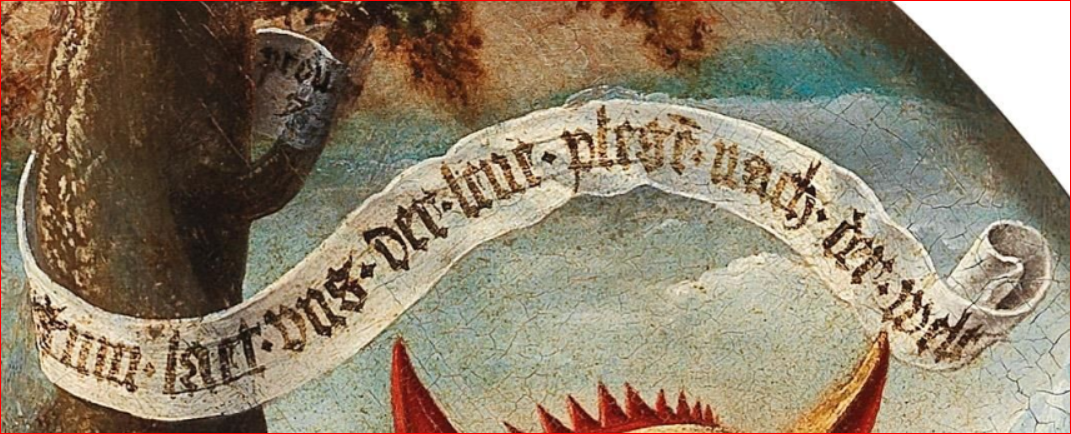
 The first text reads, as far as I can tell:
"Prou"? (top of the tree, no idea of meaning)
"...tum laet ons der leve plege nach der welt"
which means something (perhaps) like "let us care for the life after this world"

 Here part pf the text goes outside the frame, which may indicate a larger original work. The text is
"Das(?) (?) Sotthen"
"Want din leve um wolde(?)"
And a text folded below, which is something like "Bisto? Suas" but is really undecipherable. I am not certain of "Sotthen", but it certainly looks similar and would be right in the context (as it means "Fools")
 The third and fourth text are only partially lisible. "Di plarme..."

The very end, written smaller, seems to be "Sapi" and beneath it "32", so this may, just perhaps, be some signature and date? This is very tentative though.

The fourth and final text is "De frouwe ? ... wolde ? sijn", meaning "The woman wants to be ?" The question marks reads like "Dijsen", which doesn't have any meaning as far as I know, so I am clearly misreading this.

This text is to me, as far as I can read it, more German than Dutch. While this of course may be a Flemish painting made for the German market, it seems more likely that it is originally German to start with, considering the Cranach origin.

In favour of a Netherlandish origin is this work by Quentin Massys, now in the National Gallery of Art in Washington, which shows a fool in a very similar costume to the one added here on the right. Whether one painting is here based on the other for this detail, or whether it was a costume in common use at the time, is not known to me.

Similar fools caps can be seen in other works of the same period, like this engraving by Goltzius (via the Rijksmuseum). I can find older examples, from ca. 1530 on, so this doesn't really help to date the painting.

The value may be a bit high for an anonymous painting, but Cranach sells well and this is a very good work after Cranach, with an interesting image and possibilities for further research; and while not fresh on the market, it will be new for most bidders probably.

UPDATE: sold for 68,275 Euro!

Thursday, 13 April 2017

20K "Flemish School, high quality, eluded attribution" is copy after Hendrick de Clerck

Dorotheum, from Vienna, sells on 25 April 2017 a "Flemish School, 17th century"  Apollo and the Gods, estimated at 20,000 to 30,000 Euro.

From the auction catalogie on the website:
"Despite its high quality, the present painting has so far eluded a convincing attribution. It is reminiscent of late works by Jan Brueghel II or the Balen Family. An alternative attribution to Johan Hendrick Keller, a Swiss artist who later moved to the Netherlands and worked on the decorations of the Het Loo Palace, has also been suggested."

The painting looks like a good composition  executed by a mediocre artist, and more 18th century than 17th century, with some French influences perhaps. Sure enough, some research leads to a 17th century Flemish original for this, the same composition in a much more archaic style and better executed. 


The original is by Hendrick de Clerck (1560-1630), a "Parnassus" from the Royal Museum of Fine Arts in Antwerp (which was originally planned to be reopened after very extensive renovations this year, but which has sadly been delayed for another two years!).
The original is 63 by 47 cm, the copy for sale is 65 by 51 cm.

The one at Dorotheum is described as "The Gods of Mount Olympus congregating around the music-making Apollo", which is technically correct, but lacks the deeper meaning the original has: "Parnassus: allegory of the virtues of the Archduke": De Clerck was the court painter for the Archdukes Albrecht and Isabella, great patrons of the art (friends of Rubens) and two of the most powerful politicians of their time.

As an attractive but not exceptionally skilled copy, it should be worth 5,000 to 6,000 Euro, not the 20,000 estimate which is the price for an original work by a better master.

Tuesday, 11 April 2017

Sebastian Vrancx at Dorotheum: November or April? And has it been restored or repainted?

Dorotheum, from Austria, sells on 25 April 2017 a "Sebastiaan Vrancx" Month of November, estimated at 30,000 to 50,000 Euro.

This seems to be the cleaned version of an unattributed Vrancx I discussed in May 2016 which was then for sale with an estimate of 1,200 Euro and which I reckoned then should be worth 3,000 Euro. I don't know what that one fetched in the end, but the current estimate is way above that one.

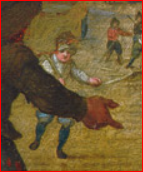
In my original post, I showed the above two versions and specifically remarked upon the minor differences, like the boy not having an axe.


In the version for sale, the boy has an axe, and the arm of the man with the basket is no longer visible (dangerous things, these axes!). This matches now exactly the better version from my original post (even the cords hanging from his arm have miraculously multiplied). But every other detail in the work for sale seems to match the work I blogged about in 2016 (and not the better version I showed then as well), like the  colour of the socks of the boy on the far left (grey instead of purple), the man with the sword walking away from us on the far right (grey-white instead of blue with yellow socks), the decoration of the house above his head (done more crudely ijn white, instead of the yellow stone colour), ... Even the craquelure, the damage to the glaze at the top (the clouds) is the same.


Underneath the arm of the boy with/without the axe, there is a particularly damning detail. In the "better" version from the previous blog, the boy continues on both sides of the arm (bottom image): but in the two versions for sale (then (top right) and now (top left)), we have the same very awkward shift between the upper torso and the legs, which simply don't fit.

Both also have an incorrect mention of "November" on the back, while the depiction is clearly of Spring (or April), with the fresh green on the trees and the erection of a Maypole.

The work for sale now is clearly worth more than my too cautious estimate of 3,000 Euro, but I have to wonder whether the significant changes are things which have been revealed when newer layers have been removed, or things which have been added by an enthusiastic "restorer" to make it look more like the "better" version? I hope it is the former, but my gut instinct tell me that it is the latter (at least the two nasty scratches, across the largest figure top to bottom, and left to right towards his left leg, have been repainted); but whoever wants to bid for this better first informs themselves of the actual restoration.

The actual value of this work depends on what happened to the work and how much the bidders know and care of course.


Friday, 16 December 2016

"Lombard School, 16th": intriguing Feeding of the Swaddled Cat

Dorotheum, Austria, sells on 22 December 2016 a "Lombard School, 16th century" satirical banquet scene, estimated at 4,000 to 6,000 Euro.

The painting seems like a copy after an unknown better work, as it has the telltale signs of a good composition and rather poor execution.

Intriguing is the central element, of a cat which looks remarkably like a swaddled baby being spoonfed. The man feeding it is masked. On the left, another man is brandishing a pig's foot. Some people have oversized cutlery

At first the painting reminded me of Dutch works, e.g. by Jan Steen. The composition and the satirical character are similar, and it also has a family of cats in it (though they are treated normally).

To my surprise, I learned through some further searching that the image of the swaddled cat appears in many Western European countries. It must be based on some well-known satire or fable to have such a widespread appeal.

In Italy, we have Bartolomeo Passarotti or Passerotti (1529-1592), a painter from Bologna (so not too far from Lombardy): someone from his circle is supposed to have painted the above. This was sold at Sotheby's in 2013 for $9,000.

The same image was also the basis for a French engraving, ''L'éducation du Matou'' by Leblond. It sadly doesn't mention an original author for the composition. The text reads:
"Avec que raison je puis dire / Que les visages que voicy / Qui n'ont point de soing que de rire / Me contraignent de rire aussi. // Esti quelque mélancholie / Qui vaille celle de ce fou / Qui veut donner de la bouillie / A ce ridicule matou. // Mais je trouve encore plus sotte / L'extravagance de Margot / Qui l'embéguine et l'emmaillotte / Plus estroittement qu'un fagot. // Un badin leur donne une aubade / Afin d'honnorer ce beau jeu / ou plustost pour faire grillade / Il prend les pincètes du feu."

Amateur translation, with the aid of Google translate:
"With good reason, I can say / that the faces that are here / that have nothing but laughter / compel me to laugh too. // Is there any melancholy / matching that madman / Who wants to give porridge / To this ridiculous tomcat. // But I find even more foolish / Margot's extravagance / Who covers and swaddles it / More narrowly than a fagot. // A joker gives them an aubade / In order to honor this beautiful game / or better to make grill / He takes the pincers of the fire."

Note the appearance of Margot la Folle, which is also the name of Brueghel's masterpiece "Dulle Griet" in French.  


In England, we have some curious woodcuts about "O Rare Show, or the Fumblers Club". Apparently a fumbler is an impotent man; the woman takes a cat instead, and people bring birthday presents for the cat as if it was a baby  These are supposedly from ca. 1660-1700. Note how in the topmost image, on the right, a fool plays the gridiron as if it was a fiddle, indicating the connection between the French image and these ones.


This then changes in later depictions in England, e.g. in this 1772 engraving (mezzotint) by W. Humphrey after J. R. Smith, showing the longevity of this particular iconographic element. It is titled "Miss Sukey and her Nursery".


In Flanders, we have David Ryckaert III with his "Old Woman feeding a cat", from the Hermitage. The English and Flemish examples show how the image evolved from a general satire on human folly, to one of silly older woman treating cats as if they are babies. 

And then finally, through some luck, I struck gold and found an original version of the work for sale.  It graced the cover of the 2009 issue (the 7th issue) of "Studiolo", the art magazine of the Académie Française in Rome - Villa Médicis. Presumably the above is a fragment of a larger work matching the one for sale here, but the quality is clearly superior. The theme of the issue was "Le comique dans l'art", "the comical in the arts", and this subject is of course perfectly suited for it. Sadly, the linked page has no information on who painted this or where it is kept.

The price for the work for sale seems about right, it is a copy but relatively large, painted well enough, and with a very intriguing image, which helps (many people would rather have this than some boring run-of-the-mill subject of course).  

UPDATE: a keen-eyed reader sent me the link to the original painting: it is housed at the Museum of Nantes and attributed to Northern Italy, second half of the 16th century. This confirms the work for sale as a good copy, but clearly not an original (especially some of the faces are clearly inferior to the Nantes version). 


The same reader also pointed, apart from the already mentioned Passerotti, to Vincenzo Campi as a possible artist for the original. He is known for similar satirical works. I found the above, attributed to a follower of Campi, which was sold at Gros & Delettrez in 2012 with an estimate of 2,000 to 3,000 Euro. It shows another version of the same story.


An original by Campi in the same vein is his "Ricotta-eaters". The style seems to be somewhat different to the Nantes work though. 


While looking at all these, I can across two French works (a beautiful drawing by Fragonard, and an engraving after Jean Baptiste Huet), showing the same basic idea but now as a piece of child's play, without any (apparent) satirical message.

UPDATE: not sold

UPDATE: another, very similar version was sold for 35,000 Euro at Debaecque (France) as "Italian School; circle of Niccolo Frangipane". (Information communicated by AuctionRadar who keeps a watchful eye  on mainly the French auctions).


Thursday, 15 December 2016

Variation on the Tower of Babel, probably from the Francken clan

Dorotheum, from Austria, sells on 22 December 2016 a "Flemish School, 17th century" Tower of Babel of unusual dimensions (25 by 76 cm), estimated at 4,000 to 6,000 Euro.

I could find no other examples of this composition, which may be a (large) fragment of a bigger (higher) work: the cutting off of the top of the Tower is a bit strange.

The closest examples are some works by Frans Francken (I or II). The remarkable blue roofs on the Tower can be seen in the above Francken from ca. 1620.

The use of big figures in the foreground which nearly dwarf the actual tower is also rather unusual, but has been practiced most often by Francken.

The work for sale seems, looking at both the composition and the style, to have been inspired by the works of Frans Francken, and is good enough to be by one of the lesser or later members of the clan, like Frans Francken III.

E.g. the  boy on the left can be compared with similar figures in other Francken works.

The King, and his turban / crown, also is comparable to other works by one of the Franckens.

In 2008, it was for sale in Italy at Blindarte as a work by Frans Francken II with an estimate of 25,000 to 35,000 Euro, which was a bit too much. However, the current estimate seems too low,  more of a come-and-get-me one, and the work should be worth about 8,000 Euro.

UPDATE: sold for 5,000 Euro only.