Showing posts with label Cranach. Show all posts

Wednesday, 3 April 2019

"17th century Master from Kronach" is a copy after Lucas Cranach the Elder

Schlosser, from Germany, sells on 5 April 2019 a "17th century Master from Kronach" Jesus and the adulteress (or "He who is without sin...", estimated at 5,000 Euro.

The work is a good copy after Lucas Cranach. It looks slightly more modern than the original, but whether it is by Lucas Cranach the Younger or another follower is not clear to me. As the Cranachs were from Kronach (hence the name), the description clearly hinted at this, but it could have been clearer...

Museum of Fine Arts, Budapest, 1532


Kronach Museum, ca. 1520


 National Gallery, Canada, ca. 1535-1540
 National Gallery, Prague, after 1537
National Museum, Stockholm
Cranach the Elder (or his workshop) has made multiple, slightly varying versions of this work. The Prague version is one of the closer versons, with e.g. the two bearded heads left and right of Christ almost identical to the one for sale. On the other hand, the Christ is closer to the Stockholm version (e.g. holding the hand of the adulteress).

A more complete overview of Cranach's versions can be found at the "Corpus Cranach" at the University of Heidelberg.

There I fould the closest match to the work for sale; a version from the Aschaffenburg Museum. I show the one for sale beneath it for easy comparison. The major visual difference is the colour of the dress. Apart from this, the paintings are very comparable, perhaps the one for sale is somewhat harsher in the treatment of contours and shadows. Since the other colours are so close to the original, the changed dress is not due to this being a copy after a drawing or an engraving, but a deliberate choice by the artist. Another version of this work was in the Pinakothek in Munich in 1937 (no idea if it is still there, destroyed during the war, or otherwise changed hands), but that one was enlarged at the top. A third version, with what looks to be a more violet-coloured dress, is said at the Cranach Corpus to be in private hands. It has the same dimensions and is otherwise very comparable as well, so it might be the one for sale, or just another version. The Corpus considers the Aschaffenburg one as a genuine (workshop or Cranach), they have no opinion on the Munich version, and they consider the third one as ''not from the workshop''.

I would call this a somewhat later copy, perhaps workshop or perhaps a close follower, and it should be worth closer to 20,000 Euro as such, as Cranachs are always popular.

UPDATE: sold for 5,000 Euro, exactly at the auction estimate and way below mine.

Monday, 9 October 2017

"Netherlandish School" is probably German

Dorotheum, from Austria, sells on 17 October 2017 a "Netherlandish School, 16th century" Ill-matched couple, estimated at 60,000 to 80,000 Euro.

The work was sold in April of this year at Abalartes, in Spain, for 5,000 Euro (which was very cheap), so this would be a very handsome profit in a few months time. I can't remember seeing that auction at that time, too bad.
UPDATE: a contact told me that it was sold for 30,000 Euro, 5,000 Euro was the estimate. Thanks!

Cranach the Elder, from the Museum of Catalunya
The work is based (as is said in the auction catalogue) very closely on a prototype by Lucas Cranach, and can be found in many variations in the 16th century in Germany and the Netherlands. This one is special with the two additional figures, and quite well painted.

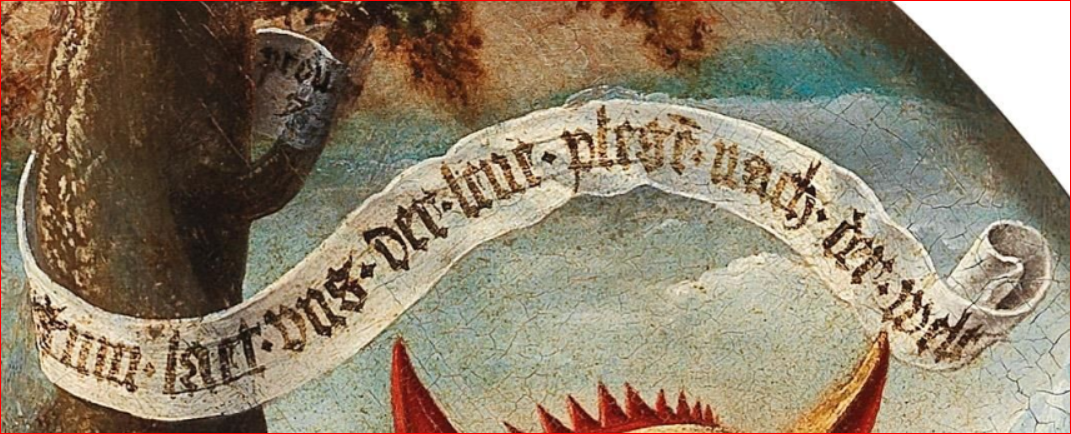
I doubt however that it is Netherlandish (or, as Abalartes said, Flemish), as the texts are in German (or just perhaps in some Limburgish, which is the language from the border region between Germany and the Netherlands around Maastricht and Maaseik). 

 The first text reads, as far as I can tell:
"Prou"? (top of the tree, no idea of meaning)
"...tum laet ons der leve plege nach der welt"
which means something (perhaps) like "let us care for the life after this world"

 Here part pf the text goes outside the frame, which may indicate a larger original work. The text is
"Das(?) (?) Sotthen"
"Want din leve um wolde(?)"
And a text folded below, which is something like "Bisto? Suas" but is really undecipherable. I am not certain of "Sotthen", but it certainly looks similar and would be right in the context (as it means "Fools")
 The third and fourth text are only partially lisible. "Di plarme..."

The very end, written smaller, seems to be "Sapi" and beneath it "32", so this may, just perhaps, be some signature and date? This is very tentative though.

The fourth and final text is "De frouwe ? ... wolde ? sijn", meaning "The woman wants to be ?" The question marks reads like "Dijsen", which doesn't have any meaning as far as I know, so I am clearly misreading this.

This text is to me, as far as I can read it, more German than Dutch. While this of course may be a Flemish painting made for the German market, it seems more likely that it is originally German to start with, considering the Cranach origin.

In favour of a Netherlandish origin is this work by Quentin Massys, now in the National Gallery of Art in Washington, which shows a fool in a very similar costume to the one added here on the right. Whether one painting is here based on the other for this detail, or whether it was a costume in common use at the time, is not known to me.

Similar fools caps can be seen in other works of the same period, like this engraving by Goltzius (via the Rijksmuseum). I can find older examples, from ca. 1530 on, so this doesn't really help to date the painting.

The value may be a bit high for an anonymous painting, but Cranach sells well and this is a very good work after Cranach, with an interesting image and possibilities for further research; and while not fresh on the market, it will be new for most bidders probably.

UPDATE: sold for 68,275 Euro!

Tuesday, 6 December 2016

"Ambrosius Benson" is a Lucas Cranach composition

Bertolami, from Italy, sells on 15 December 2016 an "Ambrosius Benson" Virgin and Child, an oil on panel (85 by 61 cm) estimated at 50,000 to 70,000 Euro. The painting is descroibed as one of the most Italienate of Bensons paintings, showing the influence of Leonardo da Vinci.

The only problem is that it isn't a work by Ambrosius Benson, but a work by (or more likely after) Lucas Cranach. There are many similar works by Cranach, the closest I could find is kept in Austria, in an abbey in Zwetti. Not only is the overall composition the same, details like the folds in the sleeces of the Virgin are absolutely identical. The Austrian version is better (or better preserved) though.

Sotheby's sold a variation of this composition in 2013 for £962,500!

Christie's went one further the same year, and sold another variation, this time attributed to Cranach the Younger, for $1,700,000...

Other variations, like this one from a private collection, or one in Minneapolis, can be used for comparison as well. 

The one for sale probably isn't an original Cranach, although it is hard to be certain (he painted a lot, and the quality varies). If the work were mine, I would withdraw it from the auction and get it looked at by some Cranach specialists. If it is real, it would be worth a lot more; as a work by a follower, it might fetch the current estimate; and as a fake (and Cranach gets faked quite often), it shouldn't be sold. But a Leonardo da Vinci influenced work by Ambrosius Benson, no, that it ain't.

UPDATE: sold for 62,500 Euro, mid-estimate, as expected for a good "Follower of ¨Cranach" as well.

Monday, 16 November 2015

Fake Cranach again for sale at Jackson's

Beware: a "Follower of Cranach" which is actually a German fake is again for sale at Jackson's auctioneers tomorrow 17 November 2015. It was sold in June at the same auction house for $3,500 (and sold in November 2014 as well, quite a hot potato work)

I discussed this picture, with evidence of why I call it a fake, in an earlier blog post. I also alerted the auction house through Twitter at the time (and again now), so they should know by now...

UPDATE: sold for $5,500 this time, probably by someone not reading this blog...

Tuesday, 28 July 2015

What I called a "Cheap "Follower of Cranach"" is probably a Christian Goller fake

UPDATE; painting again for sale at Jackson's on 17 November 2015, weird (still a fake though).

On 9 June 2015, I posted an auction of what I considered a cheap "Follower of Cranach" painting. Some further research seems to indicate that I have been duped (as was the auction house now, and many auction houses and dealers in the past).


The painting for sale (left picture) is exactly the same as one shown in an article in the Süddeutsche Zeitung of 20 November 2014 about Christian Goller, notorious German Cranach forger (right picture). The added third apple to the right of the head of the Virgin, the shape of the rocks on the left, every detail seems to be the same. The one in the article was sold for 900 Euro, so below the estimate of the one for sale at Jackson's in Iowa. The Jackson's one eventually sold for $3,500, which would mean a nice profit for the seller if it is the same painting (and possibly a rather dubious practice to buy it as a known fake but sell it as a Follower of...)

And it clearly is the same painting. Apart from the obvious visual similarity, there are more damning aspects. In the catalog for the sale in November 2014 (lot 21), the dimensions were given as 54,5 by 77 cm; in the Jackson's sale, it was 78 by 54 cm.

 And below you can see the back of the paintings, from the two catalogs. So, obviously the same painting.

Tuesday, 9 June 2015

Cheap "Follower of Cranach"

UPDATE: see also the important follow-up post about this painting.

At Jackson's, auction house from Iowa, they sell on 16 June a "Follower of Lucas Cranach the Elder" copy of the Virgin and Child under the Apple Tree, 78 by 54 cm and estimated at $1,000 to $1,500.

The original can be found in the Hermitage. The two are nearly identical, some minor differences like the position of the veil or the apples only, and nearly identical in size as well. The Hermitage version is clearly superior though, in detail, colouring, ...

If it really is a "follower", in the auction sense of a painter close in time (and usually space) to the named artist, then this is extremely cheap. Even poor Cranach copies often fetch a few thousand dollars, and this copy is very well painted and preserved. Of course, it is a much later "copy of", 19th century or more recent, then the price is about right. The painting looks to be older, both from how it is painted and from the look of the panel, but this is hard to judge from a screen only, and as the painting is an oil on canvas that has later be transferred to the panel, the panel doesn't tell us a lot (at least it doesn't look recent...)

If it is a 16th or early 17th century copy of the original painting (now in the Hermitage), then it should be worth at least $10,000. UPDATE: sold for $3,500.