Showing posts with label Vrancx. Show all posts

Tuesday, 11 April 2017

Sebastian Vrancx at Dorotheum: November or April? And has it been restored or repainted?

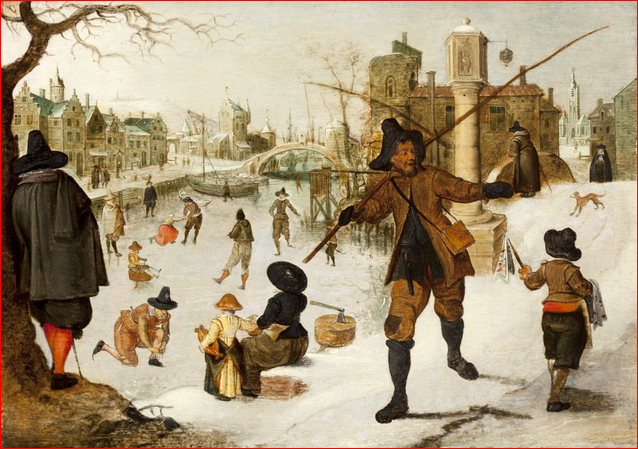
Dorotheum, from Austria, sells on 25 April 2017 a "Sebastiaan Vrancx" Month of November, estimated at 30,000 to 50,000 Euro.

This seems to be the cleaned version of an unattributed Vrancx I discussed in May 2016 which was then for sale with an estimate of 1,200 Euro and which I reckoned then should be worth 3,000 Euro. I don't know what that one fetched in the end, but the current estimate is way above that one.

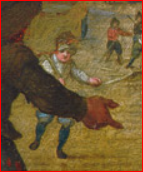
In my original post, I showed the above two versions and specifically remarked upon the minor differences, like the boy not having an axe.


In the version for sale, the boy has an axe, and the arm of the man with the basket is no longer visible (dangerous things, these axes!). This matches now exactly the better version from my original post (even the cords hanging from his arm have miraculously multiplied). But every other detail in the work for sale seems to match the work I blogged about in 2016 (and not the better version I showed then as well), like the  colour of the socks of the boy on the far left (grey instead of purple), the man with the sword walking away from us on the far right (grey-white instead of blue with yellow socks), the decoration of the house above his head (done more crudely ijn white, instead of the yellow stone colour), ... Even the craquelure, the damage to the glaze at the top (the clouds) is the same.


Underneath the arm of the boy with/without the axe, there is a particularly damning detail. In the "better" version from the previous blog, the boy continues on both sides of the arm (bottom image): but in the two versions for sale (then (top right) and now (top left)), we have the same very awkward shift between the upper torso and the legs, which simply don't fit.

Both also have an incorrect mention of "November" on the back, while the depiction is clearly of Spring (or April), with the fresh green on the trees and the erection of a Maypole.

The work for sale now is clearly worth more than my too cautious estimate of 3,000 Euro, but I have to wonder whether the significant changes are things which have been revealed when newer layers have been removed, or things which have been added by an enthusiastic "restorer" to make it look more like the "better" version? I hope it is the former, but my gut instinct tell me that it is the latter (at least the two nasty scratches, across the largest figure top to bottom, and left to right towards his left leg, have been repainted); but whoever wants to bid for this better first informs themselves of the actual restoration.

The actual value of this work depends on what happened to the work and how much the bidders know and care of course.


Tuesday, 14 February 2017

"Battle Scene" is Battle of Leckerbeetje; by Balthasar Courtois?

DVC, from Ghent, sells on 18 February 2017 an "Attributed to Sebastian Vrancx" Battle scene, estimated at 2,500 to 5,000 Euro.

Vrancx, Groeningemuseum, Bruges

It is a variation on a typical Vrancx work, the "Battle between Bréauté and Leckerbeetje, 5 February 1600", which for some reason was very popular and is known through many copies (both by Vrancx and his Studio, and later followers), as can also be seen in the inventories of Antwerp art legacies in the seventeenth century or similar sources.


The story isn't even about a real "battle" in the sense of a massive confrontation in war (although it was part of the 80 Years War, probably the second longest such named War in history), but it was a duel between 22 local, Catholic knights fighting for the Spanish, led by Leckerbeetje, and 22 Dutch and French knights, led by the Norman de Breauté for the French. Leckerbeetje died early in the confrontation, but his knights won and captured De Breauté and a few others. At the surrender, Bréauté was promised that he wouldn't be harmed (which was standard practice, much more interesting to demand a ransom than to kill prisoners, plus next time it might be your turn to get captured and you wouldn't want to be killed then either). However, the citizens lynched then anyway... The city, Den Bosch, was then still a Spanish-ruled, Catholic city, while the majority of what is now the Netherlands was Protestant and independent.

Vrancx, sold through Philip Mould

Why this moment captured the imagination isn't known, neither the actual story nor the original painting are really exceptional, but somehow it got copied and copied over and over again.


According to Jean Moust, who has a larger version of the work for sale for 11,800 Euro, Sebastian Vrancx was indeed the first to paint this, and other versions are by Pieter Snayers, Cornelis Droochsloot, Gerrit van Santen, and many anonymous artists.

Remarkable in the work for sale are the very prominent red sashes on many fighters. Perhaps this is partly due to the condition of the work, but as Moust describes, the sashes were the military uniform of the day, indicating to which party you belonged. That the work for sale shows the Red (Spanish) central figure already as victorious over Leckerbeetje, and not the more common fight between Breauté and Leckerbeetje, may indicate that this one was intended for a Catholic client, who would like to see this element stressed.

Apart from that element does the work for sale follow the composition of all these works quite rigidly. Most typical are some background elements; the gallows to the left, the tower in the middle, the mill to the right, with the city behind it; and the two watchers on the hillock on the right. The remainder is harder to see, the work needs cleaning and DVC doesn't offer high resolution images online.

The version which seems to copy this version the closest, at least with regards to the composition, is one at RKD attributed to Balthasar Courtois, a pupil of Vrancx. The colours are very weird, and the condition very poor, so a real comparison is hard, but the figures in the front, especially the fallen Leckerbeetje and some other elements like the group directly to the right of Bréauté, clearly relate this one to the one at auction now. Perhaps this indicates that the one for sale might also be by Balthasar Courtois, but it's hard to be certain with these.

It would surprise me if this work fetches the higher estimate, but the starting position of 2,500 Euro seems feasible on a good day.

UPDATE: unsold, again for sale with a 2,500 to 4,000 Euro estimate at DVC on 1 April 2017.

Monday, 9 May 2016

"Dutch painting, ca. 1600: November" is a workshop copy of Sebastian Vrancx, Spring or April

Galerie Bassenge, from Germany, sells on 27 May 2016 a "Dutch, ca. 1600" painting of Farmers on the way to the market, estimated at 1,200 Euro.

It is a somewhat weaker (and more damaged) version of a painting by Sebastiaen Vrancx, offered by Galerie Lowet de Wotrenge, an Antwerp art gallery. The work for sale lacks some details, like the axe in the hands of the boy leading the farmer, but is otherwise very close, even down to the colours (which indicates that the work for sale is based on the same painting and not on an engraving or drawing of it). It seems likely that the one for sale is a workshop copy of the one at the Wotrenge gallery.

The work for sale has an indication "November" at the back, indicating that it is one of a series of 12 allegories of the months. However, the Wotrenge gallery makes the case for this being an Allegory of Spring instead, which much better matches the iconography, from the green leaves at the trees to the erection of a maypole in the middle.

It may be part of the same series as the above "Winter" or "January" from the Museum Bredius, which has approximately the same dimensions.

Its value is probably close to 3,000 Euro, as Vrancx is popular at the moment.

Tuesday, 2 February 2016

"Studio of Sebastian Vrancx" is a copy after Bassano

Swedish art dealer JP Willborg sells (well, the site gives a price of 0 Euro, so technically that's giving away) a "Sebastian Vrancx. His studio" Allegory of Winter.

It actually is a copy after a well-known Francesco Bassano "Allegory of Winter", from the Dulwich Gallery (upper picture), or a variation by one of the other Bassanos (version by Jacopo shown below). The Bassanos were often copied in the 17th century (in Italy and Flanders), and Vrancx seems to be the painter du jour, with every competently painted work vaguely in his style attributed to him or his studio, a bit like everything was a Brueghel 100 years ago. In this case, I don't think the work is good enough for the attribution, certainly not considering it is a copy, which means that the good composition tends to make the painting look better than it actually is.

The work was known in Flanders through copies made by painters who visited Italy, and by engravings by artists like Sadeler (above).

The RKD lists e.g. the above Anonymous Flemish ca. 1600 copy, with some strange additions to the left.

I would describe the work for sale also as an anonymous Flemish copy after Bassano, and not as a Studio of Vrancx. The value should be in the low thousands.

Wednesday, 21 January 2015

Old attributions: Bruegel, Vranckx, ...


Apart from the countless "Teniers" of very varying quality, one often encounters paintings with old but now rejected attributions. If only they all were true... I already posted such a "Gerard David" in an older blog post, but nowadays, one can also buy a Bruegel, a Vrancx, ... for little to no money. Whether these were genuine old mistakes or ancient sellers knowingly trying to dupe buyers is hard to know of course. But it's fun to see what was labeled as some well-known painter in the past, and while some are 19th century copies, imitations or fakes, some are interesting second-rate paintings in their own right.

The above work, badly cracked in three, was a Breughel. Presumably Pieter Breughel the Elder, why settle for less? It is labeled at the back as "Ecole de Breugel" and now correctly sold as a Breugelian work. Date, origin, ...? Unknown, looks to me more 18th or early 19th century, but very hard to know from some pictures only. For sale at Carlo Bonte for 300 to 500 Euro  and described as late 16th century. If it truly dates from that period, I think it is a fairly conservative estimation. I couldn't find any prototypes for this painting, so it may be some invention by a late Breugelian painter, probably from Mechelen then as that city had the most of those apparently.


The topic of the Devil sowing while the people are sleeping has later been used in other paintings as well, e.g. the above one by Abraham Bloemaert (who has painted the same idea multiple times). It illustrates the parable of the Pares, from the Bible (Matthew chapter 13).

 Another former attribution in the same auction is a village scene by Sebastian Vrancx. Well, the auction house lists it as "attributed to Vrancx", but that seems a bit optimistic. Circle of Vranckx may be closer to the truth. Especially the figures aren't of the quality one would expect of Vrancx. Estimated at 1,500 to 2,000 Euro seems quite correct though, an interesting painting but with quite a lot of damage, with the paint wrinkled all over the work.


And as an extra special final one, here is a painting currently listed as attributed to Sebastian Vrancx, which was formerly attributed to Breughel, Wouwerman, Callot and Carel Breydel. For sale at Jordaens on 9 February, it is estimated at 11,000 to 12,000 Euro. It seems to me to have more chance of really being a Vrancx than the other one, and it is in better condition. Interesting cityscape, with the cupola in the right background.