Monday, 19 November 2018

"17th century Flemish School" goes back to a Rogier Van der Weyden composition

Mercier, from France, sells on 25 November 2018 a "Flemish School, 17th century" "Christ with the stigmata and saint", estimated at 1,500 to 3,000 Euro.

First off, it is a trinity, with God (not a saint) holding Jesus while the Holy Ghost flies above them. God is often represented with a papal tiara.

The work is probably 16th, not 17th century, and goes back to a composition by Rogier Van der Weyden. One version is kept in the Museum M in Leuven, Belgium (said to be by Van der Weyden, but seems like a good copy to me instead).

But it is unlikely that the version for sale is based directly on this one, which is known through other copies as well. For example the above one, listed at the RKD, is attributed to Marcel Koffermans. It stays closer to the original. In the version for sale, the way God holds Jesus has been changed (not improved though), and his head is turned.

As a 16th century reinterpretation of a Van der Weyden composition (there is also a similar composition claimed to be by Robert Campin), it should fetch the estimate quite easily.

Friday, 16 November 2018

"Flemish School" is copy after Hans Memling (or the Master of the Embroidered Foliage)

Galerie Moderne, from Belgium, sells on 11 December 2018 a "Flemish School" oil on panel estimated at 1,000 to 1,500 Euro.

It's a good copy after Hans Memling, the "Virgin and Child" from Burgos, but with a different background (which points to a slightly later date than the original, 1510-1520 probably). That work has also been attributed to the Master of the Embroidered Foliage though, and is then in turn more loosely based on Memling examples.

The work for sale is nice (dirty and somewhat damaged). The label on the reverse seems to indicate that the work was in Spain in the late 1930s (either this, or it has been added much later to legitimize a fake). I haven't found an online database to cross-check the label to the actual records of what the Spanish  government seized or stored in these years, it might help to get much more information on this work.

If the work isn't a 19th century (or later) pastiche / fake, then the estimate is clearly to low and it should fetch 8,000 to 10,000 Euro as a good, early follower of Memling.

UPDATE: sold for 3,900 Euro, way above estimate but still only half of mine...

Wednesday, 14 November 2018

Alexander Wiskemann or Dirck De Quade Van Ravesteyn

Bonham's, from England, sells on 5 December 2018 an "Attributed to Alexander Wiskemann" Venus and Amor, estimated at 21,000 to 29,000 Euro.

They give an extensive provenance, including a sale at Im Kinsky in 2010. It was offered there with an estimate of 20,000 to 30,000 Euro, and failed to sell in the regular auction (it may have sold during the aftersale).

It seems to have been offered at Teeuwisse in 2011 as well.

A different or uncleaned version of this painting was sold at Neumeister in 2008, with an estimate of 30,000 Euro. It was attributed to Dirck de Quade van Ravesteyn.

I
understand the attribution to Ravesteyn better than the one to Wiskemann, as the Venus here shares similarities with Venuses (Veni?) in other works by the artist. But these Ravesteyns show a more accomplished artist, so at best it would be a "circle of" or "follower of" him.

Alexander Wiskemann on the other hand is a nearly unknown painter, and I have not found any comparable paintings. So I have not the faintest idea why the attribution to Wiskemann is given, it doesn't seem to be based on a signature either. Strange!

UPDATE: the composition is close to a 1610 work by Mattäus Gundelach, sold at Dorotheum in 2011 with an estimate of 60,000 Euro. I don't think the artist of that work and the one for sale are the same though, but I wouldn't be surprised if one artist lies at the basis of both.

UPDATE 2: not sold

Tuesday, 13 November 2018

Simon Marmion, Anonymous, or Master of the Gold Brocade?


Hermitage, from Monaco, sells on 24 November 2018 a "Flemish School, 16th century" Maria lactans, estimated at 30,000 to 40,000 Euro.

The same painting was for sale on 12 April 2018 at Hampel, in Germany, as the work of Simon Marmion, estimated at 50,000 to 70,000 Euro.


 Version from the Metropolitan Museum
It is most likely the work of the Master of the Gold Brocade; the three other versions of the same work are all attributed to him (or her) by the RKD, and I see little reason to doubt their judgment or to believe that this one is  suddenly the work of Marmion. The original composition of the Virgin and Child is the work of Rogier Van der Weyden.

This version is also listed at the RKD, where they know it from a collection in 1937, and from being listed by the French Government as a recuperated work from (Récuperation Française, M.N.R. 853). Such M.N.R. numbers often point to looted art, but without further provenance it is hard to be certain if this work had been given back to the original owners and has reached the art market from there, or if this work may still be the rightful and moral poperty of the family of Nazi victims.

UPDATE: most of the same info was already posted at the AuctionRadar blog at the time of the Hampel auction!

UPDATE 2: and now again for sale at Hampel (28 March 2019), still as Marmion, and still with a 30,000 to 50,000 Euro estimate.

Friday, 9 November 2018

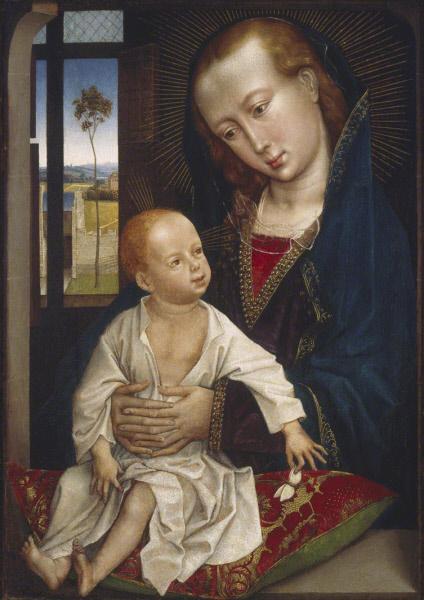
"Attributed to Van der Weyden": can this be a youth work by Bouts?

Deutsch, from Austria, sells on 4 December 2018 an "Attributed to Rogier Van der Weyden" Virgin and Child, an oil on panel estimated at 2,800 to 5,500 Euro. The combination of "attributed to Van der Weyden" and a 2,800 Euro estimate makes me believe that one or the other is wrong...

The composition is by Van der Weyden, as can be seen in this workshop version in the Art Institute of Chicago. The one for sale is, apart from the background, an extremely close copy of the Chicago one. Only the face of the virgin is less well executed, and the condition of the work (while still remarkably well preserved for a 500 years old painting) is somewhat lacking, although a removal of the yellowed varnish may solve most of this.

I can't find any examples of Van der Weyden himself using such a background in a Virgin and Child. A similar window and landscape is used by a Follower of van der Weyden in the Saint Louis Art Museum.


Even more remarkable are the similarities with a Dirk Bouts Virgin and Child in the National Gallery.Not only does the window have the same general appearance as the other two examples, the crisscrossed windows at the top seem to have the exact same pattern of coloured elements round the border.

Which leaves me rather puzzled. Is this an early Dirk Bouts, who is supposed to have been a pupil of Van der Weyden? A version from the workshop of Van Der Weyden executed by Bouts, who later in his own work reused elements he invented then, like the window? The work isn't good enough to be a mature Bouts (or a Van der Weyden), but it is close enough in quality to be a work of Bouts as an apprentice, a pupil.

Or is it a work by someone who copied a Van der Weyden composition but added a Bouts window to it? That seems strange, certainly if it is contemporary (late 19th and 20th century forgers are more known to combine elements to create "new" works or new copies). Of course, it may also be a copy after a lost (or to me unknown) Van der Weyden or Bouts.

I would love it to be by Bouts, but I know that I sometimes get carried away when I am duped by a good fake. It certainly seems to be worth the gamble at the very low estimate. If it turns out to be the best-case scenario, the value is immense. If it is a good follower of Van der Weyden and Bouts, from around 1500, then it still is worth 25,000 Euro (well, the value depends also on what the cleaning would reveal, if the painting is even better below the yellowing, it only gets more valuable).


Thursday, 8 November 2018

"Flemish painter, ca. 1520" is copy after Quinten Massys

Lempertz, from Germany, sells on 14 October 2018 a "Netherlandish Master, ca. 1520" Lamentation, estimated at 20,000 to 25,000 Euro.

The work is a somewhat awkward copy after Quinten Massys, a Lamentation from the Royal Museum of Fine Arts in Antwerp.

The Lempertz catalogue mentions a sale of the work in 1976, but it is also included at the RKD which shows that it was known to Friedländer in 1967. The estimate seems rather high, even though it is a large, well preserved early work. But it really isn't well painted, the figures and faces seem wooden (on its own, and certainly when compared to the original).

Wednesday, 7 November 2018

"Ferrarese School" is copy after Scarsellino

Cambi, from Italy, sells on 14 November 2018 a "Ferrarese School, 17th century" Bathing women, estimated at 5,000 to 6,000 Euro.

It is a good copy after a work by Scarsellino (1550-1620), who was indeed a Ferrarese painter. It is now housed in the Minneapolis Institute of Art. The original is larger than the copy for sale (120 by 176 compared to 94 by 130, still a considerable size of course). Copies are usually a lot less valuable of course, but this is a good enough one, and the subject (Naiads) is always popular.