Showing posts with label Lempertz. Show all posts

Friday, 30 August 2019

Two versions of same composition, one Bruges, one South Germany?

Lempertz, from Germany, sells on 20 September 2019 a "Probably South German master, 16th century" Holy Kinship, estimated at 6,000 to 8,000 Euro.

While there are many somewhat similar works with this subject, sharing some aspects with the one here, I could only find one other work with nearly the same composition. Strangely enough, the execution of that one is quite different, and it was described at the auction in 2005 as "Circle of Anthuenis Claeissins", referring to the Bruges painter Anotnis Claeissens (1536-1613). I found that one through Artnet, and I have no idea of which auction house, estimate or result. They also only offer a relatively small image, which is too bad, but beggars can't be choosers I suppose.

The two paintings may look quite different at first sight, but too many details are the same to be a coincidence.


At the bottom left, we have Saint John the Apostle and Saint James the Great, with their mother Salomé. In both cases, Salomé has very similar headgear and mantle, the same position with the slightly opened book in one had and the other around the standing Jacob, and John sitting at her knees and reading.


The top left shows 6 important Biblical figures (plus a child), including Joseph, Salomon, and Zebedeus. The order and placement of the figures is identical, with e.g. Josephh standing with his hands on the balcony on either side of the head of Mary, Zebedeus on the left pointing to his wife Salome, or the two women directly to the right of Zebedeus, with the baby and the same headgear. As in all these comparisons, it will also be clear that the colours vary wildly, and that postures and details are sometimes very similar, and at other times completely at odds.


In the centre we get Mary and her mother Anna, and Jesus between them.These are less similar, but some details like the dress and headdress of Anna (and the way it falls over her shoulders), the hand in the open book, all point to the same origin.


At the top right we see six further figures (again with an extra child, John the Baptist), with Elizabeth, Simeon, Cleophas, and others. The three left-most figures, Salomon (labeled (Salomé in the painting), Simeon, and Joachim, have the same position and gestures, but by mistake has the bishops hat of Zacharias been given to Simeon in the Claeissens version (or vice versa). The figures on the right are less similar, although they are placed in the same order and e.g. the rightmodst one, Alphaeus, points to his wife Mary in both examples.


The bottom right has Mary Alphaeus, and 4 children; James (the son of Alpheus), Simeon (probably Simon the Zealot or Simeon of Jerusalem), Barnabas, and Judas Thaddeus. Striking similarities include the headdress of Mary, the position of all 5 figures (with Judas Thaddeus half kneeling, his head turned, one hand stretched out towards Jesus, and the other holding a basket; and Simeon and Barnabas together reading a book).

All in all, these similarities can not possibly be a coincidence, and point to a common origin for these two works. However, the clear differences seem to indicate that their have to have been intermediate versions, not one common origin (like an engraving), but e.g. two different drawings after some common work, which then formed the basis for these two paintings.

I haven't found a trace of these possible other (better) versions of this composition, nor of a possible original artist. Any and all information is welcome!


Wednesday, 28 August 2019

"Probably early 17th century Antwerp Master" is Workshop of Hendrick van Balen

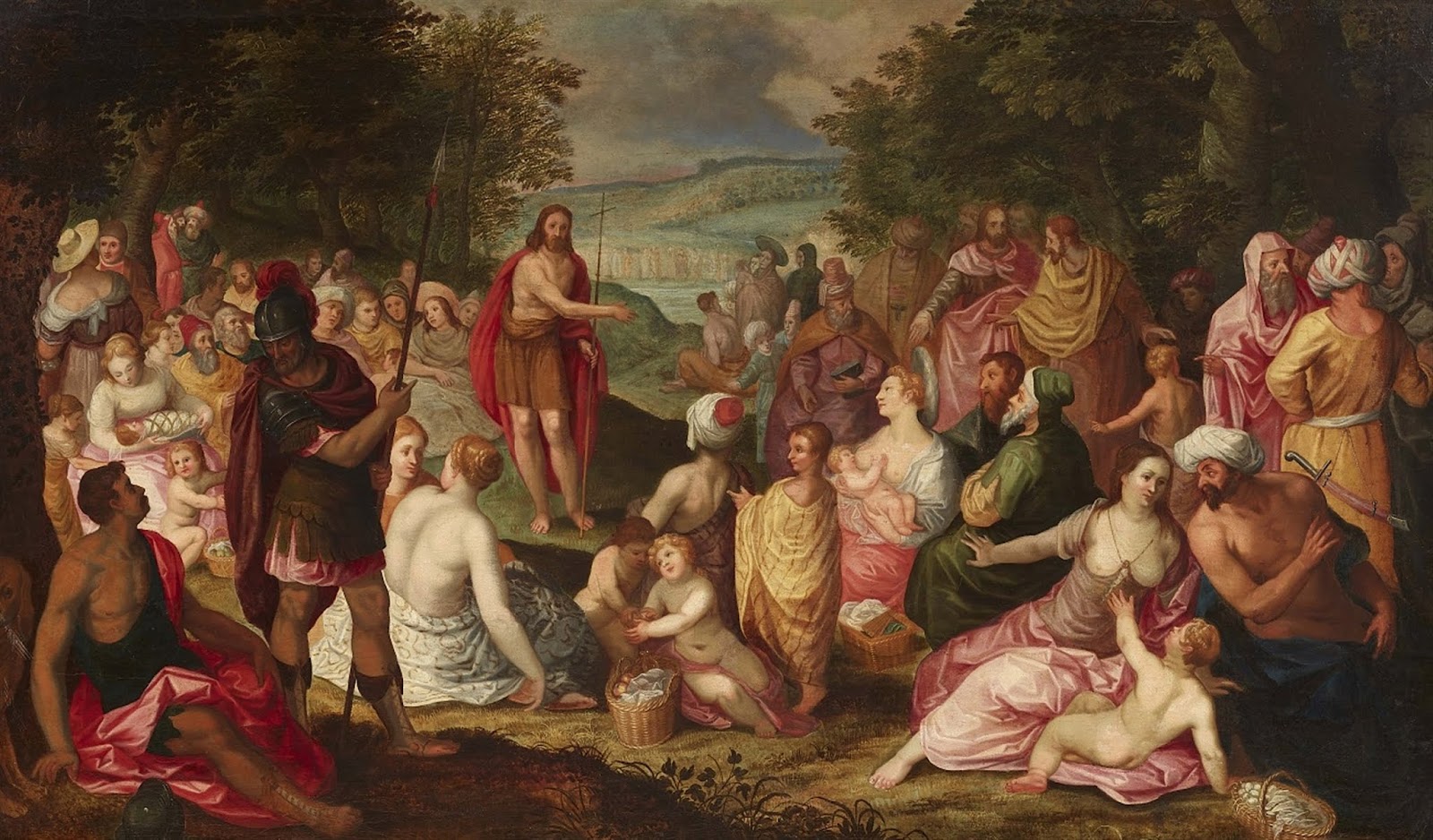
Lempertz, from Germany, sells on 20 September 2019 a "Probably Antwerp master, early 17th century" John the Baptist preaching, estimated at 8,000 to 10,000 Euro.

It is a copy after a work by Hendrick van Balen, a version of which was sold at Christie's in 2018 for £200,000. The one for sale, though still very good, is clearly inferior when looking at the detailing, but may be good enough to be called a Workshop version perhaps, or otherwise a School of or Follower of version.

The strange thing is that while for this lot 3, Lempertz didn't find the link with Van Balen, their very next lot is catalogued as a "follower of Hendrick van Balen" with an estimate of 10,000 to 12,000 Euro. This is indeed supported by a similar work at the RKD which was listed as by Hendrick van Balen: if that version was by him, it has to be one of his very last works, as it is unsigned but dated 1632.

I personally like the first lot more than the second one, and would estimate it slightly higher, basically reversing the two estimations.

Monday, 6 May 2019

"German School" is copy after (?) Claude Sevin

Lempertz, from Germany, sells on 18 May 2019 a "German school, ca. 1700" Alexander the Great meets Diogenes, estimated at 3,000 to 4,000 Euro.

The original of the work for sale is kept in the Museum of Fine Arts in Nîmes.

At first I thought it was a copy after a work from Pierre-Paul Sevin (1646-1710), a French painter mostly known for his creations of backdrops and decorations for festivities at the Versailles Palace, and not so much for independent, traditional paintings. This was the name given as artist on commercial sites like Alamy and Magnoliabox.


These are some examples of the more typical work of Pierre-Paul Sevin.

However, some further research showed me that Getty Images gave a different artist, Claude Sevin (1750 - ?). This lead me to an old guide for the Toulouse Museum, which discussed this painting and identified the artist quite convincingly. It was a work intended for the yearly Prix de Rome contest for young artists, which in 1776 had as theme "Alexander and Diogenes". He won a second prize with this painting. He never achieved the first prize, and either ended his career as painter early or perhaps became a minor portrait painter. Basically, this work was the zenith of his career... How and when it moved from the Toulouse Museum to the Nîmes one is unknown to me.

It seems probable that Claude Sevin was a descendant of Pierre-Paul Sevin, as both came from the same city, Tournon (just like Pierre-Paul's father François, another painter).

The copy may seem rather mediocre at first sight, but this is mainly due to the very tiny scale of it: only 10 by 15 cm! When one takes this into consideration, and seeing how little known the painter and this work is (which makes it less likely that someone would have painted a copy of it), I have to wonder if this isn't the original small-scale design for the much larger finished work. Even so, he is a barely known painter, so the price won't be spectacularly changed by finding the artist.

UPDATE: sold for 4960 Euro. I wonder if whoever bought it knew the things I posted here or had read my blog before the sale!

Thursday, 8 November 2018

"Flemish painter, ca. 1520" is copy after Quinten Massys

Lempertz, from Germany, sells on 14 October 2018 a "Netherlandish Master, ca. 1520" Lamentation, estimated at 20,000 to 25,000 Euro.

The work is a somewhat awkward copy after Quinten Massys, a Lamentation from the Royal Museum of Fine Arts in Antwerp.

The Lempertz catalogue mentions a sale of the work in 1976, but it is also included at the RKD which shows that it was known to Friedländer in 1967. The estimate seems rather high, even though it is a large, well preserved early work. But it really isn't well painted, the figures and faces seem wooden (on its own, and certainly when compared to the original).

Tuesday, 24 April 2018

"Italo-Flemish painter" is copy after Maerten de Vos

Lempertz, from Germany, sells on 16 May 2018 an "Italo-Flemish Master, 16th century" Scenes from the live of the virgin, estimated at 15,000 to 17,000 Euro.

At least two of the three panels, the Flight into Egypt and the meeting with Elizabeth, are copies after engravings by Maerten de Vos. Considering that the prints date to ca. 1598, it may be more likely that the paintings are 17th century than 16th century. The estimate seems a bit optimistic, even though they are fairly good copies and in a nice frame.

UPDATE: unsold, as expected

Monday, 23 April 2018

What's the link between the 1440/50 Lempertz painting and Dirk Bouts?

Lempertz, from Germany, sells on a "Netherlandish Master, ca. 1440/1450" Pieta, a very small (20 by 15 cm) oil on panel estimated at 6,000 to 8,000 Euro.

I already tweeted about this work, but it probably deserves the full blog treatment.

From the period 1440/1450, very few paintings survive, most by masters like Van Eyck and Van der Weyden. Others active then include Hugo Van der Goes and from about 1450 on Dirk Bouts. Contrary to what one might expect, few of those have a gold-painted background, most have some form of landscape, interior, ... unlike Italian or German paintings from the period. Such golden backgrounds seem to be more popular in the later 15th century in Flanders, with people like the Master of the Gold Brocade.

The painting for sale most closely resembles the work of Dirk (Dieric) Bouts and his followers, including two of his sons. The face of Christ and the position of the hands of Mary, with the intertwined fingers, both resemble a Lamentation by Bouts from the Louvre, dated to circa 1460.

Both have Christ as a dead human, not some God in a suspended state. The work for sale takes this even further though, with the grey-blue lips and greyish body colour. The Virgin in that version also isn't some young, beautiful, mourning woman, but an older, grief-stricken mother.

Such realism is not common for depictions of Mary and Jesus, who were gods or godlike, not human like everyone else. The artistic quality though, while certainly not bad, isn't up to par with the composition, so perhaps it is a copy after an older and better work?

The only way I see to place it in 1440/1450 is to see it as the oldest known painting by Dieric Bouts, a somewhat clumsy prototype for his later work like the above Lamentation. In that case, it should be worth a lot (a huge lot even) more than the estimation.

If it is (as is of course more likely) a follower of Bouts, someone like Dirk Bouts II, then the estimate is probably right, but the date is off. by some 40 years at least.

UPDATE: sold for 9,920 Euro, it will be interesting to see if anything further on this work will appear.


Monday, 4 September 2017

"Flemish Master, ca. 1520" is a follower of Cornelis Engebrechtsz.

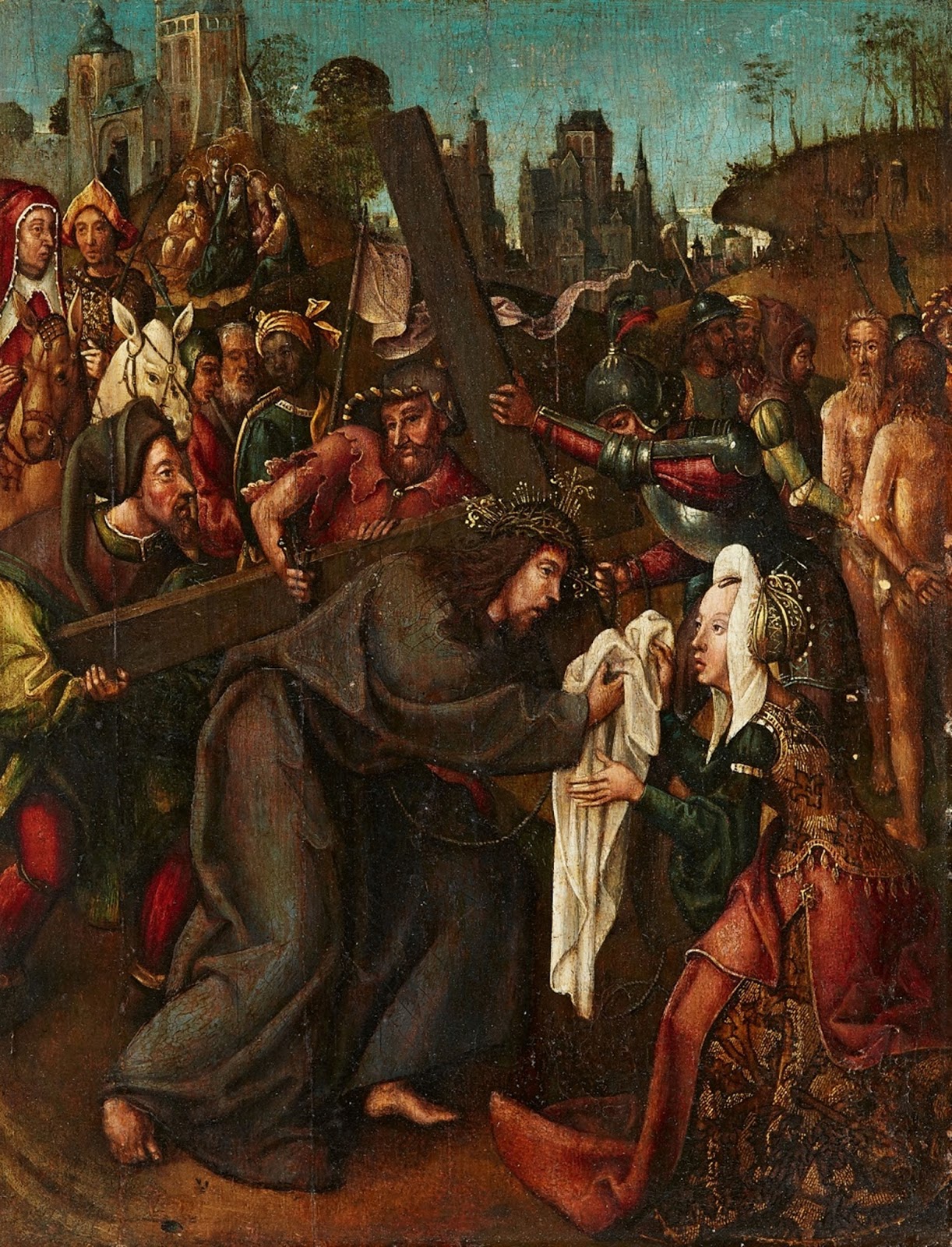
Lempertz, from Germany, sells on 20 September 2017 a "Flemish Master, ca. 1520" Christ and Veronica, estimated at 4,000 to 5,000 Euro.

This work is listed at the RKD as "current location unknown" and made by a follower of Cornelis Engebrechtsz, first half of the 16th century. It is nice to see it reappear now after some 50 years.

Another version of the same work, also attributed to Engebrechtsz., is also listed at the RKD. It can be found in Alveston House, in the UK. It has nearly the same dimensions and seems to be made by the same artist or workshop.

Thursday, 28 April 2016

"Flemish School ca. 1600" is weak copy after Marten De Vos

Lempertz, from Germany, sells on 21 May 2016 a "Flemish School, ca. 1600" Marriage at Cana, a large (91 by 122) work presumably from Antwerp, estimated at 8,000 to 10,000 Euro.

It is a mediocre copy (fairly detailed, but without much talent) of a work by Marten de Vos from the Onze-Lieve-Vrouwekathedraal in Antwerp. The original oozes luxury, renaissance ideals, and considerable talent (though it would soon be eclipsed by the generation of Rubens). The copy isn't completely identical, so it may be based on a variation of the work, but in any case is not an original composition nor the work of a named master.

Another painting, optimistically given to Frans Francken the Elder, is also related to this composition, but somewhat more remote.

The one for sale will struggle to fetch the estimate, anything above 5,000 Euro would really surprise me.


Monday, 26 October 2015

Lempertz "Antwerp Master, ca. 1520" adoration may be by the Master of 1518 or Pieter Coecke

Lempertz, from Germany, sell on 14 November 2015 a, "Antwerp Master, ca. 1520" Adoration of the Kings, estimated at 8,000 to 12,000 Euro.

Unlike many other interesting paintings in the auction, it has no further explanation about the artist, similar works, attribution, ... But the description seems to indicate that they were aware of the extremely similar works that exist by or from the circle of the so-called Master of 1518, an Anonymous Antwerp Master.

Perhaps the closest is the above central panel from a triptych now in the Bonnefantenmuseum in Maastricht, which is sometimes attributed to the Master of 1518, and sometimes (e.g. at the RKD) to a follower of him.

The Harvard Art Museums also own a triptych (again central panel shown) with the same image, attributed to the Master of 1518. This one varies a bit more from the one for sale, but the common origin is clear.

The Brera version is even further removed from the one at Lempertz, but still basically the same painting.

Of course, it would be too simple if there weren't different attributions floating around as well. The above, location unknown, can be found at RKD as "Studio of Pieter Coecke van Aelst", which would date it somewhat later perhaps. It is perhaps even closer to the one for sale than the first one I showed.

The RKD also lists a nearly identical one from the Princeton University Art collections. Other nearly identical ones are this one and this one.

In any case, the one for sale is very close to the above paintings (though only the central panel), and is probably good enough to be considered a Studio of Pieter Coecke or a close circle of Master of 1518 painting. It should be worth considerably more than the estimate, anything below 20,000 Euro seems cheap to me.

UPDATE: sold for 11,160 Euro, cheap in my opinion.

Wednesday, 26 August 2015

School of the Master of the Prodigal Son


Lempertz, from Germany, sells on 23 September 2015 a "South Netherlandic Master, ca. 1520" Adoration of the Magi triptych, estimated at 8,000 to 12,000 Euro.


It is a version of a work by the Master of the Prodigal Son. There should be other copies in Warsaw and Baltimore, but the only one I could find an image of (thanks to the RKD) is this copy (probably cut down as well) from a church in Nijmegen, in the Netherlands.

The one for sale probably isn't an authograph work by the Master of the Prodigal Son, but it is a good painting and a relatively rare example of these 16th century Flemish triptychs, best known from the works of Pieter Coecke van Aalst who made some rather similar works as well. The estimate seems about right, perhaps even a bit low, but more research into the connection with the Master and his possible authorship are needed.

UPDATE: sold for 18,600 Euro, so the estimate was indeed too low.

Monday, 27 April 2015

German master, Pieter Coecke or Joos van Cleve?

At Lempertz, on 16 May 2015, they sell a "German Master, 16th century" depiction of Saint Jerome, estimated at 22,000 to 26,000 Euro. A very nice painting, no matter who painted it, inspired by a 1521 work by Dürer. Lempertz indicates that version by Flemish masters like Pieter Coecke van Aalst are known, but attributes it to a German master because of the angular painting style, and the very busy decoration.

Other sites have attributed other versions with nearly the exact same decoration to Coecke or Joos van Cleve though, so it seems that the opinions are divided.

The above was attributed to Circle of Coecke at Bonham's in 2010: apart from the view through the window on the left, the extra details at the top, and the addition of the lion (typical of Saint Jerome) on the right, it is nearly identical to the one for sale, so they probably should be attributed to the same artist (or circle).

And then there is another version in the Cathedral of Burgos, attributed to Joos Van Cleve. This one is even closer to the one for sale, with the same book on the right and a very similar landscape in the background. In fact, apart from the bits to the top which are missing in the Lempertz version, it's hard to see any difference between those two, apart from the fact that the Lempertz one seems to have slightly less quality of painting.As it comes from a Spanish private collection, and the Cleve one is kept in Spain, one can wonder whether the one for sale at Lempertz isn't a Spanish copy instead of a German one. Assuming it is old, it should still be worth a lot of money.

A horizontal version, with only minor variations but in the same style, is shown at BBC Your Paintings, from the Wellcome Library Collection, by "unknown artist". Rather amazing that with all these very high quality copies, we still don't know who painted these!