Thursday, 20 April 2017

Unknown artist C. De Vylder

Walldorf, from Germany, sells on 22 April 2017 as lot 1091 an "Unclearly signed, 19th century Belgian school, Antwerp 1860" genre painting estimated at 500 Euro.

The painting isn't especially good, but signed Belgian paintings always make me curious to find out who actually painted it. Luckily, the auction house provided a close-up of the signature. It seems to say C. De Kylder or C. De Vylder or any variation thereof.

It turns out that this is a largely unknown painter, who appears from time to time at auction with similar works, often dated to the same year, 1860. One auction stated that he or she was Dutch and lived from 1840 to 1880, but I haven't been able to confirm this. The RKD doesn't list them.

A possibility is that this was a student at the important Antwerp Royal Academy of Art, who painted a lot during his studies (ca. 1860) but then quit painting and went on to live an unremarkable live somewhere. Seems like a pity in that case, as they had some talent, enough probably to become a moderately succesful painter of commercial works like the above. They wouldn't have become a major master of the genre though.


Above are shown the other works by him that I could find. And that's it. No trace of his origin, first name, ... could be found online.

Value? The estimate seems about right. The first and fourth painting above were sold together at Christie's South Kensington in 2000 for £3,500, but they seem to be somewhat better than the one for sale, and were twice as large. The work for sale is quite small (32 by 25 cm).


"Flemish genre painting" is by a Follower of the Master of the Female Half-Lengths

Quentin, from Berlin, Germany, sells on 22 April 2017 a "Flemish genre painting, ca. 1600" of a merry company, estimated at 3,500 to 5,000 Euro.

The work is a variation on a painting sold at Sotheby's London in 2013, which was then attributed to the Master of the Female Half Lengths. It sold for £86,500.

Another, more elaborate version with the story of the Prodigal Son, is kept in the Musée Carnavalet and has been attributed in the past to the same master, or Jan van Hemessen, or Quentin Massys, or the Monogrammist of Brunswick. This version lacks the jester with his marotte though. But it does have what seems to be Paris in the background (the Notre Dame!), which explains what it does in the Musée Carnavalet, which is a historical museum first and foremost.

While the original artist is thus clearly unidentified, the work for sale is a copy of lesser quality, but with some interesting variations which may help people define the original artist (if these variations are based on some original version of course). The exact allegorical meaning isn't really clear to me, but women, alcohol and music all seem to be foolish things to get involved with. Perhaps it is simply another Parable of the Prodigal Son. The estimate may be somewhat high for a clearly less skilled artist, but it is an interesting old work anyway and should be worth a few thousand Euros.

Wednesday, 19 April 2017

"Circle of Vrancx" is another copy after Hendrick Aerts

Merry Old England, a quantly named auction house from Germany, sells on 20 April 2017 a "Circle of Sebastiaen Vrancx and Hendrick van Steenwijk the Younger, monogrammed CVL f(ecit)" church interior, estimated at 16,000 Euro.

It is another (nice) copy after Hendrick Aerts, a view of the church of Laterans which I already discussed in September 2016.

I have no idea why the auction house references Sebastiaan Vrancx, I see no link with his work. Strangely, the work for sale was offered at Sotheby's Amsterdam in 2002 with the correct identification of subject and origin, as can easily be found at RKD. This makes it clear that the scene on the left, which replaces the baptismal font in the original, is "Jesus and the Adulterous Woman". It dates the work to 1658. I haven't been able to find the result in 2002 though.

The estimate seems somewhat high for what is in the end one of many copies of this work (though far from the worst of them). 6,000 to 8,000 Euro seems more realistic.

Monday, 17 April 2017

"Dutch school" portraits are probably Swiss, by a follower of Johannes Dünz

Veritas, from Portugal, sells on 19 April 2017 a pair of "Dutch School, 17th century" portraits of a couple, dated 1670, and estimated at 4,000 to 6,000 Euro together.


While the attire of the man is not really remarkable, the woman is more distinctly represented, holding a flower and wearing a very large hat. These things are typical for some Swiss portraits of the period, especially by Johannes Dünz (1645-1736). The two examples are from 1671 and 1672.

The link is not really strong though, but the paintings for sale don't look Dutch to me. Paintings by Dünz only fetch about 1,000 Euro, so it is not as if this attribution would increase these in value; but it's always nice to bring a lesser known painter to attention, and to see a pair of portraits which have remained together for ages.

Thursday, 13 April 2017

20K "Flemish School, high quality, eluded attribution" is copy after Hendrick de Clerck

Dorotheum, from Vienna, sells on 25 April 2017 a "Flemish School, 17th century"  Apollo and the Gods, estimated at 20,000 to 30,000 Euro.

From the auction catalogue on the website:
"Despite its high quality, the present painting has so far eluded a convincing attribution. It is reminiscent of late works by Jan Brueghel II or the Balen Family. An alternative attribution to Johan Hendrick Keller, a Swiss artist who later moved to the Netherlands and worked on the decorations of the Het Loo Palace, has also been suggested."

The painting looks like a good composition executed by a mediocre artist, and more 18th century than 17th century, with some French influences perhaps. Sure enough, some research leads to a 17th century Flemish original for this, the same composition in a much more archaic style and better executed. 


The original is by Hendrick de Clerck (1560-1630), a "Parnassus" from the Royal Museum of Fine Arts in Antwerp (which was originally planned to be reopened after very extensive renovations this year, but which has sadly been delayed for another two years!).
The original is 63 by 47 cm, the copy for sale is 65 by 51 cm.

The one at Dorotheum is described as "The Gods of Mount Olympus congregating around the music-making Apollo", which is technically correct, but lacks the deeper meaning the original has: "Parnassus: allegory of the virtues of the Archduke": De Clerck was the court painter for the Archdukes Albrecht and Isabella, great patrons of the arts (friends of Rubens) and two of the most powerful politicians of their time.

As an attractive but not exceptionally skilled copy, it should be worth 5,000 to 6,000 Euro, not the 20,000 estimate which is the price for an original work by a better master.

Tuesday, 11 April 2017

Sebastian Vrancx at Dorotheum: November or April? And has it been restored or repainted?

Dorotheum, from Austria, sells on 25 April 2017 a "Sebastiaan Vrancx" Month of November, estimated at 30,000 to 50,000 Euro.

This seems to be the cleaned version of an unattributed Vrancx I discussed in May 2016 which was then for sale with an estimate of 1,200 Euro and which I reckoned then should be worth 3,000 Euro. I don't know what that one fetched in the end, but the current estimate is way above that one.

In my original post, I showed the above two versions and specifically remarked upon the minor differences, like the boy not having an axe.


In the version for sale, the boy has an axe, and the arm of the man with the basket is no longer visible (dangerous things, these axes!). This matches now exactly the better version from my original post (even the cords hanging from his arm have miraculously multiplied). But every other detail in the work for sale seems to match the work I blogged about in 2016 (and not the better version I showed then as well), like the  colour of the socks of the boy on the far left (grey instead of purple), the man with the sword walking away from us on the far right (grey-white instead of blue with yellow socks), the decoration of the house above his head (done more crudely ijn white, instead of the yellow stone colour), ... Even the craquelure, the damage to the glaze at the top (the clouds) is the same.
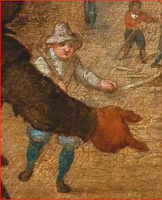
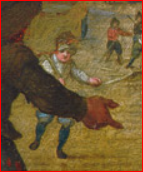
Underneath the arm of the boy with/without the axe, there is a particularly damning detail. In the "better" version from the previous blog, the boy continues on both sides of the arm (bottom image): but in the two versions for sale (then (top right) and now (top left)), we have the same very awkward shift between the upper torso and the legs, which simply don't fit.

Both also have an incorrect mention of "November" on the back, while the depiction is clearly of Spring (or April), with the fresh green on the trees and the erection of a Maypole.

The work for sale now is clearly worth more than my too cautious estimate of 3,000 Euro, but I have to wonder whether the significant changes are things which have been revealed when newer layers have been removed, or things which have been added by an enthusiastic "restorer" to make it look more like the "better" version? I hope it is the former, but my gut instinct tell me that it is the latter (at least the two nasty scratches, across the largest figure top to bottom, and left to right towards his left leg, have been repainted); but whoever wants to bid for this better first informs themselves of the actual restoration.

The actual value of this work depends on what happened to the work and how much the bidders know and care of course.


Monday, 10 April 2017

"Follower of Philippe de Champaigne" is Follower of Frans Francken instead

Crait+Müller, from Paris (part of the Drouot empire), sells on 29 April 2017 a "17th century French school, follower of Philippe de Champaigne" Crucifixion, estimated at 800 to 1200 Euro.

I can't see any resemblance to de Champaigne, the work is a typical School of Frans Francken composition.

I discussed similar works already a long time ago, in March 2015, when a much better version was sold at Drouot. That blog included a few very similar works, with only the central panel different.


The system of the Franckens can be seen beautifully in these works. This version had a fixed border, but with alternative scenes where needed; e.g. in the lower example, there is a crucifixion scene on the right. In the one for sale, and the upper example, the crucufixion is already the central scene, so repeating this as a border scene would be weird, and it gets replaced with a not really clear scene, perhaps an element from a Last Judgment?

The upper example is identical to the one for sale, but for a minor variation in the central crucifixion. That one was sold in 2011 for 2,400 Euro. The one for sale now is perhaps a bit less appealing, as it lacks a splash of colour and is a cheap or late Francken work, not one of the very good more original ones which fetch 10,000 Euro and more quite easily, but at 800 Euro, it would be a very nice bargain, and it should be worth closer to 2,000 Euro.

A much more elaborate example can be seen in the Museum M in Leuven, Belgium.