Showing posts with label resale. Show all posts

Thursday, 21 March 2019

Reappearing at Hampel, March 2019: an overview

I've updated quote a few older blog posts with reference to the 28 March 2019 auction at Hampel, Germany, because many paintings (or very close copies) reappear in that auction.

This includes:


*A "resurrection" (or ascension), sold at Audap Mirabaud in June 2018. The version at Hampel is probably not the same but nearly identical.

*An "attributed to Hermann tom Ring" which they tried to sell in September 2018, and now again with a lowered estimate. The attribution is still wrong though.

*A "Simon Marmion", for sale at Hermitage in November 2018, with an identical lower estimate. It still isn't by Marmion though.

*I already wrote a blog post this week about the Francken they now correctly offer and which I first discussed in 2015.

*And finally, an "adoration of the shepherds", for sale at Carlo Bonte in September 2017, is now offered as the work of Hans Rottenhammer and estimated at 28,000 to 35,000 Euro. It is a copy after engravings by Maerten de Vos: whether the copy is made by Rottenhammer is hard to be sure of.

Friday, 8 December 2017

"Spinning virgin revisited"

Badisches Auktionshaus, from Germany, sells on 13 December 2017 a "16th / 17th century" Mary with spindle, estimated at 800 Euro.

It immediately reminded me of one of my early blog posts from March 2015, on the "Virgin child spinning", a theme which is popular in so-called Cuzco painting. The painting then was a lot better than the one now (although this one is charming and not too amateuristic, which is often a plague with Cuzco paintings), but then again the estimate was 10,000 Euro, not 800 Euro.

Searching for more information on the one for sale now led me by a happy coincidence to more information on the painting I discussed back then.

I knew that it was sold at the previous auction, but not for how much. The new owner is Robert Simon Fine Art, a major Old Master dealer from New York City.

They have been able to attribute the painting to Juan Simon Gutierrez (1643-1718), and they describe it as "the earliest and most elaborate depiction of the Child Virgin Spinning theme." They also claim that the version in the Prado (which I also discussed in that earlier blog post) is also by Gutierrez. No indication of the current price, but it may be considerable...

They also seem to carry other paintings I discussed, e.g. this one.

The one for sale in Baden is probably a lot more recent than the description thinks, I would guess it is late 18th or 19th century. The value is probably about right. 


Tuesday, 11 April 2017

Sebastian Vrancx at Dorotheum: November or April? And has it been restored or repainted?

Dorotheum, from Austria, sells on 25 April 2017 a "Sebastiaan Vrancx" Month of November, estimated at 30,000 to 50,000 Euro.

This seems to be the cleaned version of an unattributed Vrancx I discussed in May 2016 which was then for sale with an estimate of 1,200 Euro and which I reckoned then should be worth 3,000 Euro. I don't know what that one fetched in the end, but the current estimate is way above that one.

In my original post, I showed the above two versions and specifically remarked upon the minor differences, like the boy not having an axe.


In the version for sale, the boy has an axe, and the arm of the man with the basket is no longer visible (dangerous things, these axes!). This matches now exactly the better version from my original post (even the cords hanging from his arm have miraculously multiplied). But every other detail in the work for sale seems to match the work I blogged about in 2016 (and not the better version I showed then as well), like the  colour of the socks of the boy on the far left (grey instead of purple), the man with the sword walking away from us on the far right (grey-white instead of blue with yellow socks), the decoration of the house above his head (done more crudely ijn white, instead of the yellow stone colour), ... Even the craquelure, the damage to the glaze at the top (the clouds) is the same.
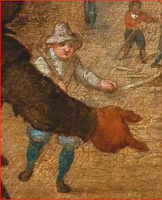
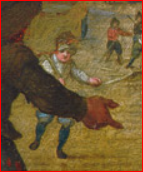
Underneath the arm of the boy with/without the axe, there is a particularly damning detail. In the "better" version from the previous blog, the boy continues on both sides of the arm (bottom image): but in the two versions for sale (then (top right) and now (top left)), we have the same very awkward shift between the upper torso and the legs, which simply don't fit.

Both also have an incorrect mention of "November" on the back, while the depiction is clearly of Spring (or April), with the fresh green on the trees and the erection of a Maypole.

The work for sale now is clearly worth more than my too cautious estimate of 3,000 Euro, but I have to wonder whether the significant changes are things which have been revealed when newer layers have been removed, or things which have been added by an enthusiastic "restorer" to make it look more like the "better" version? I hope it is the former, but my gut instinct tell me that it is the latter (at least the two nasty scratches, across the largest figure top to bottom, and left to right towards his left leg, have been repainted); but whoever wants to bid for this better first informs themselves of the actual restoration.

The actual value of this work depends on what happened to the work and how much the bidders know and care of course.


Tuesday, 27 September 2016

"Caravaggesque School" is one I located close to Valentin de Boulogne instead

Dorotheum, from Austria, sells on 18 October 2016 a "Caravaggesque School, 17th century" Bacchanal, a large work (142 by 217) estimated at 40,000 to 60,000 Euro.

It is a work I posted about on 22 January 2016, when it was for sale in France with an estimate of 4,000 to 7,000 Euro (which I thought was about right). It has since been restored quite intensely, and this is reflected in the new estimate. The auction house has no real idea who made it (Italian, Dutch (Bentvueghels), influenced by Spain), but my suggestion of the school of Valentin de Boulogne is not shared apparently.

While the work in its current condition is a lot more attractive, the deficiencies of the original largely remain. I wouldn't estimate it higher than 15,000 to 20,000 Euro.

UPDATE: sold for a whopping 54,000 Euro! I wonder who it will eventually be attributed to.

Monday, 26 September 2016

Former "Brueghel the Younger?" now for sale as "Brueghel the Younger"!

Dorotheum, from Vienna, Austria, sells on 18 October 2016 a "Pieter Brueghel II" Flemish proverb tondo, estimated at 180,000 to 220,000 Euro.

It is the same painting I highlighted in my 25 May 2016 post on an auction by Wannenes. It was then "Attributed to Pieter Brueghel (1564-1638)" and estimated at 1,600 to 1,800 Euro only. I discussed the painting and other examples of the same image (engraving, drawing) extensively, but didn't dare to conclude that it really was by Pieter Brueghel II (stating "it seems quite certain that the painting for sale is either by Brueghel II or more likely a direct copy after a painting by him". However, I indicated that the estimate was way too low in any case (even as an old copy), and said it "should be worth a lot more than the estimate, at least 10,000 Euro." I haven't been able to confirm it online yet, but a good source tells me it eventually was sold for 60,000 Euro.

Dorotheum, which doesn't seem to list any provenance, not even the Wannenes sale, had it expertised by Klaus Ertz, who is the current leading expert on Brueghel the Younger, and he has confirmed it as an original work by Brueghel (and also probably an original composition by him, not a copy after his father). It has also been reframed inbetween, the current frame looks more like the original probably. The work may also have been lightly cleaned, or the picture is simply somewhat lighter.

The auction catalogue offers a detailed description of the work and its origins, listing some other versions I hadn't found. It doesn't seem to list the above drawing from the Museum in Dresden though, which is somewhat strange. While I'm a bit disappointed that the one time I had the chance to discover a real Brueghel II, I was too cautious and didn't believ it wise to promote it to you as the real deal, I'm still glad that I did post about it and indicated the origins and qualities of it (and the way too low estimate of the original auction). Very curious to see what it will fetch now of course! The estimate seems cautious for a newly discovered Brueghel II original.

UPDATE: sold for 216,000 Euro, good estimate by the auction house, serious profit for the seller and a bit sour for the seller at the previous auction of course...

Wednesday, 17 August 2016

Reading this blog can save you a lot of money ;-)

Vanderkindere, from Brussels, sells on 13 September 2016 a"Probably Dutch school (?) 17th century" Denial of Saint Peter, estimated at 1,000 to 1,500 Euro.

It is the (over-)cleaned version of a painting sold at Rops (also in Belgium) in May, which was then estimated at 2,000 to 3,000 Euro and sold for 2,000 Euro, against my advice that "I certainly don't believe it is worth as much". In that blog post, I had identified it as a "reversed copy after one of the masterpieces of Gerard Seghers, "The Denial of Saint Peter"". They now have the right subject but omit the origin of the image. I'm not convinced it's a 17th century copy either.

The current estimation may be right (or still too high), but after paying 2,000 Euro plus auction costs plus the costs of cleaning the painting, it must hurt to only get back a probable 1,000 Euro minus the auction costs.

UPDATE: sold for 1,400 Euro, seems still too high to me.

Monday, 16 March 2015

Christ on Mount of Olives


A Netherlandish "Christ on the Mount of Olives" is (again) for sale at Bukowski's. Estimated at about 1,000 Euro and currently at 480 Euro, it is described as "Unknown Flemish artist, 17th or 18th century" but looks to be older, 16th century probably. In December 2014, it was for sale at Stockholms Auktionsverk (then dated to 16th century or later) and estimated at 3,200 Euro to 4,300 Euro, but failed to sell. The no-sale and changed date perhaps indicate some correct doubts about whether it is an old painting or a later copy / style of version, which would be worth less. But it is charming and unusual, and at the current estimation one can't go wrong with it. UPDATE: ended at 734 Euro, not sold.

Thursday, 12 March 2015

First! Picture I highlighted now for sale at another auction


In this post of 21 January 2015, I discussed a painting with a very old (too hopeful) Brueghel attribution, but which was otherwise intriguing, interesting, and in my opinion undervalued at 300 to 500 Euro, at Carlo Bonte.


Someone obviously agreed (no idea if this blog alerted them to it though), bought it, apparently had it cleaned (or the picture just gives that impression), and now offers it at Mercier on 22 March 2015 as "Flemish School, ca. 1620" (seems late to me if it is original, I would guess second half of the 16th century). They also changed the subject from "allegorical scene" to "Parable de 'l'ivraie", matching my identification of it as the "Parable of the Tares" (ignoring my typo of Pares for Tares in my original post).

It is now estimated at 3,000 to 4,000 Euro, which is at least more realistic of the value of such an exceptional work (in its own crude way) than the earlier estimation at Bonte. I don't know what it sold for at Bonte, presumably a lot less than the current estimation.