Bremens & Belleville, from France, sells on 16 June 2019 an "Attributed to Marten van Valckenborch" Alexander and Diogenes, estimated at 5,000 to 7,000 Euro.
The RKD lists two other versions of this work, both attributed to a "Follower of Gillis Van Coninxloo II".
The first is a drawing in the British Museum, with some detail differences in the composition but basically showing the same work, but by a different hand.
The second work was sold at Tajan in 2008, according to the RKD. At first I thought it was this work (but cleaned) that reappeared at auction now, as it has the same dimensions (50 by 66 cm) and the same crack in the middle. However, closer inspection show some differences, e.g. in the castle at the right (more elegant in the Tajan version), or in the people directly to the left of the central tree, which can't be explained by cleaning only. So it looks as if these are two versions of this work by the same hand or workshop.
Showing posts with label Valckenborch. Show all posts
Thursday, 6 June 2019
Friday, 27 October 2017
Reversed libraries in this work (perhaps by Marten van Valckenborch)
De Zwaan, from the Netherlands, sells on 1 November 2017 as lot 4509 a "Northern European School, ca. 1600" portrait of a seated man, estimated at 1,500 to 2,000 Euro.
It is a reasonably well painted work, but far from a masterpiece or a great artist. It has a partly erased inscription, which I sadly can't decipher completely:
"... Reinius Hisp.
Et. S. Anno LXII"
The top line seems to be his name, Reinius (? A Latinised version of Rein or Reinier perhaps, if I read it correctly) an "Hisp." an abbreviation of Hispanicus or some other word indication a link with Spain. The second line simply says that he is 62 years old. I have so far not found any person who could be matched with this name.
What caught my attention was the library behind the man. Libraries become reasonably common in paintings after 1600, before they are very rare; but I never noticed that in many examples, the books are shown with the spine hidden and the "wrong" side to the front. This seems illogical, as the author name and title can not be seen like this: but in reality many books didn't have these things on the spine yet at the time, while the pages were sometimes gilded or otherwise coloured, and the books were closed with gilded clasps. Showing this side gives a much richer effect than the rather drab spines one so often encounters in this period.
Similar cupboards can be seen in e.g. a portrait by Claes Moeyaert from 1647, or one by Johannes Vinck from 1614, or a third by Samuel Hofmann from 1616. The standard position of books as we usually know it is shown on many other paintings of the period, but this one is not unique, just peculiar.
And researching this painting and topic in the RKD, where all the above images are from, I suddenly came upon a work by Marten van Valckenborch from 1589: this very painting!
The work was in a private collection, but previously sold at Sotheby's London in 1978, and Sotheby's Amsterdam in 1988.
It has not only an attribution, but a better description of the inscription:
'1589. M / V V' (V V beneath the M).
Below, in lighter paint: '...) PLINIVS HISP. / AET.S. ANNO LXII'.
The sitter was said to possibly be Carolus Clusius, who would match the age / date combination, but no idea how the inscribed name comes into play. Looking at other portraits of Clusius seems to indicate that this is not a portrait of him, sadly. The above portrait is from 1585, or only four years before, and shows cleearly a different man.
The attribution to Marten van Valckenborch may well be correct though, even if the name of the supposed sitter should be rejected. He is mainly known from Tower of Babels and works dominated by landscapes, but his few portraits show the same considerable skill and lack of brilliance.
The most interesting comparison can be made with a work by Valckenborch together with Georg Flegel, from 1595-1600, which was for sale at Christie's in 2015 for a staggering $500,000 (but unsold? I can no longer find it at the Christie's site...). The figures were the work of Valckenborch, while Flegel painted the flowers and fruits.
The resemblance in style is quite clear, so an attribution of the work for sale to Marten van Valckenborch seems reasonable.
Remarkable is the similarity between the flowers in the work for sale, and the flowers by Flegel in the Christie's work, especially the large central flower.I am no botanist so I have no idea at all what flower it could be, but it seems too much of a coincidence that it appears in both works (and at the same time shows that the choice of Flegel over Valckenborch for this apect was not without reason).
As a signed Marten van Valckenborch, but far from his best work, it should be worth around 5,000 Euro.
UPDATE: sold for 7200 Euro, more than 3 times the highest estimate and even above my estimate!
UPDATE 2: now again sold at Dorotheum (24 April 2018) as a Marten van Valckenborch, where it fetched 31,250 Euro. A nice profit for whoever bought this a few months ago. Seems too much to me, but it shows the value of picking the right auction house, and even more importantly getting the right attribution (certainly in this case, where it was known all along, not some recent discovery).
It is a reasonably well painted work, but far from a masterpiece or a great artist. It has a partly erased inscription, which I sadly can't decipher completely:
"... Reinius Hisp.
Et. S. Anno LXII"
The top line seems to be his name, Reinius (? A Latinised version of Rein or Reinier perhaps, if I read it correctly) an "Hisp." an abbreviation of Hispanicus or some other word indication a link with Spain. The second line simply says that he is 62 years old. I have so far not found any person who could be matched with this name.
What caught my attention was the library behind the man. Libraries become reasonably common in paintings after 1600, before they are very rare; but I never noticed that in many examples, the books are shown with the spine hidden and the "wrong" side to the front. This seems illogical, as the author name and title can not be seen like this: but in reality many books didn't have these things on the spine yet at the time, while the pages were sometimes gilded or otherwise coloured, and the books were closed with gilded clasps. Showing this side gives a much richer effect than the rather drab spines one so often encounters in this period.
Similar cupboards can be seen in e.g. a portrait by Claes Moeyaert from 1647, or one by Johannes Vinck from 1614, or a third by Samuel Hofmann from 1616. The standard position of books as we usually know it is shown on many other paintings of the period, but this one is not unique, just peculiar.
And researching this painting and topic in the RKD, where all the above images are from, I suddenly came upon a work by Marten van Valckenborch from 1589: this very painting!
The work was in a private collection, but previously sold at Sotheby's London in 1978, and Sotheby's Amsterdam in 1988.
It has not only an attribution, but a better description of the inscription:
'1589. M / V V' (V V beneath the M).
Below, in lighter paint: '...) PLINIVS HISP. / AET.S. ANNO LXII'.
The sitter was said to possibly be Carolus Clusius, who would match the age / date combination, but no idea how the inscribed name comes into play. Looking at other portraits of Clusius seems to indicate that this is not a portrait of him, sadly. The above portrait is from 1585, or only four years before, and shows cleearly a different man.
The attribution to Marten van Valckenborch may well be correct though, even if the name of the supposed sitter should be rejected. He is mainly known from Tower of Babels and works dominated by landscapes, but his few portraits show the same considerable skill and lack of brilliance.
The most interesting comparison can be made with a work by Valckenborch together with Georg Flegel, from 1595-1600, which was for sale at Christie's in 2015 for a staggering $500,000 (but unsold? I can no longer find it at the Christie's site...). The figures were the work of Valckenborch, while Flegel painted the flowers and fruits.
The resemblance in style is quite clear, so an attribution of the work for sale to Marten van Valckenborch seems reasonable.
Remarkable is the similarity between the flowers in the work for sale, and the flowers by Flegel in the Christie's work, especially the large central flower.I am no botanist so I have no idea at all what flower it could be, but it seems too much of a coincidence that it appears in both works (and at the same time shows that the choice of Flegel over Valckenborch for this apect was not without reason).
As a signed Marten van Valckenborch, but far from his best work, it should be worth around 5,000 Euro.
UPDATE: sold for 7200 Euro, more than 3 times the highest estimate and even above my estimate!
UPDATE 2: now again sold at Dorotheum (24 April 2018) as a Marten van Valckenborch, where it fetched 31,250 Euro. A nice profit for whoever bought this a few months ago. Seems too much to me, but it shows the value of picking the right auction house, and even more importantly getting the right attribution (certainly in this case, where it was known all along, not some recent discovery).
Wednesday, 12 October 2016
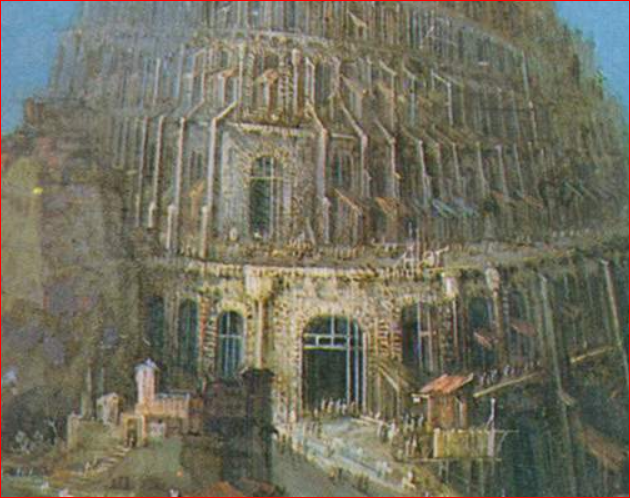
"Circle of Hendrick van Cleve III" is by Lucas van Valckenborch
De Vuyst, Belgium, sells on 22 October 2016 a "Circle of Hendrick van Cleve III" Tower of Babel, estimated at 6,000 to 9,000 Euro.
Hendrick van Cleve III is one the most prolific of the Flemish Babel painters, and in June I highlighted a huge work by or after him.
This Tower however is a "Circle of" or even "Attributed to" Lucas van Valckenborch, another of those Babel painters, since the work for sale is a copy or alternative version of a work I already displayed during the discussion of yet another Babel painting sale in March 2015 (many of these were made, but they are still popular and often wonderful to look at). This version can be found in the Museum of Strasbourg.


The one for sale now is much more detailed though, and much more precisely painted, which is unusual for a copy or for the work of a follower. The way the tower is constructed (e.g. the arches, the flying buttresses, ...) and the general look of the work are closer to another work attributed to the hardly known Lucas van Valckenborch II, from the Museum of Geneva.
It looks as if this work is either the original or much closer to the original, and that both the work from the Strasbourg Museum and the work from the Geneva Museum are copies after it. This is to me more likely than the reverse, that a very skilled copyist took elements from two paintings and created this new one. It thus seems to be a work from either Lucas van Valckenborch or his Workshop, and should be worth at least 20,000 Euro.
UPDATE: sold for 14,000 Euro, double the estimate, but if I'm right still a bargain.
Hendrick van Cleve III is one the most prolific of the Flemish Babel painters, and in June I highlighted a huge work by or after him.
This Tower however is a "Circle of" or even "Attributed to" Lucas van Valckenborch, another of those Babel painters, since the work for sale is a copy or alternative version of a work I already displayed during the discussion of yet another Babel painting sale in March 2015 (many of these were made, but they are still popular and often wonderful to look at). This version can be found in the Museum of Strasbourg.
The one for sale now is much more detailed though, and much more precisely painted, which is unusual for a copy or for the work of a follower. The way the tower is constructed (e.g. the arches, the flying buttresses, ...) and the general look of the work are closer to another work attributed to the hardly known Lucas van Valckenborch II, from the Museum of Geneva.
It looks as if this work is either the original or much closer to the original, and that both the work from the Strasbourg Museum and the work from the Geneva Museum are copies after it. This is to me more likely than the reverse, that a very skilled copyist took elements from two paintings and created this new one. It thus seems to be a work from either Lucas van Valckenborch or his Workshop, and should be worth at least 20,000 Euro.
UPDATE: sold for 14,000 Euro, double the estimate, but if I'm right still a bargain.
Monday, 19 September 2016
Not Marten but Frederik van Valckenborch
Ursula Nusser, from Germany, sells on 20 September 2016 an "Atributed to Martin van Valckenborch" Masked ball, estimated at 1,000 Euro.
This fairly unusual subject is absent from the works of Marten van Valckenborch, but is a few times painted by Frederic van Valckenborch though. He was the son of Marten and is not a very important painter, but this is an agreeable painting with an attractive estimate.
Most of his works feature more figures and life, but the style seems comparable. The above is from the RKD, from an art dealer in Oegstgeest, the Netherlands.
This fairly unusual subject is absent from the works of Marten van Valckenborch, but is a few times painted by Frederic van Valckenborch though. He was the son of Marten and is not a very important painter, but this is an agreeable painting with an attractive estimate.
Most of his works feature more figures and life, but the style seems comparable. The above is from the RKD, from an art dealer in Oegstgeest, the Netherlands.
Subscribe to:
Posts (Atom)