Dorotheum, from Austria, sells on 25 April 2017 a "Sebastiaan Vrancx" Month of November, estimated at 30,000 to 50,000 Euro.
This seems to be the cleaned version of an unattributed Vrancx I discussed in May 2016 which was then for sale with an estimate of 1,200 Euro and which I reckoned then should be worth 3,000 Euro. I don't know what that one fetched in the end, but the current estimate is way above that one.
In my original post, I showed the above two versions and specifically remarked upon the minor differences, like the boy not having an axe.
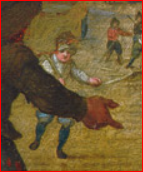
In the version for sale, the boy has an axe, and the arm of the man with the basket is no longer visible (dangerous things, these axes!). This matches now exactly the better version from my original post (even the cords hanging from his arm have miraculously multiplied). But every other detail in the work for sale seems to match the work I blogged about in 2016 (and not the better version I showed then as well), like the colour of the socks of the boy on the far left (grey instead of purple), the man with the sword walking away from us on the far right (grey-white instead of blue with yellow socks), the decoration of the house above his head (done more crudely in white, instead of the yellow stone colour), ... Even the craquelure, the damage to the glaze at the top (the clouds) is the same.
Underneath the arm of the boy with/without the axe, there is a particularly damning detail. In the "better" version from the previous blog, the boy continues on both sides of the arm (bottom image): but in the two versions for sale (then (top right) and now (top left)), we have the same very awkward shift between the upper torso and the legs, which simply don't fit.
Both also have an incorrect mention of "November" on the back, while the depiction is clearly of Spring (or April), with the fresh green on the trees and the erection of a Maypole.
The work for sale now is clearly worth more than my too cautious estimate of 3,000 Euro, but I have to wonder whether the significant changes are things which have been revealed when newer layers have been removed, or things which have been added by an enthusiastic "restorer" to make it look more like the "better" version? I hope it is the former, but my gut instinct tell me that it is the latter (at least the two nasty scratches, across the largest figure top to bottom, and left to right towards his left leg, have been repainted); but whoever wants to bid for this better first informs themselves of the actual restoration.
The actual value of this work depends on what happened to the work and how much the bidders know and care of course.
Showing posts with label Estimate. Show all posts
Tuesday, 11 April 2017
Monday, 26 September 2016
Former "Brueghel the Younger?" now for sale as "Brueghel the Younger"!
Dorotheum, from Vienna, Austria, sells on 18 October 2016 a "Pieter Brueghel II" Flemish proverb tondo, estimated at 180,000 to 220,000 Euro.
It is the same painting I highlighted in my 25 May 2016 post on an auction by Wannenes. It was then "Attributed to Pieter Brueghel (1564-1638)" and estimated at 1,600 to 1,800 Euro only. I discussed the painting and other examples of the same image (engraving, drawing) extensively, but didn't dare to conclude that it really was by Pieter Brueghel II (stating "it seems quite certain that the painting for sale is either by Brueghel II or more likely a direct copy after a painting by him". However, I indicated that the estimate was way too low in any case (even as an old copy), and said it "should be worth a lot more than the estimate, at least 10,000 Euro." I haven't been able to confirm it online yet, but a good source tells me it eventually was sold for 60,000 Euro.
Dorotheum, which doesn't seem to list any provenance, not even the Wannenes sale, had it expertised by Klaus Ertz, who is the current leading expert on Brueghel the Younger, and he has confirmed it as an original work by Brueghel (and also probably an original composition by him, not a copy after his father). It has also been reframed inbetween, the current frame looks more like the original probably. The work may also have been lightly cleaned, or the picture is simply somewhat lighter.
The auction catalogue offers a detailed description of the work and its origins, listing some other versions I hadn't found. It doesn't seem to list the above drawing from the Museum in Dresden though, which is somewhat strange. While I'm a bit disappointed that the one time I had the chance to discover a real Brueghel II, I was too cautious and didn't believ it wise to promote it to you as the real deal, I'm still glad that I did post about it and indicated the origins and qualities of it (and the way too low estimate of the original auction). Very curious to see what it will fetch now of course! The estimate seems cautious for a newly discovered Brueghel II original.
UPDATE: sold for 216,000 Euro, good estimate by the auction house, serious profit for the seller and a bit sour for the seller at the previous auction of course...
It is the same painting I highlighted in my 25 May 2016 post on an auction by Wannenes. It was then "Attributed to Pieter Brueghel (1564-1638)" and estimated at 1,600 to 1,800 Euro only. I discussed the painting and other examples of the same image (engraving, drawing) extensively, but didn't dare to conclude that it really was by Pieter Brueghel II (stating "it seems quite certain that the painting for sale is either by Brueghel II or more likely a direct copy after a painting by him". However, I indicated that the estimate was way too low in any case (even as an old copy), and said it "should be worth a lot more than the estimate, at least 10,000 Euro." I haven't been able to confirm it online yet, but a good source tells me it eventually was sold for 60,000 Euro.
Dorotheum, which doesn't seem to list any provenance, not even the Wannenes sale, had it expertised by Klaus Ertz, who is the current leading expert on Brueghel the Younger, and he has confirmed it as an original work by Brueghel (and also probably an original composition by him, not a copy after his father). It has also been reframed inbetween, the current frame looks more like the original probably. The work may also have been lightly cleaned, or the picture is simply somewhat lighter.
The auction catalogue offers a detailed description of the work and its origins, listing some other versions I hadn't found. It doesn't seem to list the above drawing from the Museum in Dresden though, which is somewhat strange. While I'm a bit disappointed that the one time I had the chance to discover a real Brueghel II, I was too cautious and didn't believ it wise to promote it to you as the real deal, I'm still glad that I did post about it and indicated the origins and qualities of it (and the way too low estimate of the original auction). Very curious to see what it will fetch now of course! The estimate seems cautious for a newly discovered Brueghel II original.
UPDATE: sold for 216,000 Euro, good estimate by the auction house, serious profit for the seller and a bit sour for the seller at the previous auction of course...
Monday, 5 September 2016
Third type of banquet by Frans Francken
Azur, from Cannes, France, sells on 21 October 2016 a "Circle of Frans Francken (17th century)" "Banquet scene", a large (111 by 160 cm) canvas, without an estimate.
It is one of the more distinct variations made by the Francken school of their banquet scenes. In a previous post, I indicated how they used the same composition for both a "Wedding at Cana" and a "Parable of the Wedding Banquet".
This one, with a somewhat different but clearly related composition, is another story, the "Banquet of Esther", also known in a lot of copies. The RKD lists versions in Olomouc (Frans Francken II), and at a Dorotheum sale in 2011 (after Francken II), but both are considerably smaller.
Another version is kept in the Musée Bertrand in Châteauroux.
The work for sale is of somewhat lesser quality than the others shown here, and somewhat changed in the details (the other three are remarkably close to one another), and is probably a slightly later work (Francken III or an anonymous copier). Considering its size, it should be worth about 3,000 Euro.
UPDATE: the auction house has since revised the description and added an estimate: it now is a "Follower of Frans Francken" "Feast of Esther" estimated at 2,000 to 3,000 Euro. Can't argue with that!
It is one of the more distinct variations made by the Francken school of their banquet scenes. In a previous post, I indicated how they used the same composition for both a "Wedding at Cana" and a "Parable of the Wedding Banquet".
This one, with a somewhat different but clearly related composition, is another story, the "Banquet of Esther", also known in a lot of copies. The RKD lists versions in Olomouc (Frans Francken II), and at a Dorotheum sale in 2011 (after Francken II), but both are considerably smaller.
Another version is kept in the Musée Bertrand in Châteauroux.
The work for sale is of somewhat lesser quality than the others shown here, and somewhat changed in the details (the other three are remarkably close to one another), and is probably a slightly later work (Francken III or an anonymous copier). Considering its size, it should be worth about 3,000 Euro.
UPDATE: the auction house has since revised the description and added an estimate: it now is a "Follower of Frans Francken" "Feast of Esther" estimated at 2,000 to 3,000 Euro. Can't argue with that!
Subscribe to:
Posts (Atom)