Dreweatts & Bloomsbury, from England, sell on 13 July 2016 a "Flemish School, 18th century" hunting still life, estimated at £2,000 to £3,000.
The frame bears a label for "Anton Grief 1670-1715. No such painter exists, but in older catalogues I can find the same name, and link it to Adriaen de Grijef (1657-1722), a nice example of the progress of the purely factual aspects of art history.
A real, comparable (though somewhat larger) De Grijef was sold at Christie's in 2012 for £11,250. The quality of that work is somewhat better than the one for sale now, but they are clearly from the same school.
Other examples, as can be found at RKD (which helpfully assembles all different methods of writing his name in one list, which e.g. a Google search can't do), also are very similar in their individual elements.
As a work from the School or Workshop of De Grijef, the estimate on this one seems somewhat conservative. The rather strange way the dog on the left is cut off by the frame suggests that this painting may have been cut down at some time in the past though, which makes it somewhat less attractive.
Wednesday, 6 July 2016
Monday, 4 July 2016
Painting reappears as "Spanish School", but still looks Dutch to me
Quite often I see a painting I discussed reappear at a later auction. I usually note this with an update in the original blog post only, but this one is more interesting.
Tradart, from France, sells on 17 July 2016 a painting that was sold in Brussels in February 2016. It then fetched 1,100 Euro and is now estimated at 1,000 to 1,500 Euro, so apparently the hopes for a profit didn't work out quite so well. The original auction gave no country of origin but a date of 1673: the new auction describes it as "Spanish" but only indicates 17th century. Was the date a later addition or do they hope to avoid people finding the earlier auction too easily?
To me it still looks Dutch, not Spanish at all, and most other examples I have noted with similar red and gold or silver undergarments usually were Dutch as well. Look at woman portraits from this period by Luttichuys, Terborch, Van der Helst, ... A few English and Italian paintings have a somewhat similar pose, but usually not with the kind of dress seen here. But no Spanish examples I'm aware of. I still believe it is worth a bit more than the estimate, but perhaps not with this description.
UPDATE: unsold, again for sale with same estimate and description at Tradart Deauville on 9 October 2016. A hard sell, this one.
The same auction also has an Italian Virgin and Child, which they first offered in April. I tweeted about it then: it is a simplified copy after Giampetrino. Still, at 1,200 to 1,500 Euro it offers good value for money.
Tradart, from France, sells on 17 July 2016 a painting that was sold in Brussels in February 2016. It then fetched 1,100 Euro and is now estimated at 1,000 to 1,500 Euro, so apparently the hopes for a profit didn't work out quite so well. The original auction gave no country of origin but a date of 1673: the new auction describes it as "Spanish" but only indicates 17th century. Was the date a later addition or do they hope to avoid people finding the earlier auction too easily?
To me it still looks Dutch, not Spanish at all, and most other examples I have noted with similar red and gold or silver undergarments usually were Dutch as well. Look at woman portraits from this period by Luttichuys, Terborch, Van der Helst, ... A few English and Italian paintings have a somewhat similar pose, but usually not with the kind of dress seen here. But no Spanish examples I'm aware of. I still believe it is worth a bit more than the estimate, but perhaps not with this description.
UPDATE: unsold, again for sale with same estimate and description at Tradart Deauville on 9 October 2016. A hard sell, this one.
The same auction also has an Italian Virgin and Child, which they first offered in April. I tweeted about it then: it is a simplified copy after Giampetrino. Still, at 1,200 to 1,500 Euro it offers good value for money.
Friday, 1 July 2016
How to turn a "Parable of the Wedding Banquet" into a "Wedding at Cana"
Neumeister, from Germany, sells on 6 July 2016 a "Parable of the Wedding banquet" by Simon de Vos and the Francken Workshop, estimated at 8,000 to 10,000 Euro.
Van Ham sold the above "Wedding at Cana" by Francken for 9,500 Euro.
So, what does one have to do? Change Christ to some king, and change the people in the garden to a man being dropped in a well. Add or remove some details at random, and you have a new painting with a new subject!
The one for sale now is in a worse condition than the Van Ham example. It is in parts by a different hand, but it's hard to tell which one is better.
This clearly better version is unlikely to hit the market soon as it is safe in the collection of the Hermitage. it is by Frans Francken II and may be the base composition all these other ones are copied from. The one for sale is one of the more original ones though, the Cana version is much more common than the Parable version.
Van Ham sold the above "Wedding at Cana" by Francken for 9,500 Euro.
So, what does one have to do? Change Christ to some king, and change the people in the garden to a man being dropped in a well. Add or remove some details at random, and you have a new painting with a new subject!
The one for sale now is in a worse condition than the Van Ham example. It is in parts by a different hand, but it's hard to tell which one is better.
This clearly better version is unlikely to hit the market soon as it is safe in the collection of the Hermitage. it is by Frans Francken II and may be the base composition all these other ones are copied from. The one for sale is one of the more original ones though, the Cana version is much more common than the Parable version.
Italian 16th c. pietà is copy after Carracci
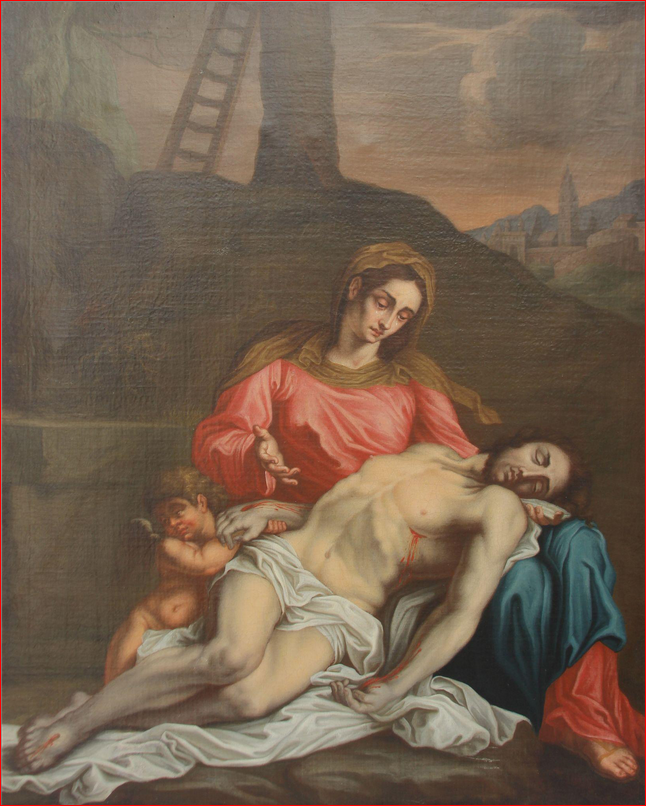
Neumeister, from Germany, sells on 6 July 2016 an "Italy, 2nd half 16th c." Pieta, estimated at 2,000 to 3,000 Euro.
It's a powerful painting, but dirty and damaged and perhaps painted somewhat simplistic. It looks later than the 16th c., I would guess 17th c.
Searching for an artist or origin, I came across art shop Rubylane.com, which sells an "18th c. Baroque" pieta with the same composition, but with differences (e.g. a putto instead of John the Baptist).
Both turn out to be adapted reversed copies of a Pietà by Annibale Carracci from ca. 1600, which makes it clear that auction dating is some 100 years (or more) off. The copies, reversed and with different colours, are likely based off an engraving and not from the original painting. Whether that makes it worth more or less than the estimate depends on how much you like it, it certainly won't be worth much more. I do wonder how much the Rubylane site charges for their copy though!
It's a powerful painting, but dirty and damaged and perhaps painted somewhat simplistic. It looks later than the 16th c., I would guess 17th c.
Searching for an artist or origin, I came across art shop Rubylane.com, which sells an "18th c. Baroque" pieta with the same composition, but with differences (e.g. a putto instead of John the Baptist).
Both turn out to be adapted reversed copies of a Pietà by Annibale Carracci from ca. 1600, which makes it clear that auction dating is some 100 years (or more) off. The copies, reversed and with different colours, are likely based off an engraving and not from the original painting. Whether that makes it worth more or less than the estimate depends on how much you like it, it certainly won't be worth much more. I do wonder how much the Rubylane site charges for their copy though!
Thursday, 30 June 2016
Summer's here!
Summer's here, so The Auction Augur will run on a reduced schedule. Fewer auctions, some periods where I don't have the time to check them or write about them, probably fewer interested readers as well (and this just when June broke my all-time pageview records again).
I'll try to post a few things anyway, and perhaps I may browse some of the art galleries and shops one can find online to search for interesting works there, in the same vein as what I did so far for auctions.
In any case, enjoy your summer and see you in September in full swing.
I'll try to post a few things anyway, and perhaps I may browse some of the art galleries and shops one can find online to search for interesting works there, in the same vein as what I did so far for auctions.
In any case, enjoy your summer and see you in September in full swing.
Wednesday, 29 June 2016
"17th century Spanish School" is altered copy after Van Dyck
Bearnes Hampton & Littlewood, from England, sell on 12 july 2016 a "Spanish School, 17th century" Armoured horseman, estimated at £300 to £500.
It is a copy (with variations) of the famous portrait of Charles I by Van Dyck. No idea why it is supposed to be Spanish, perhaps some romantic idea of Don Quixote playing in the mind of the auctioneer? The painting's not all bad, it starts of course from a brilliant composition, but with some basic cleaning a decorative work may appear. Nothing more than that though. Just somewhat unusual, also in its description, not valuable
Tuesday, 28 June 2016
Deciphering labels to identify sitters
Murray's, from the Isle of Man, sell on 2 July 2016 a "19th c. English" portrait of a woman, estimated at £350 to £500.
It has a number of papers stuck to the back, one barely readable letter and one paper identifying the sitter. The auctioneer has deciphered this paper as follows:
"Selina Dowager of Governor Passon of St. Helena and widow of General Lumsdaine, then wife of William Walker Rowley (b 1790, d 1873)"
The actual text, with some further research, seems to be:
"Selina, daughter (!) of Governor Patton (!) of St. Helena and widow of general Lumsdaine, then wife of William Walker Rowley (b 1790 (c), d. 1873).
Selina was the 9th daughter and 13th child (out of 10 daughters and 17 children) of Robert Patton (1743-1812), Governor of Saint Helena between 1800 and 1807. She was born 24 September 1793 in Scotland, and died in 1872 or 1873. In 1813 she married James Lunsdaine in India, but he died in 1816. William Walker Rowley was a clergyman, younger than Selina Patton (one site gives 1813 as his year of birth, but that seems too young), who survived her.
And there the trail ends. She apparently had no children, and no claims to fame. But she left behind a nice enough portrait, though the auction site photos seem to distort it significantly. Probably not worth more than the estimate, but better than many of those anonymous portraits at least.
It has a number of papers stuck to the back, one barely readable letter and one paper identifying the sitter. The auctioneer has deciphered this paper as follows:
"Selina Dowager of Governor Passon of St. Helena and widow of General Lumsdaine, then wife of William Walker Rowley (b 1790, d 1873)"
The actual text, with some further research, seems to be:
"Selina, daughter (!) of Governor Patton (!) of St. Helena and widow of general Lumsdaine, then wife of William Walker Rowley (b 1790 (c), d. 1873).
Selina was the 9th daughter and 13th child (out of 10 daughters and 17 children) of Robert Patton (1743-1812), Governor of Saint Helena between 1800 and 1807. She was born 24 September 1793 in Scotland, and died in 1872 or 1873. In 1813 she married James Lunsdaine in India, but he died in 1816. William Walker Rowley was a clergyman, younger than Selina Patton (one site gives 1813 as his year of birth, but that seems too young), who survived her.
And there the trail ends. She apparently had no children, and no claims to fame. But she left behind a nice enough portrait, though the auction site photos seem to distort it significantly. Probably not worth more than the estimate, but better than many of those anonymous portraits at least.
Subscribe to:
Posts (Atom)