Tuesday, 16 May 2017

"17th century school" is close to Cornelis van Poelenburgh

Cambi, from Italy, sells on 17 May 2017 a "School of the 17th century" landscape with nymphs and satyrs, estimated at 3,000 to 3,500 Euro.


It is a work from the School of Cornelis van Poelenburgh (1586-1667), who painted many similar vaguely mythological works with nymphs, satyrs, ... without a real story behind them.

Another (better) version of the same painting is given to van Poelenburgh (on Pinterest) with a date in the 1620s, but I know nothing more about it. The value depends on how close the work is to Van Poelenburgh, I would guess that it is not by him but by his studio or a close follower, and that the estimate is about right.

UPDATE: not sold

Thursday, 11 May 2017

"Pastoral village landscape" is unique view of Bruges

Dirk Soulis, from the United States, sells on 21 May 2017 a "Continental school pastoral village landscape", described as Flemish (Belgian or Dutch), dated 1841 and estimated at $800 to $1,200.

It is a view of Bruges. The unique belfry in the background wa easily recognisable, but the square church tower in the foreground was harder to identify. There are a few villages nearby with this type of  tower: located in the polders, the sub-sea level lands typical of this region of Flanders (and much of the Netherlands) where the winds can blow so hard that more traditional church towers didn't have a chance to survive.

However, none of these had a church resembling the one shown here, or were close enough to have this view. Further research revealed that this is actually the Saint Salvator, the cathedral of Bruges. It looks quite different now, but in 1839 (only five years after it was raised to a cathedral) it partially burned down, and the building of a new upper tower only started in 1843.

So this is a rare, high quality window on this short period of time when the tower was severely damaged, and makes it for anyone interested in the architectural history of Bruges and its cathedral really interesting. I haven't found other views of the cathedral in this period, but of course not everything can be found online.


It is even hard to find a picture of the cathedral and the belfry together today, since usually either the belfry is photographed, or the cathedral is photographed from the top of the belfry. There seem to be very few vantage points left where you can see both at once. Still, the above picture shows that the two buildings are indeed the same, and how the cathedral changed with the added (not really very beautiful) top.

I have no idea who the painter is, the only name I can think of that might perhaps be related is Auguste Vande Steene, a landscape painter from Bruges. But the estimate is really very low and I think for a Bruges collector (or one of the city museums) this may be an interesting opportunity.

UPDATE: sold for $725, seems cheap.

Wednesday, 10 May 2017

"Dutch School" is copy after English engraving

Doyle, from New York, sells on 24 May 2017 a "Dutch School, 17th century" Orpheus and the animals, estimated at $4,000 to $6,000.

While the topic has been treated multiple times by Dutch and Flemish artists, this version is probably British, as it is based on an English engraving from ca. 1650-1670, as can be seen at the British Museum website. The engraving is more detailed and richer than the painting, which lacks some elements (changed to the little stream left of Orpheus). As the painting is worse than the engraving, it is obvious that it is based on the engraving. It may well be early 18th century. The estimate is too high for this copy.

UPDATE: sold for $3,437, still seems like plenty for a good copy after an engraving.

UPDATE 2: For sale at Hargesheimer on 17 March 2018, with the description "DUTCH/FLEMISH SCHOOL Master, active in the second half of the 17th c" and estimated at 2,800€, which is still too much and which would mean a loss for the previous buyer anyway.

Tuesday, 9 May 2017

"German 17th century still life": after Georg Flegel, but how recent?

Bassenge, from Germany, sells on 26 May 2017 a "German, 17th century" Still life, estimated at 1,200 Euro.

It is a copy after works by Georg Flegel (1566-1638), the German version of Jan van Kessel (actually, Flegel was the older painter by far, so it would be more correct to describe Van Kessel as the Dutch version of Flegel). Multiple elements are copied almost literally (the frog on the coins, the wasp with the pearl ring, the snail ...) but in reverse.

A similar work by a follower of Flegel was sold at Lempertz in 2013 for 18,000 Euro against an 8,000 Euro estimate. The work for sale now is a lot worse though, an the estimate is probably about right, if this really is an old copy. I wonder though, with the reversion, whether it isn't a more recent attempt to make this copy after Flegel harder to detect? It is painted on metal, which again makes it harder to date, and it has the bee of the Lempertz one in reverse as well.

Monday, 8 May 2017

Grisaille annunciation

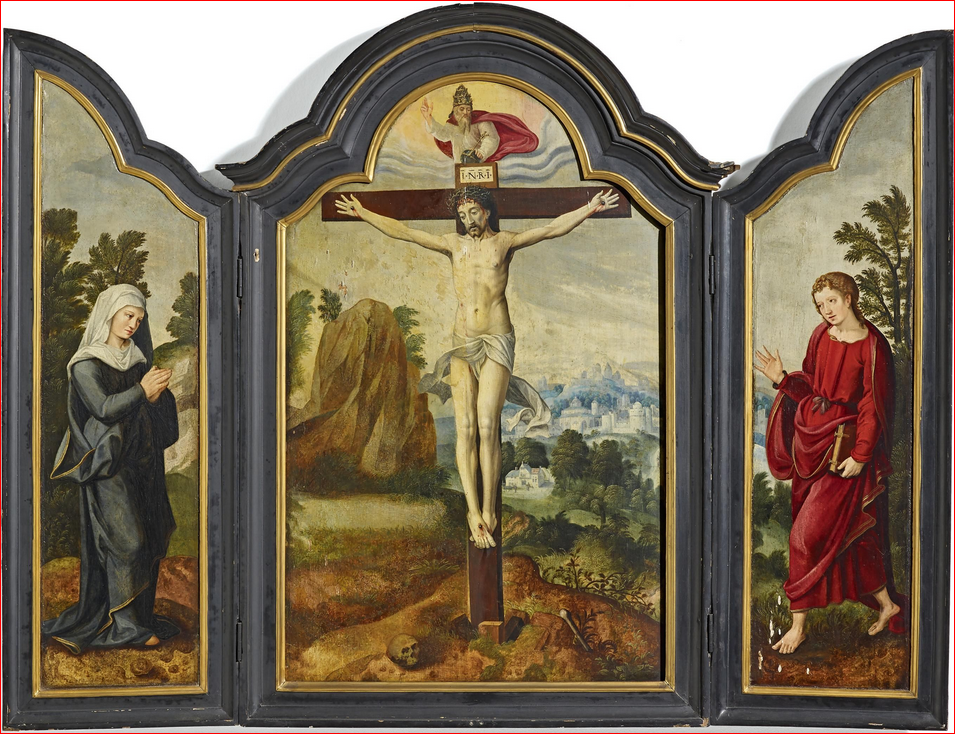
Van Ham, from Germany, sells on 19 May 2017 an "Antwerp Master, ca. 1520" crucifixion triptych estimated at 10,000 to 15,000 Euro.

It is a very nice, complete triptych, and what caught my eye were the reverse of the wings. They display an Annunciation in grisaille (or near-grisaille, flesh and hair are coloured but the remainder is black and white). Searching for "Flemish painting grisaille annunciation" gives only a few results, but these are from the very, very best 15th century painters. This of course is selection bias, you have much more chance to find works by the best known artists on the internet than works by lesser gods, but I have rarely seen this effect at work in such an extreme fashion.

The examples above are by Hans Memling (who also colours the flesh and hair), Hugo van der Goes, Gerard David (again coloured), and Van Eyck.

Of course, looking a bit further, e.g. at the RKD, reveals many other examples, some a lot closer to the one for sale, e.g. by Joos van Cleve, the Master of the Ursula Legend, or the Master of Frankfurt.

One of the closest to the one for sale is by Barend van Orley, from the Museums of Fine Arts of Belgium (here from the RKD, the link at the Museum gives a Bad Gateway error...). The central of the triptych here is a deposition: it is usual for these to contrast the annunciation on the outside with the death of Christ in some form on the inside. It is from ca. 1521 (so the same date), and also has the angel Gabriel barefooted and in a similar pose. The painting style of the work for sale is somewhat different though, so while perhaps Orley was an inspiration, he wasn't the author of this work.


Back to the actual work, the triptych of the crucifixion. It has a lot of resemblances to another anonym work which was, according to the RKD, earlier attributed to Van Orley as well. Once is coincidence, twice is something of a pattern. The position of the virgin, Christ, and especially Saint John, with his left feet front and outwards facing...

But in the end it will remain an anonymous work, from the circle of Van Orley but not by his studio. It is firmly rooted in the Flemish tradition, and especially the reverse of the wings is very well achieved. A complete triptych of reasonable proportions (probably intended for a smallish church or a castle chapel, not for more private devotion) in good condition is becoming rare on the market, and this is reflected in the estimate, which seems reasonable.

UPDATE: sold for 10,000 Euro.

Thursday, 4 May 2017

Interesting German predella

Van Ham, from Germany, sells on 19 May 2017 a "Southern Germany, ca. 1500" Christ and the Apostles, estimated at 10,000 to 15,000 Euro.

It is a predella (the rectangular bit beneath a triptych or polyptych, a relatively rare element either because many have been lost or because many polyptychs didn't have one to start with). This specific type seems to be typical for the region and period, just like at other times you can find realistic depictions of the dead Christ there.


They all share some characteristics, with the same nearly Byzantine look, the apostles with their attributes (like Saint John the Apostle putting a miniature snake in a glass), the same position along a table (the depiction is closely related to that of the Last Supper, but is more a depiction of the main characters than the depiction of a story, a moment in time).

One example comes from Bernhard Strigel (1461-1528), main painter of the Swabian School (Swabia meaning South-West Germany). It was for sale at Christie's in 2016 but apparently remained unsold.

Another example (for which I only have this poor picture) is now housed in a museum in Warsaw.

 
The Cincinnati Art Museum also has one, which according to the RKD should be placed in the circle of the Master of the Bartolomew Altar.

A final anonymous but very good example is housed in Russia (picture via GettyImages, hence the annoying text on the image).

It would be wonderful to find the triptych to which this work belonged, or to be able to put a name to the artist. Still, it is an interesting example of a shortlived type of work of which only a few examples have survived.

UPDATE: sold for 10,000 Euro.

Wednesday, 3 May 2017

Antwerp Master, ca. 1500 "Virgin and Child" at Van Ham: Master of the Gold Brocade

Van Ham, from Germany, sells on 19 May 2017 an "Antwerp Master, ca. 1500" Virgin and Child against a gold background, a private devotional panel (31 by 21 cm) estimated at 14,000 to 18,000 Euro.

It is a composition which appears in many minor variations and by many, mostly anonymous hands around 1480, and which has fetched remarkable prices at auction sometimes.

The original or at least most commonly known and probably best version of the composition is by Quinten Massys (1466-1530), although the actual original is considered to be lost.

Christie's sold this rather weak or dubious version, attributed to "Studio of Metsys", for $31,000 in 2015.

Sotheby's attributes the composition to Joos van Cleve (1485-1540) instead. This nice version from his circle sold for $100,000 in 2013.

This composition was also used by the Master of the Parrots.

Another version, closer to the one for sale, was offered at Koller in 2014 and sold for about 40,000 Euro. This one was attributed to the Master of the Brocade Background (active 1480-1500). While it is slightly better, and slightly older, it is very close to the one for sale in most aspects, although the hands and the heads are somewhat different.
It is now, after restoration, for sale at Mullany. The restoration has made the difference in quality with the work at auction now much clearer.


The painting for sale seems to be a copy after another work "After the Master of the Brocade", which can be seen at RKD and was sold in 1938.

Works from the Brocade Master often used such a calligraphic border and a golden background. A similar work by the Master fetched £37,000 at Christie's in 2009.

Depending on whether you think the work for sale is a work by or after the Master of the Brocade, the value of it will vary. To me, it seems somewhat too weak, too stiff, and it looks more like a "follower" or "circle" work. It should be worth around the estimate in that case.

UPDATE: not sold.