Tuesday, 21 June 2016

Another version of a Francken II I discussed before

Galateau, from France, sells on 3 July 2016 a "Workshop of Frans Francken" Preaching of John the Baptist, estimated at 3,000 to 4,000 Euro.

It is a seriously damaged (the wood has warped, causing the big crack in the middle and making ot very hard to properly frame this I guess) version of a work I already discussed in December 2015. It shows again the standard Francken composition, but is more detailed and has better colours. Seen up close it still is a rather mediocre copy though, and may struggle to get the estimated price. But it is nice to see another version of this less common Francken work (compared to some other works from their studios with dozens of copies).

"Attributed to Marten van Cleve" is copy after Maerten de Vos

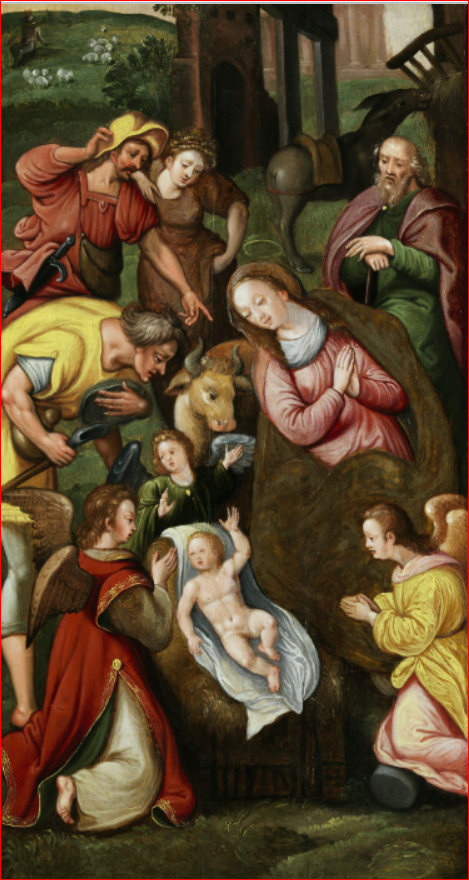
Hampel, from Germany, sells on 30 June 2016 an "Attributed to Marten van Cleve" Adoration of the Shepherds, estimated at 16,000 to 18,000 Euro.

The RKD lists another version of the same composition, this time said to be "After Maerten de Vos", which is of much higher quality than the one for sale, despite being much smaller (15 by 10 cm only!, vs. 92 by 49). That work is half of a diptych together with a "Carrying of the Cross" (als pictured above).

The work for sale is a rather awkward copy and not worth the estimate by a wide margin. It can at best be described as by a Follower of Cleve.

Monday, 20 June 2016

"Flemish School follower of Ryckaert" seems closer to Jacob Grimmer

Ader, from France, sells on 24 June 2016 a "Flemish School, follower of Marten Ryckaert" "The sower", estimated at 2,000 to 3,000 Euro.

It is another work depicting the Parable of the Pares, which I discussed  in a few posts like this one from March 2015. It even shows the same two-handed sowing, which is probably symbolic and differs from the standard one-handed technique usually seen. The clothing of the Devil also is very similar (the cap, and the long coat ending in a tail)

The RKD lists a very similar work by Jacob Grimmer, but it is about 100 years older than the date given by Ader.

They also list one version of the same story by Marten Ryckaert, but this is a lot less similar to the work for sale than the Grimmer when looking at the composition. Details like the way the tree is painted are more Ryckaert-like though.

In general, the work seems to old to be by a follower of Ryckaert, and looks to me more like a late 16th century work. It should easily fetch the estimate.

Master of the Prodigal Son or Antoon Claissens? In any case, a partial copy after Bronzino

Ader, from France, sells on 24 June 2016 an "Antwerp School, follower of the Master of the Prodigal Son" Passing of the Red Sea, estimated at 3,000 to 5,000 Euro.

It was sold at Christie's New York in 1996 for $10,000 (!), and was then described as Circle of Antoon Claeissens. While the old attribution is listed at the Ader sale, the Christie's provenance isn't. It seems that giving proper provenance happens less and less at auctions, even when it is about a sale of 20 years ago (not some very recent one where they try to avoid price comparisons).

Whether it is by someone from the circle of Claeissens or the Master of the Prodigal Son, what apparently hasn't been noticed is that the work is at least in part copied from a work by Angelo Bronzino from ca. 1540 from the Palazzo Vecchio.


The lower right corner (or about half the painting) is clearly deroved straight from the Bronzino, but with a lot of alterations. It doesn't seem to be based on an engraving, but probably made after copies (made during an Italian trip?). It is interesting to see how the Italian work is adapted and how such Renaissance works influenced Flemish paintings.

The work is known from engravings though, like the above anonymous one (published by Hieronymus Cock and found at the Rijksmuseum). So it can't be ruled out that the influence came indirectly.

As a copy, it is harder to identify the artist; the composition can't be used to determine who may have painted it. The style is a bit more Master of the Prodigal Son than Claeissens, but I'll not risk a guess any further.It should be worth the estimate, but probably not more, unless you try to track the influence of Italian art on Flemish painting in the 16th century.

Friday, 17 June 2016

"Flemish, 17th century" is a French portrait of a princess by the circle of Claude Deruet or Daniel Dumonstier

Dresden auctions, from Germany, sells on 18 June 2016 (tomorrow!) a "Flemish 17th century" portrait of "La Princesse deguimene", dated 1633, estimated at 1,200 Euro.

It is a French portrait of Anne de Rohan, princess of Guéméné (1606-1685, so about 27 years old at the time of the painting), an important figure in France at the time (her son was the child companion of the young Louis XIV, but he would be decapitated in 1674 for conspiring to murder the same Louis XIV). Not that many portraits of her are known, so this is historically speaking an important work. The above engraving seems to be at a later age, and these French idealized portraits are hard to match with a real portrait in any case.

But also from an artistic point of view is this an interesting piece, which firs perfectly in a certain French portrait style of the period (near the end of the style, to be exact). The main painters of this type are the Dumonstier family (Daniel and the others), but also painters like Charles Beaubrun. The above paintings are attributed to (top to bottom) Circle of Daniel Dumonstier, ca. 1630; Charles Beaubrun (clearly inferior, but not the best Beaubrun either); and Claude Deruet (probably closest to the one for sale here).

I would call the one for sale "Circle of Claude Deruet". It is badly damaged, although much of it (certainly in the face) can be restored, ut I think it is worth about 2,000 Euro (as the sitter is known and the face is less formulized then in many of these), the value of unknown sitter portraits of this type is lower unless they are exceptionally well painted).

Thursday, 16 June 2016

"Nice antique religious painting" is copy after Jan Gossaert

De Wit, from Oostende in Belgium, sells a "Nice antique religious painting" (lot 743), a small oil on copper (23 by 16) estimated at 100 to 200 Euro.

It is a version of one of the most copied paintings by Jan Gossaert, "Christ on the Cold Stone"or Christ as the Man of Sorrow. The above version, from the Museum of Krakow, may be the original. The one for sale clearly doesn't match the quality of that one (even from the very small picture on the auction website), but is of reasonable quality and very cheap at that. Other versions have sold for 720 Euro (a weaker version at Christie's, 2005) to 6,500 Euro (a better version, Cologne, 2011). The one for sale here is probably worth around 1,000 Euro, no fortune, but always nice to find such an old work in an auction which doesn't know or care much about old paintings.

Wednesday, 15 June 2016

"Venus Anadyomene": an important Carlo Carrà work?

Blank (yeah, that really is the name), an auction house from Germany, sells on 25 June 2016 a "twice signed, "Old. Konicek" dated 1922 and "C.Carrà"" Venus Anadyomene in front of the Bay of Kotor (Croatia), a 114 by 100cm canvas estimated at 5,000 Euro.

Carlo Carrà  (1881-1961) was an Italian Futurist (one of the original signatories of the Futurist Manifesto!) who then became a Surrealist (and also, sadly, a fanatical fascist). As a surrealist, he developed the Italian version of it together with Giorgi de Chirico. But this ended around 1920, and he then turned to landscapes and many other forms of painting. All this makes him one of the most important Italian painters of the early 20th century, but in general his later works are less interesting. 1922 would be on the cusp of these periods.

Oldřich Koníček (1886-1932) was a Czech painter who worked in Italy from 1919 on. Although also a respected modernist painter (mainly influenced by Fauvism), he is much less well-known (and important) than Carrà.

It looks to me as if the work for sale is a painting by Carrà made in 1922 when he visited Koníček in Croatia. The signature seems to be a "who (Carra), where (at Konicek) and when (1922)" signature, not an indication that the two collaborated or that one of the two signatures is fake. Koníček has painted the exact same view of the Bay of Kotor in 1916, so we know that he has stayed there. The above work was sold at Dorotheum 2 weeks ago for about 1650 Euro.

The painting for sale is way too ambitious for Konicek, but would fit the late Surrealist work of Carra quite good, even though the end result is a one-off, not really comparable to any other finished work I could find. If this was painted during a stay abroad, with an old friend (not that I have found any evidence otherwise that the two knew each other, but it certainly is quite possible as we know that Konicek stayed in Italy for a while), then it may have been the perfect time for some experimentation, something new and different which still fits well into his oeuvre and style.


It is hard to find the right images to convince people of this at a glance. In 1909 he painted as a pointillist, a year later he painted as a life-long cubist; from 1915 on his works resemble those of De Chirico. The man was a chameleon, although a very early one usually. The above paintings are from 1919-1921.


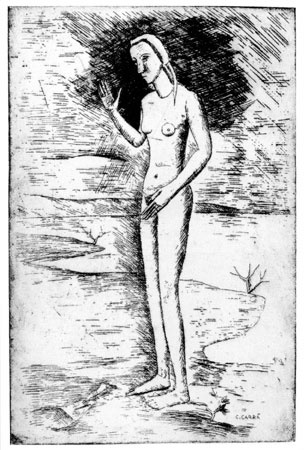
He painted a Venus Anadyomene II in 1944, so there certainly was one earlier than that. And in 1923 he made an engraving of a Venus in  kind of intermediate position between the two paintings (but in quite a different style again).

If it is an original Carra, then this is an important work and should be worth at least 50,000 Euro instead of the estimated 5,000 Euro. But it will take experts much more familiar with the life and work of Carra to determine whether the above scenario is realistic, or whether this signature is only added to dupe people like me.