Thursday, 19 September 2019

Nice auction at Neumeister, including a Brueghel the Younger which is a Grimmer instead

Neumeister, from Germany, sells on 25 September 2019 a fine collection of Old Master paintings.

Lot 94 is an "Antwerp, Early 16th century" Man of Sorrows (or Christ and the Instruments of the Passion), estimated at 4,000 to 6,000 Euro. It is painted by an accomplished artist, even though it may be based on an engraving (though I haven't found one with this composition).

On the middle left, next to his shoulder, I think I have found a monogram, "PA". It is cleverly hidden in the decoration, but as these are the only letters anywhere, and they clearly aren't "PAX" or some such, I wonder if they may be a monogram for the artist? But it doesn't really look like Pieter Aertsen I think, and I doubt that Pieter Coecke van Aelst would use PA. Others may have a better idea (e.g. the way the flesh of the left arm is painted seems to be very artist-specific). It should easily sell at the estimate, and may go a lot higher if some people have an idea of the actual artist.


Lot 109, Saint Paul with the viper by "Dutch school, 17th century" (est. 2,500 to 3,000 Euro) is a copy after an engraving by Harmen Jansz Muller from ca. 1590, after a design by Dirck Barendsz, as found at the Rijksmuseum site. Considering that the charm of the painting is all derived from the composition of the engraving, and the actual artistic merits of the painting are very small, it might struggle to reach the estimate.

Lot 119 is the most interesting of these, a "Workshop of Pieter Brueghel the Younger" allegory of Spring, estimated at 25,000 to 30,000 Euro.

Other versions of this work are known, and in 2013 one was sold at Sotheby's for $2,285,000!

A full set of the four seasons was sold at Christie's in 2016 for £6,466,500.

But the description of that version brings the cat out of the bag: the one for sale here is most likely not from the workshop of Pieter Brueghel the Younger, but from the workshop of Abel Grimmer. The Brueghel versions all have some characteristics not found in the Grimmer ones, and vice versa.

Private collection


In the Brueghel ones, you can see that they are planting flowers, there are two sheep close to the river, and there is a row of houses across the river.

The Grimmer ones, on the other hand, follow the original engraving after Pieter Brueghel the Elder much closer. This was made in 1570 by Pieter Van der Heyden (example from the Met Museum).


A signed 1607 copy (i.e. older than the Pieter Brueghel the Younger versions) is kept in the Royal Museum of Fine Arts in Antwerp (together with the remainder of the series). It is clearly a lot closer to the one for sale than the Brueghel ones: no flowers are planted, no loose sheep, but on the other hand you get a small boat on the water, the houses behind the river are replaced with some stand, the gate behind the workers (smack in the middle of the painting) is longer to the left, the large pigeon tower isn't red at the bottom but yellowish white, ...

A full set of the four seasons by Grimmer was sold at Lempertz in 2018 for 285,000 Euro. This one seems to be a bit further removed from the original, as some details become weird or are missing (the boat on the river, which will pass the stand in some festive manner, is replaced with a swan; the shovel in the front gets a strange angle; the pigeon tower becomes a generic tower...) suggesting that this may be the work of a follower of Grimmer and not directly a work by Grimmer; the work for sale seems closer to his original though.

As such, I would estimate it at 50,000 Euro.

UPDATE: The Man of Sorrows sold for a very nice 35,560€, the Saint Paul for 2858€, and the Grimmer for 120,650€, impressive!


Thursday, 12 September 2019

The missing link

Arcimboldo, from Czechia, sells in a very interesting Old Master auction on 14 September a "Flemish School, 17th century" Still life, estimated at 4,000 Euro.

The work is the "missing link" between a work by Jan Davidsz de Heem from the Städel Gallery, and a "follower of de Heem" sold at Christie's in 1996 (through RKD).

The work is very close in composition to the Christie's one, but of much better quality. Sadly, it isn't good enough to be by De Heem probably, but at 4,000 Euro it is still reasonably cheap.


By the way, the first lot in the auction, a "Circle of Dürer" resurrection at 16,000 Euro, is closely based on the Dürer woodcut from the "Small Passion" series. They hinted at this with their "circle of" statement, but I prefer it when auction houses simply state flat-out if a composition is so closely based on a famous existing one.

Wednesday, 11 September 2019

"Late 17th century French School" looks like a follower of the Master of the Parrot

Conan (the Barbarian?), from France, sells on 14 September 2019 a "French School, late 17th century" triptych of the Holy Family, estimated at 8,000 to 10,000 Euro.

The work has no elements as far as I can see which would date it so late, or which would make it French: it looks to be painted by a follower of the Master of the Parrots (or of the two stylistically closely related other masters, the Master of the Female Half Lengths and the Master of the Prodigal Son).

The origin of the composition seems to be a work by Joos van Cleve (via RKD). The version here is likely a third-hand version, after a work by the Master of the Parrot.

Comparable work by the Master of the Female Half-Lengths

Value of this work should be around 3,000 Euro, not the estimated 8,000. 

UPDATE: the work is on 30 January 2021 again for sale, with Berard et Peron in Lyon. The description is even further off, now it is said to be a Florentine School, 16th century! The estimate of 4,500 to 5,000 Euro is at least more realistic.


Friday, 30 August 2019

Two versions of same composition, one Bruges, one South Germany?

Lempertz, from Germany, sells on 20 September 2019 a "Probably South German master, 16th century" Holy Kinship, estimated at 6,000 to 8,000 Euro.

While there are many somewhat similar works with this subject, sharing some aspects with the one here, I could only find one other work with nearly the same composition. Strangely enough, the execution of that one is quite different, and it was described at the auction in 2005 as "Circle of Anthuenis Claeissins", referring to the Bruges painter Antonis Claeissens (1536-1613). I found that one through Artnet, and I have no idea of which auction house, estimate or result. They also only offer a relatively small image, which is too bad, but beggars can't be choosers I suppose.

The two paintings may look quite different at first sight, but too many details are the same to be a coincidence.


At the bottom left, we have Saint John the Apostle and Saint James the Great, with their mother Salomé. In both cases, Salomé has very similar headgear and mantle, the same position with the slightly opened book in one had and the other around the standing Jacob, and John sitting at her knees and reading.


The top left shows 6 important Biblical figures (plus a child), including Joseph, Salomon, and Zebedeus. The order and placement of the figures is identical, with e.g. Joseph standing with his hands on the balcony on either side of the head of Mary, Zebedeus on the left pointing to his wife Salome, or the two women directly to the right of Zebedeus, with the baby and the same headgear. As in all these comparisons, it will also be clear that the colours vary wildly, and that postures and details are sometimes very similar, and at other times completely at odds.


In the centre we get Mary and her mother Anna, and Jesus between them.These are less similar, but some details like the dress and headdress of Anna (and the way it falls over her shoulders), the hand in the open book, all point to the same origin.


At the top right we see six further figures (again with an extra child, John the Baptist), with Elizabeth, Simeon, Cleophas, and others. The three left-most figures, Salomon (labeled (Salomé in the painting), Simeon, and Joachim, have the same position and gestures, but by mistake has the bishops hat of Zacharias been given to Simeon in the Claeissens version (or vice versa). The figures on the right are less similar, although they are placed in the same order and e.g. the rightmost one, Alphaeus, points to his wife Mary in both examples.


The bottom right has Mary Alphaeus, and 4 children; James (the son of Alpheus), Simeon (probably Simon the Zealot or Simeon of Jerusalem), Barnabas, and Judas Thaddeus. Striking similarities include the headdress of Mary, the position of all 5 figures (with Judas Thaddeus half kneeling, his head turned, one hand stretched out towards Jesus, and the other holding a basket; and Simeon and Barnabas together reading a book).

All in all, these similarities can not possibly be a coincidence, and point to a common origin for these two works. However, the clear differences seem to indicate that their have to have been intermediate versions, not one common origin (like an engraving), but e.g. two different drawings after some common work, which then formed the basis for these two paintings.

I haven't found a trace of these possible other (better) versions of this composition, nor of a possible original artist. Any and all information is welcome!


Wednesday, 28 August 2019

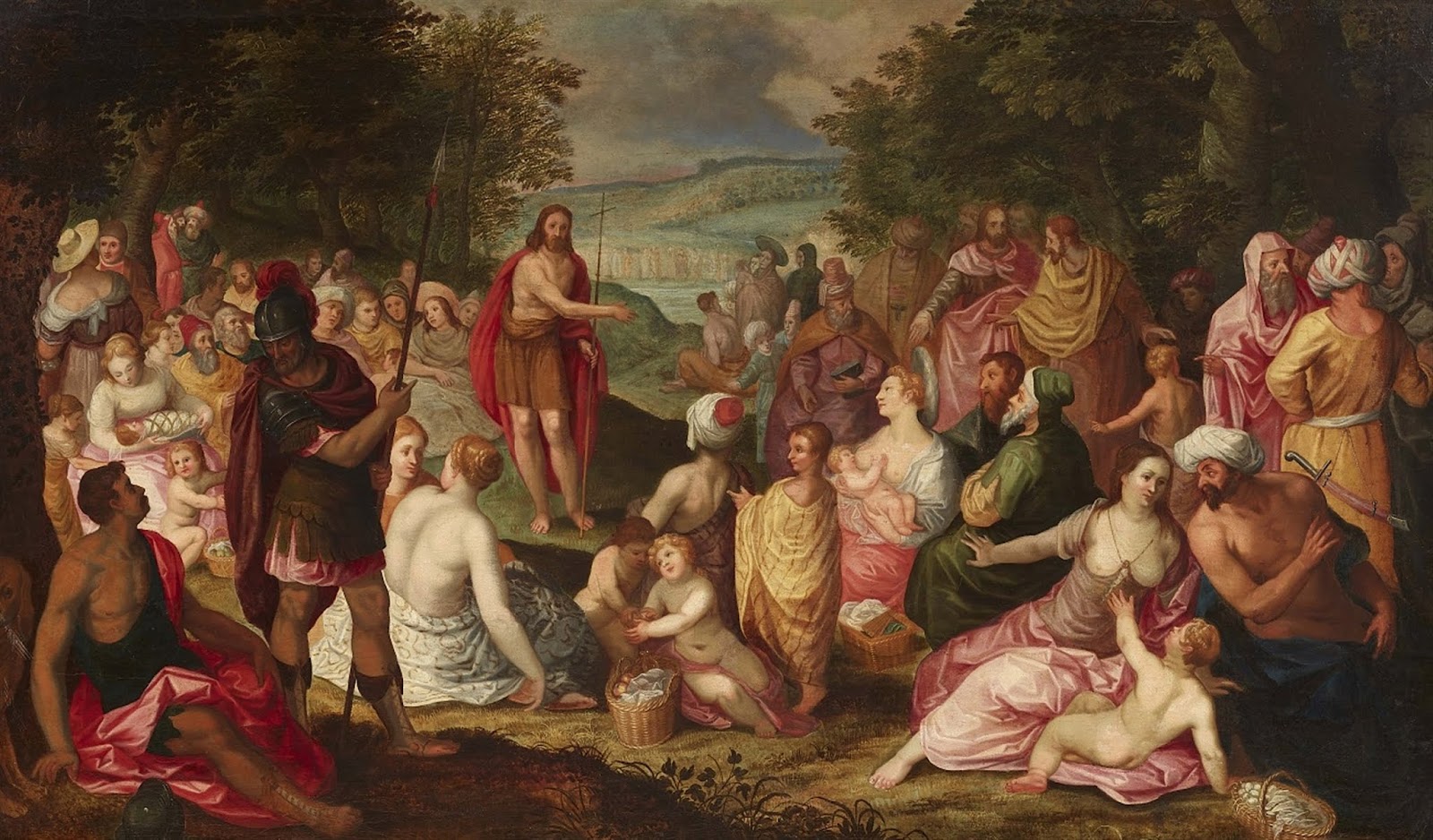
"Probably early 17th century Antwerp Master" is Workshop of Hendrick van Balen

Lempertz, from Germany, sells on 20 September 2019 a "Probably Antwerp master, early 17th century" John the Baptist preaching, estimated at 8,000 to 10,000 Euro.

It is a copy after a work by Hendrick van Balen, a version of which was sold at Christie's in 2018 for £200,000. The one for sale, though still very good, is clearly inferior when looking at the detailing, but may be good enough to be called a Workshop version perhaps, or otherwise a School of or Follower of version.

The strange thing is that while for this lot 3, Lempertz didn't find the link with Van Balen, their very next lot is catalogued as a "follower of Hendrick van Balen" with an estimate of 10,000 to 12,000 Euro. This is indeed supported by a similar work at the RKD which was listed as by Hendrick van Balen: if that version was by him, it has to be one of his very last works, as it is unsigned but dated 1632.

I personally like the first lot more than the second one, and would estimate it slightly higher, basically reversing the two estimations.

Thursday, 22 August 2019

"Follower of Brueghel" in 2018, "attributed to Jakob Grimmer" now, but still a copy after Hans Bol

Hargesheimer, from Germany, sells on 14 September 2019 an "attributed to Jakob Grimmer" "Parable of the Sower", estimated at 30,000 Euro.

The same work was for sale last year at Saarbrûcken, as a "follower of Brueghel", for 900 Euro. I then wrote a blog post about it, explaining that it is not the Parable of the Sower but the Parable of the Tares (the Sower is about indiscriminately sowing and includes no devil or sleeping men, the Tares is about "But while men slept, his enemy came and sowed tares among the wheat, and went his way.", and the "enemy" is later explained to be the Devil).

More importantly, I showed that the work is a copy after an engraving by Hans Bol from 1574. It seems unlikely that Jakob Grimmer would have copied this engraving, and the work is not good enough to be by him either (e.g. the cloudscapes by Grimmer are one of the best parts of his work in many cases, but here the sky is rather boring). While Grimmer sometimes has rather simplistic work, they still show a lot more skill than this copy. The estimate here seems way too high.

This isn't the only seriously overestimated work in this auction though.

This "Workshop or School of Rubens" Magdalene was already overpriced at Hampel in 2017 (15,000 Euro, no sale), and is still overpriced here at 12,000 Euro. It looks good on their website at first glance (with the rather small default image Hargesheimer provides), but when seen more closely, it becomes obvious that it is a poor later copy, as indicated by the Lartsite as well (scroll down to number 11). Worth 3,000 to 5,000 Euro perhaps?

They also have a "Frans Hals (workshop?)" boy with a flute, estimated at 5,000 Euro. It is a very poor copy after Hals (or at least after a follower of Hals, much better example thanks to the RKD). Worth 500 Euro instead? The same applies to another similar "Hals" estimated at 4,000 Euro.

I also seriously doubt that Rembrandt made this rather poor drawing in 1636 for his 1654 etching of "Jesus between his parents returning from the Temple" (and not a "flight into Egypt"), but if it was by Rembrandt, 3,500 Euro would be cheap.

I haven't looked in detail at all the works yet: there are many paintings with a very affordable estimate, and it may well be that there are some bargains among these. But there were very few works among the more expensive ones which seemed to be worth their estimate.

Wednesday, 21 August 2019

Leemans Brothers

Galerie Moderne, from Belgium, sells on 9 September 2019 an "anonymous, 17th century" "Dog in a landscape", estimated at 2,000 to 3,000 Euro.

The painting isn't terribly well executed, but has some rather intriguing elements in it. It turns out to be a collection of bird hunting equipment. More importantly, some of the exact same elements can be found on better works, giving us a name and period for this work as well.


The largest, horizontal bird cage can be seen nearly identical in works by Johannes Leemans (1633-1688), a painter of trompe-l'oeils with hunting papaphernalia. One of those was sold at Christie's in 2009 for 49,000 Euro. A very similar one is in the collection of the Museum of Fine Arts in Brussels.

Another one with a very similar cage (and especially the cloth on top) also has the same bag (or whatever it is) below it. This one was sold at Sotheby's in 2001 for £14,000, not as the work of Johannes Leemans but by his slightly older brother Anthonie Leemans (1631-1673). Even the position of the bag in front of the cage, and the horizontal "arrows"(?) behind it, are nearly the same, and some other more mysterious elements are comparable as well.

The main differences are that the painting for sale is in much worse condition, and seems to have been painted by a follower of the Leemanses, not directly by either of the two brothers. As a "follower of Anthonie Leemans", it should be worth the estimate, if you can find a bidder willing to look past the damage.

As an aside, I wonder at the business model of such one-trick ponies as the two Leemanses. They were competent painters, and the produced quite a few of these works: but if you only sell one product, and the taste or fashion changes, then you suddenly are very vulnerable. It's bad enough if your style gets outdated by new painters, but if you then only have one subject, and basically just one composition (like Johannes here), then it may get hard to scrape a living from these.

UPDATE: unsold, again for sale on 20 January 2020 at Galerie Moderne with a very reasonable 1,000 Euro estimate.