Showing posts with label Wannenes. Show all posts

Tuesday, 28 November 2017

Wannenes 29 November 2017 part 5: quick messages

A final post with some leftovers from the series on the 29 November 2017 Wannenes auction, as I don't have the time to write or research more on these.

First is a "Seventeenth century Dutch painter" which was previously attributed to Frans Pourbus the Elder. I think it is closer to Frans Pourbus the Younger. Estimate is only 600 to 800 Euro, so a bargain!


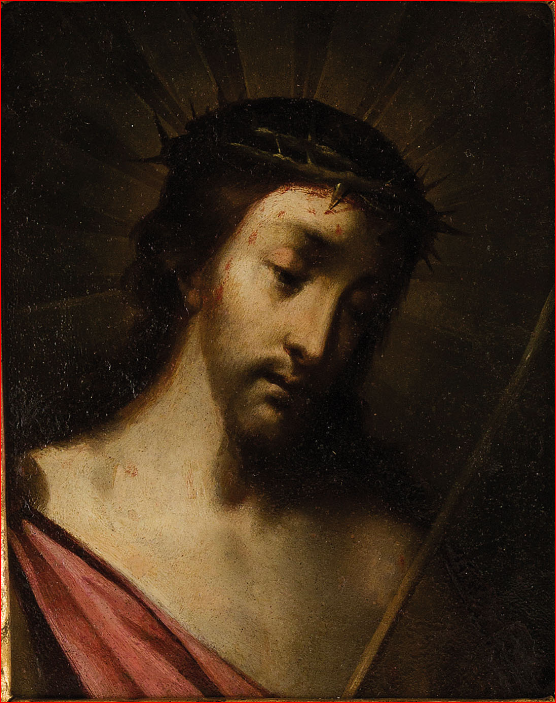
The last painting that caught me eye was a "16th-17th century Flemish painter" Ecce Homo, estimated at only 200 to 500 Euro. It has a spectacular frame (looks like marble but seems to be in wood), and a decent painting in it.

 It looks to me more similar to Spanish examples, a follower of  Murillo perhaps. But it seems cheap with such a frame.

Wannenes 29 November 2017 part 4: Spanish or German?

Wannenes, from Italy, sells on 29 Noveùber 2017 a nice collection of Old Masters.


Lots 928 and 928 clearly belong together, but have been separated here presumably for the first time in 500 years, which is a pity. Perhaps the same buyer will acquire them both.

The auction house describes them as "Painter of the 15th-16th century" with estimates of 50,000 to 70,000 Euro each. They are said to be parts of a polyptych (presumably from the predella), and to have a Mediterranean character (Spanish + Provence) with Flemish influences. They were originally attributed to Bartolomé Bermejo (1440-1501, Spain), who is not to be confused with Bartolomé de Cardénas (1575-1628), a Portuguese painter. Wannenes sees a Catalan or Valencian origin for these paintings.

Bermejo is clearly influenced by Flemish art of his period, and is a very good painter, but I don't see the match with the paintings for sale at all. His "Santa Engracia" shows of course that it is from the same period, but is much more restrained, static, "Flemish" than the works for sale, which are more exuberant, lively, caricatural, "German" (I'm using Flemish and German here to describe their art from the late 15th century).

I wouldn't place the paintings in a Hispano-Flemish or southern Mediterranean circle, but in a German or perhaps Northern Italian one. Looking for matches there gave me two names.


The more general influence, and evidence of the link with German painting, is with an engraving by Martin Schongauer (1445-1491), the most important German (or French-German) engraver of his period, before Dürer came along. His "Christ carrying the corss" ha multiple elements which are clearly similar to the same work here. The most obvious one is the horse on the extreme left (engraving) vs the one of the right (painting): a neraly exact mirror (even the position of the rider), apart from the tail which points in the same direction.


The "Garden of Gethsemane" is nearly identical to a fresco by Giovanni Canavesio (ca. 1450-1500), a painter from Piedmont, whose main work is a fresco cycle of the Passion of Christ in La Brigue, a French village very close to Italy (and actually a part of Italy until 1947), but who is also known from panel painting and miniatures. Most of his work was done in this Northwestern corner of Italy. The artists are not the same, clearly, but either the two works have inspired one another directly, or they have some common ancestor. The soldiers coming from the top left behind the wall, entering through the gate: the angel on the top right holding the cup, the figure of Christ, with the way his cape is draped... It all seems a bit too much to only see a coincidence in this.

The two works (which, like I said, should really stay together) are beautiful and worthy of much more attention to find out their origin or even the artist; but to me they seem both visually and considering the influences I found, to be most likely German (or perhaps Austrian or North Italian), not Spanish. Doesn't really change the value probably.


Wannenes 29 November 2017 part 3: women portraits

Wannenes, from Italy, has an interesting auction on 29 November 2017.

A 17th century miniature of Elizabeth I, estimated at 500 to 800 Euro, is quite good. I can find the necklace in other miniatures, but the dress and the crown (or whatever you wuold call such a head decoration) are distinct from what I can find online in other portraits. It is unsigned, and probably not good enough to be by Nicholas Hilliard, but it still is a fine old miniature (no idea why they consider it 17th century and not 16th century), and I could see it fetch 1,000€ or more.


More intriguing is a "Female figure" by Ambrosius Benson, estimated at 9,000 to 11,000 Euro.


Ambrosius Benson (ca. 1500-1550) was an Italian who worked most of his career in Bruges, in a typical Flemish style. Most of hs works are religious, some have mythological or historical themes, but he also painted a few portraits. The uppermost portrait ,which is attributed to Benson but not certain, is quite different; the bottom one is much closer though, and other works also show the same style.

The work for sale is comparable to this Lucretia, another (semi-)nude with a similar braid in the hair. The position of the sitter can even be compared with the small figire in the bed in the Lucretia, who has the same position apart from the upraised arm.

As far as I can tell though, the work for sale is his only female nude portrait, and even more amazing is that this (based on some limited online research including the RKD) is the oldest known surviving Flemish nude portrait. Before this work, nudes were usually religious inspired (like the wonderful Adam and Eve from van Eyck), or mythological (the Hercules and Deianira by Gossaert from 1517), or allegorical (the lost Bathing Woman by Van Eyck).

But the oldest nude portrait I could find was the ca. 1540 Joos van Cleve version of the Da Vinci / Salai Mona Vanna. That nude also has a small jewel on her head and another between her breasts, which may be significant (the Benson also has a bracelet around her arm, which is just visible on the right side of the painting).


One detail caught my eye: the jewel on the head of the Benson is quasi identical to the one between the breasts of the Mona Vanna. I don't know whether this detail reveals anything about the origin of the work, or the profession or status of the women, or whether it makes the Benson a forgery where the forger used details from other paintings, but it was too striking to remain unmentioned.

If this truly is the oldest female nude portrait in Early Netherlandish painting, then it probably should be worth considerably more than the estimate. Otherwise, and assuming it is correctly dated 1520 and by Benson, the estimate is right or perhaps a bit low.

Monday, 27 November 2017

Wannenes 29 November 2017 part 2: Joseph-Désiré Court

Wannenes, from Italy, sells on 29 November a "19th century painter" Murder of Caesar, a large work (141 by 173 cm) estimated at 9,500 to 12,000 Euro.

The auction house is enthusiastic about the work, but gives no indications about the artist or even a country of origin. In fact, it is a version of a work by Joseph-Désiré Court (1797-1865), French Classical history painter, student of Antoine-Jean Gros. His breakthrough came with "The Death of Caesar" at the Salon of 1827.

There are multiple versions this work. The one above, from the Fabre Museum in Montpellier, seems to be a study.

The final version, from the Museum of Arras (and presumably the same one as on the 1827 Salon), is clearly the same composition as the one for sale here.

So, is the one now for sale a final study for this work, and thus a very important work in its own right and something French musea would probably like to own? Or is it a large-scale but somewhat rough copy made after the finished work? Ah, that's always a tricky question. I think in this case it is a copy, and thus not the major work the auction house hopes to have . It should still be worth 2,000 to 3,000 as a well-painted though not very detailed copy, but not the asking price.

Wannenes 29 November 2017 part 1: Anguissola and Ruysch

Wannenes, from Italy, sells on 29 November 2017 an interesting collection of Old Masters, on which I will spend a few posts.

As a start, let's look at two paintings attributed to or from the circle of two early women painters.

The first is attributed to Lucia Anguissola (1536-1565), the younger sister of the more famous Sofonisba Anguissola. The work is certainly in her style. It is estimated at 4,000 to 6,000 Euro.

The Anguissola sisters all look rather similar, as can be seen in this portrait of Lucia, Minerva and Europa (didn't they just have the best parents ever? Such names, and then such a progressive education, encouraging them all to be cultured and to work in their own name, giving us a whole series of named woman painters at a time when only a handful are known otherwise!).

This is a self-portrait by Lucia, which is clealy better painted than the work for sale. I wonder whether the sitter and artist isn't one of the other Anguissola sisters, Elena, Europa or Minerva, who all were painters before getting married or becoming a nun.

She seems to resemble most closely Minerva Anguissola (here portrayed by Sofonisba, from the Milwaukee Art Museum). She lived from about 1539 to 1566, so the painting is probably ca. 1560.

It would need further investigation to be sure of any of this, but it definitely is a very interesting one and if authentic is again a nice find.

The other work Il'd like to highlight in this first post is by another famous female painter I haven't discussed yet; Rachel Ruysch (1664, 1750), a Dutch painter specialized in still lifes (one of the genres where women were more accepted as you didn't need to know anatomy (i.e. nude painting) for it).

Described as "Dutch painter, 17th century", the description indicates that the work is signed by Ruysch and dated 1663. They consider the signature to be apocryphal, which isn't surprising as the date is one year before her birth ;-) It is estimated at 3,000 to 5,000 Euro.

It can be compared to other compositions which are certainly by her, like the above from the Fitzwilliam Museum.


The signature on that work is very similar to the "apocryphal" one on the work for sale (where I can't find the date, perhaps it's below the sig but not included in the photograph?).

Looking at the work and comparing it with other Ruysch' paintings, I wouldn't have been surprised if this was an original after all. However, other punters have thought the same and seem to have no success in convincing experts or auction houses to sell it as a tue Ruysch. It was for sale at Lempertz in 2011, again as "Netherlandish School, 17th century", where they indicated that another version of the work can be found in the Museum of Rostock (I haven't found an image so far). It was sold then for 21,780 Euro against an estimate of 18,000 to 20,000 Euro; to see it now for 3,000 Euro is quite a disappointment then, but in auctions the things that matter are quality and originality, and while this one has quality, it lacks originality apparently and is considered a copy.

Thursday, 25 May 2017

"Dutch painter" is a painting from the workshop of Abraham van Cuylenborch

Wannenes, from Italy, sells on 31 May 2017 as lot 533 a "Dutch painter, 18th-19th century" Bathing nymphs estimated at 500 to 800 Euro.

Another, at first sight better painted version of the work, but with about the same dimensions, was for sale at Dorotheum in 2016 with an estimate of 6,000 to 7,000 Euro. There it was called a Bath of Diana. It wasn't sold.


The work for sale lacks the same quality, but I wonder whether this is due to some poor overpainting. Normally, a poorer copy wouldn't have such rather greyed out but otherwise good figures in the background, I think. The second and fourth picture show the same details in the Dorotheum version.

Anoother version was available from Sotheby's (2016, est. 10,000 Euro, unsold) Other, simlilar works by Cuylenborch usually fetch around 4,000 to 5,000 Euro.

Considering all this, the estimate for this one seems to be too low and a 1,500 Euro estimate may be more correct if you are willing to take the gamble that cleanup will indeed reveal more detail and quality.

Wednesday, 25 May 2016

Brueghel the Younger?

Wannenes, from Italy, sells on 1 June 2016 an "Attributed to Pieter Brueghel (1564-1638)" tondo of two farmers or peasants, estimated at 1,600 to 1,800 Euro.

The dates make it clear that this is Brughel the Younger, not Pieter Bruegel the Elder. The quality of the work makes me wonder whether it isn't a Brueghel III though. The painting for sale is considerably more simplistic than many certain Brueghel II works, but matches other works sold (sometimes for a lot of money) as by him.


By far the most closely related picture is the above proverb, for sale (but unsold) at Sotheby's in 2008 for an estimated $500,000 to $700,000!! It has the same dimensions as the one for sale, the same or very similar house to the left and farm in the background, and similar figures. The one for sale also seems to illustrate a proverb. The Sotheby's one was signed though, which is of course a big plus. To me, the one for sale now looks more like a copy of a work from the same series than an original, so the big question is whether it is a contemporary copy, or one made more recently (worst case: made after the Sotheby's sale and inspired by it). It certainly is an interesting one to follow.

An auction searcher colleague  posted me better evidence linking this to Brueghel II: an engraving with the same image, with added text (typical for Brueghel proverb paintings) but a different background. I couldn't find a better quality image though.

What I did find was a drawing by Brueghel II of the two figures, from the Staatliche Kunstsammlungen Dresden.

These two images make it undeniable that the basic composition is by Pieter Brueghel II (or less likely by his father). Coupled with the Sotheby painting, which gives us the correct background, it seems quite certain that the painting for sale is either by Brueghel II or more likely a direct copy after a painting by him (and not a copy after the engraving, which has a different background).

The anatomical knowledge and liveliness of a Brueghel II seems to be lacking, and the painting is also dull and brownish, which all helps to make it a less attractive work than what one expects from an authentic Brueghel II. If you believe it to be 17th century (I have no reason to doubt it, but everything gets faked and copied these days), then it should be worth a lot more than the estimate, at least 10,000 Euro.