Showing posts with label Rops. Show all posts

Friday, 13 December 2019

Some lots from Rops

Rops, from belgium, sells on 15 and 16 December a few interesting lots.

Lot 1918 is a "German School" portrait of Ioannes Draconites, estimated at 4,000 to 6,000 Euro.

Johannes Draconites (1494-1566) was a German theologian and humanist. The portrait here matches the few known portraits, so no problem there, and is actually the best portrait of him among those I found online.

The painting was sold by Galerie Moderne in 2017 (as "German School, 16th century"), where it fetched 34,000 Euro against a 4,000 Euro estimate.

It was then offered as a work by Bartholomäus Bruyn the Elder on 18 May 2019 at Lempertz, with an estimate of 60,000 Euro to 80,000 Euro, but failed to sell and was afterwards removed from the website. And now it is back on the market at the original price and description... An interesting work, worth more than the estimate, but probably rather "burned" by now to expect an actual profit.

UPDATE: sold for 13,000 Euro!

Lot 1937 is a "Joos de Momper" landscape estimated at 600 to 800 Euro.

While the work isn't as good as known similar works by the artist, and should probably be described as workshop or follower, it still is a very good work for the price, and should fetch 2,000 Euro instead. The two details above compare similar bits from the one for sale (above) and a winter landscape from a private collection, included in the Ertz Catalogue Raisonnée from 1986. The figures are not by Joos de Momper normally though, but by Jan Brueghel II, and the detail from the work for sale closely follows his style.

If it is an authentic work by these two, then I am way too cautious. One sold at Sotheby's in 2014 fetched £386,500! To me eyes, it lacks that intensity, the detailing and colouring from a real work. Still, it wouldn't surprise me if this one became the sleeper of the auction.

UPDATE: indeed, sold for 30,000 Euro!!

Unless of course lot 1986, a 1544 portrait of Emperor Charles V, estimated at 800 to 1,200 Euro, is even more interesting.

The auction house gives no indication of date and origin, and the estimate seems to suggest that they doubt ots authenticity. The face seems right, the date matches the age on the image, so if it is a fake, it was done cleverly. It can also be a much more recent copy of an old work of course.

The text on the outer rim reads "S. Propagand(e?) Anno Aetatis S. XXXXIIII" "Gloriosiss. Victoriosiss. Clementiss. Imp. Carolus V." "PP. ReiFubi" (no clear space between Rei and Fubi).


The peculiarity of one gloved hand and one holding the other glove is reminiscent of the portrait of Charles V by Titian fom 1548, now in the Alte Pinakothek.

If this is an original, contemporary portrait of Charles V from a painter from the German School, it should be worth around 10,000 Euro instead.

UPDATE: sold for 6,500 Euro, nice.

Lot 2097 is nothing spectacular, just a bargain in my opinion. A beautiful drawing of a Neogothic building (or design for one), very decorative, even if we don't know the name of the architect or whether the house is real or not. At 100 to 160 Euro, you get a large work (98 by 66 cm) which would fit perfectly in many houses. They offer a whole series of good architectural coloured drawings, but this one seems to be the best.

UPDATE: sold for 100 Euro, people didn't really share my enthusiasm.

Finally, lot 2198, is a "15th century Italian school of Lorenza de Paolo", an ordination of a priest/saint estimated at 3,000 to 4,000 Euro.

It looks like the work of a miniaturist who tried to paint at a larger scale, ca. 1480-1500 (perhaps because the market for miniatures was diminishing with the introduction of book printing?). The problem with the description is that I can't find any trace of a Lorenzo de Paolo. "Lorenza" is unlikely in any case, but no Lorenzo de Paolo or variation thereof seems to be known either. Perhaps they meant Giovanni di Paolo? He also painted with these heavy folds, and made both panel paintings and illuminations, so there may be a link, but it seems tenuous.

I haven't been able to find a more precise subject for the painting (i.e. which saint?), and the iconography looks to be rather unusual. The value seems about right though.

UPDATE; indeed, sold for 3,600 Euro.

On the 16th they sell lot 5009, a poster estimated at 80 to 120 Euro.

It is a badly damaged lot, torn and darkened, but it turns out to be a highly desirable work anyway (assuming that it is an original, which seems likely). It is a poster for "Les Montmartroises" "Poésies et chansons par Jean Goudezki" "Les musiques par Léopold Gangloff" "Editeur Georges Ondet" with an address in Paris, and a small note that the poster may not be sold.

It turns out to be a poster by Georges de Feure (1868-1943) for the famous Chat Noir cabaret. Another one was sold at ArtPrecium in 2018 for 2,000 Euro!

Now, there is good and bad news. The bad news is that, apart from the condition issues already noted, the one for sale misses the leftmost part, with the signature and indication of Chat Noir. The discoloration is also much more obvious when compared to one in good condition.

So what's the good news, apart from this being a sought-after poster? Well, the one sold was a nice format, 31 by 79 cm. The one for sale now though is 128 by 63 cm! At double the size of the other one, it looks to be much rarer still. I can find information about the small one from a few other sales (Sotheby's Fine posters auction, 1979, Swann Auctions in 2008, and another sale in 1968) and a poster catalogue from 1977, but the large one is never mentioned as far as I can see. Even a book on Georges de Feure only mentions the small one.

Which means that I have no clue about the value. If it is original (and my gut instinct says yes), then a complete one in good condition may be worth 10,000 Euro. An incomplete, battered one? No idea, but definitely more than 80 Euro surely?

UPDATE: not sold. Not an original? Or is an original, even if rare and sought after, worthless in this condition? No idea.


Thursday, 13 June 2019

A costly tear

Rops, from Belgium, sells on 16 June 2019 a "Baron Gros" Battle of Lodi, estimated at 160 to 240 Euro.

This work supposedly is an oil sketch by Antoine-Jean Gros (1771-1835), pupil of David and a very important classicist French painter in his own right. Despite the ugly tear at the upper left (at the top of the mountain), it is a remarkably low estimate for a work by this painter..

Certainly when compared with the estimate it had last year, when it was for sale at the important Accademia auction in Monaco (but with a Belgian collection), an auction I commented on at the time (but not about this painting). It was then described as "French School, 18th century, attributed to Gros", with an estimate of 15,000 to 20,000 Euro!! Oh, and it didn't have that tear then...

So, a much firmer attribution now, for one hundredth of the price, but with serious (but reparable) damage... I have found no references to a finished painting by Gros with this subject.

Monday, 18 March 2019

Master of the Prodigal Son, of the Parrot, or of the Female Half-lengths?

Rops, from Belgium, sells on 1 April 2019 a "Master of the Prodigal Son" Virgin and Child, estimated at 6,000 to 8,000 Euro.

This work is one of many based on a composition by Pieter Coecke van Aelst, and has been reused mainly by three closely related masters, the Master of the Prodigal Son, the Master of the Female Half-Lengths, and the Master of the Parrot.

A more elaborate and sculptural version by the Master of the Parrot was sold at Lempertz in 2014 for 62,000 Euro.

A variation on this one was sold over the years as either Parrot or Prodigal Son, and fetched in 2010 at Hampel 48,000 Euro, according to the RKD.

Another version by the Parrot master was sold at Christie's in 2005 for £38,000.

According to the RKD, Christie's sold a version by the Master of the Female Half Lengths in 1976. This one seems a lot closer to the work for sale now, especially in the execution of the face of the Virgin.

Philadelphia Museum of Art


Rijksmuseum


I have not immediately found a version by the Master of the Prodigal Son. In general, his work (like that of the Master of the Parrot) is more sculptural, both in colouring and in the lack of sfumato, while the Master of the Female Half Lengths creates a much softer, smokier effect, with more natural flesh colours.

I would estimate the one for sale at 12,000 Euro.

UPDATE: sold for 15,000 Euro.

Thursday, 11 October 2018

An early Belgian post-impressionist portrait for 70 Euro

Rops, from Belgium, sells on 22 October 2018 a "Men's portrait of Colbrandt 1907" estimated at 70 to 90 Euro.

Even as an anonymous portrait, it would be cheap to get this at 70 Euro, as the work is fairly well done and is  rather avant-garde for its time. But what's is strange is that the auction house seems to think this a portrait of Colbrandt, instead of this being a work by Colbrandt. Or at least they don't use their standard "signed Colbrandt" language, nor add "Colbrandt" or "Oscar Colbrandt" as the artist.

Oscar Colbrandt (1879-1959) was a Flemish painter who first specialized in portraiture, then turned to religious art, stopped exhibiting in 1925, and finally succumbed to "madness" (of whatever kind) and spent most of the last twenty years of his life in the well-known Guislain Institute in Ghent, one of the most modern mental institutions in the world at the time.

Little known during his lifetime, he got more attention afterwards, with solo or duo exhibitions nearly every decade.

He studied in Ghent shortly after 1900, together with people like Constant Permeke, Frits Van den Berghe, and Albert Servaes, who would become leading figures in the Flemish Expressionism. Servaes especially also turned to similar religious art. Colbrandt made very few paintings, and most of his known works are drawings. The only painting I could find in art sales databases was a Pieta which went for nearly 4,000 Euro. His drawings usually fetch around 1000 Euro though.

This work though is different, as it is a very rare example of his early work in portraiture, and not his later religious art. The work is strikingly fauvistic in it use of colouring, but the physiognomy, the look of the face is more realistic and already points to the later Expressionistic style of a Constant Permeke. The style may not strike us immediately nowadays as something special, but that is caused by the many later artists who used the same techniques to create portraits. In 1907 though, this was a novel, artistic choice, not a commercial thing.if the work had been painted in the 1950s, it would be a normal, neglectable work, but in this period very few Belgian artists showed any Fauvist influences, or general post-Impressionist characteristics. The combination of the wild colouring and the rough, anti-idealized features make this an unusual and very modern work.

It should be worth 1,500 to 2,000 Euro, but with such relatively unknown artists and very few comparable works, it is very hard to put a price on it. Still, 70 Euro would be an extreme bargain.


Thursday, 29 March 2018

"17th century" painting is copy after lost Abraham van Diepenbeeck

Rops, from Belgium, sells on 22 April 2018 a "17th century" Flagellation, estimated at 200 to 300 Euro.

It seems to be a copy after an unknown painting by Abraham van Diepenbeeck. The quality seems insufficient for it to be the original, unless the quality is hidden beneath layers of overpaint.


The RKD shows a coloured engraving of the same Christ figure, by Alex Voet after Van Diepenbeeck. This is supposed to be an engraving after an older engraving by Cornelis Galle, also after Diepenbeeck, but I haven't been able to find that engraving, so I can't judge whether the painting for sale isn't simply a painting after that engraving.

I have found a few other engravings of similar compositions in the database of the Rijksmuseum though.

Both are said on the print to be by Hieronymus Wierix and thus somewhat older. As Van Diepenbeeck started painting around 1622, and Wierix died before 1619, it seems as if the original creator of this composition wasn't van Diepenbeeck after all!

I have also found another engraving by Galle after Diepenbeeck which shows the next scene, and which features the same elements.

All in all, we have a rather run-of-the-mill 17th century Flemish painting which is more important art historically than artistically, but even so it is cheap at 200 Euro.

UPDATE: sold for 240 Euro, auction house estimate was right on the ball after all.

Friday, 1 December 2017

Harp

Rops, from Belgium, sells on 17 December 2017 a "18th century" King Salomon, estimated at 4,000 to 5,000 Euro.

No idea who painted it, it is too generic and not showing enough character to place it with or close to a specific painter, but I can tell you two things: it is a King David, not a King Salomon, and the beautiful harp is not a new invention but copied with minor modifications (making it less explicit, which may also explain the changed position of the harp).

It can be found originally on a painting of the same subject by Domenichino, some 200 years earlier. Our painter may have learned about it from a print (example from the British Museum).

The estimate seems somewhat optimistic, but Rops has surprisingly high results sometimes.

Monday, 6 November 2017

Early Flemish or 19th century?

Rops, from Belgium, sells some early Flemish paintings on 12 November 2017.

First, there is this 16th century copy of Van der Weyden's Deposition, estimated at 1,000 to 2,000 Euro. To me, it looks like a 19th century one instead, e.g. the face of the Virgin, and not a good one at that. No 16th century Flemish work I know is painted like that.

UPDATE: sold for 850 Euro, seems still too much for me but at least didn't make the lower estimate.

The second is a "Salvator Mundi" from "Flemish School, 16th century: Claeissens", estimated at 400 to 600 Euro. I'm not convinced about this one either, but it seems more likely that it has been restored in the 19th century and that an old original is hidden beneath it. Antoon and Pieter Claeissens were prolific Bruges painters from the 16th century, continuing the work of the great 15th century masters like Memling with works in an archaic vein and with a lot less talent.

This one is not a Salvator Mundi, simply a Head of Christ, and is in the vein of the works of Quinten Messys and the like. It is way better than the first work I showed, but there are many, many versions of this one, which explains its relatively low value. Even so, this should be closer to 1,000 Euro if people believe it to be original, and is probably the cheapest type of authentic 16th century Flemish painting of some (though limited) quality one can acquire nowadays.

UPDATE: sold for 1,700 Euro, which seems to be the correct price for this.

Tuesday, 3 October 2017

A nice underestimated De Condamy

Rops, from Belgium, sells on 8 October 2017 a "De Condamy" watercolour of a horse jumping during the hunt, estimated at 400 to 600 Euro.

This is a work by Charles-Ferdinand de Condamy (1855-1913), who specialized in this type of work. Many of his works were copied or reproduced as coloured prints, but originals aren't rare on the market either.

Christie's sold last month three small drawings, estimated at 2000 to 3000 Euro but sold for only 375 Euro (oops!). Still, normally such drawings are considerably cheaper than a complete aquarel, and such non-bloody hunting or horsemanship scenes are still popular. Pierre Bergé sold a series of watercolours of similar size for about 1100 Euro each in 2011.

Compared to the many other De Condamy works sold the last few years, I would estimate this good one at 1,000 to 1,500 Euro, so considerably above the auction estimate.

UPDATE: sold for 750 Euro, between top estimate and my estimate.


"Oil on panel: portrait of a lady" is work by Jan Tilius

Rops, from Belgium, sells on 8 October 2017 a "Portrait of a lady" small (36 by 29 cm) oil on panel, estimated at 3,000 to 3,600 Euro.

It is strange that they don't add anything about the artist, a she is (most likely correctly) identified on the back of the painting. Thisis a work by Jan Tilius (1653-1714), a painter who wasn't really known to me but seems to be comparable to Peter Lely (though less talented).  He was also active in London from 1694 on. His works are often somewhat lifeless, and anatomically simplified. The difference with the countless high quality portrait painters of the Dutch golden age is obvious, and his works also show what an exceptional follower of Van Dyck Lely was, compared to most other artists of the period. Even so, Tilius is relatively sought after and his works have a certain charm. The knee-length is typical for him, as are the large, dark eyes.

Lempertz sold a comparable work for 10,000 Euro in 2013.

The work for sale is somewhat less attractive, so the estimate may be about right. But why they avoided the obvious attribution is not clear.

UPDATE: unsold

Monday, 20 March 2017

J. Wilhelm Jankowsky

Rops, from Belgium, sells on 9 April 2017 a "Signed oil on canvas" View of a city, estimated at 600 to 800 Euro.

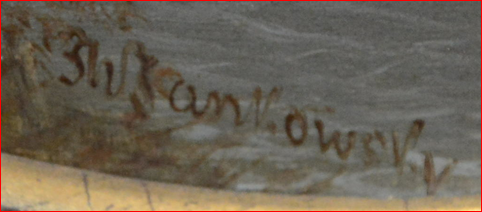
The signature and style of painting is that of J. Wilhelm Jankowsky (or Jankowski) (1825-1870), who painted landscapes (either real cities, like Venice or Prague, or Romantic imaginary ones).


His works fetch between 1,000 and 10,000 Euro.

The painting comes in a nice, probably original frame and should be worth 2,000 Euro.

UPDATE: sold for 950 Euro, above the highest estimate but still cheap!

UPDATE 2: now for sale at Carlo Bonte on 21 March 2018 for 1,500 to 1,800 Euro, which seems reasonable.

UPDATE 3: apparently unsold, because again at Bonte on 26 September, but with the original estimate of 500 to 800 Euro. These things are apparently less popular than I thought.

Tuesday, 24 January 2017

Anonymous "Interior scene" probably work by Charles de Groux

Rops, from Belgium, sells on 29 January 2017 an Interior scene, described as "oil on panel", 70 by 55 cm, estimated at 80 to 120 Euro.

It is a very nice drawing (painting?) with some labels on the back which identify it as a work by Charles de Groux (or Degroux) (1825-1870), an originally French artist who worked and lived in Belgium, and was a student of François-Joseph Navez. He worked as an engraver and lithographer, as well as a painter (often in watercolour). He was an early Social Realist and the teacher of Constantin Meunier and father of Symbolist painter Henry de Groux, and thus an important figure in mid-19th century art in Brussels.


The labels on the back describe this work as by Charles de Groux and call it "In the workshop". It looks like the house of a wealthy art lover, mainly interested in older art and antiques. The labels are from Galerie Georges Giroux, which existed from 1912 to 1960 and was at the time one of the most important galleries in Brussels, introducing avant-garde artists like Kandinsky (in 1912 already!). It also sold a lot of 19th century works, and the art of De Groux would have fitted perfectly in the gallery.  

Here is an example of some auction catalogues for the gallery, where works by father and son De Groux were included, and this is an example of a work by Charles, now in the Musée d'Orsay, which was sold through Giroux as well.


The work for sale is finely detailed, not just some sketch but a large scale stand-alone drawing which, even as an anonymous work, seems underestimated. The subject, a 19th century collector of old Flemish art, should also appeal to many readers of this blog. Paintings by De Groux easily fetch 3,000 to 10,000 Euro, so this work should be worth about 1,000 Euro. 

UPDATE: sold for 600 Euro, a lot more reasonable than the estimate of 80 Euro.