Showing posts with label Provenance. Show all posts

Sunday, 14 November 2021

The lost "Berry-Hill" portrait of Lady Jane Grey: an unrecognised gem at auction in the US


Butterscotch, from Bedford, New York, sells on 21 November an "Anglo-Dutch School, 17th century" "Portrait of Mary, Queen of Scots", with a provenance of "Private collection, Scarsdale, NY": the unsigned oil on panel is estimated at $5,000 to $10,000. 


The bad news is that this finely painted work probably isn't a portrait of Mary, Queen of Scots, who had on nearly all portraits a less rounded, sharper face. 


The remainder of this post is good news though. This is another version of a portrait of Lady Jane Grey (1537-1554), the so-called "Nine Days' Queen". The most important portrait of her (until now!) was the Syon House portrait


Other versions also exist, e.g. the above one.


But the few sites discussing the portraits of Jane Grey most lament the loss of the so-called "Berry-Hill" portrait, presumed lost since the 1960s, and presumed to be the model, the original, for the above two portraits. 


Hmm, doesn't that look an awful lot like the one for sale now? Now, to throw a spanner in the wheels, some sites claim that this is not a portrait of Jane Grey, but of her sister Katherine Grey, which would have served as a model for the later portraits of Jane Grey, painted posthumously. Which would be too bad, as Katherine, though important, wasn't a nine days' queen of course. But the most important of those sites, Katherinethequeen.com, does give a lot of information about this painting, including the following provenance; 

    John Lumsden Propert (d.1902)

    John Pierpont Morgan (d.1913)

    Metropolitan Museum of Art, New York;

    de-accessioned January 1956;

    Parke-Bernet Galleries, sold 25 October 1956;

    Berry-Hill Galleries, New York until at least 1961;

    Current whereabouts unknown.»

Which is, well, wow! And nicely fits in with being in the US now, of course. 

The sitter was given as "unknown" when with the Met, apparently, and is also said to be "Elisabeth I as a princess, ca. 1555". Which wouldn't be too bad either, but seems out of the question: it is nearly certain to be one of the Grey sisters.

So, value? If this was believed by enough bidders to be the original portrait of Jane Grey, well, the sky is the limit. For Katherine Grey, I think the interest would be less, but it still should easily fetch the higher estimate. And in any case this find will make a lot of writers and sites very happy I think!


UPDATE: sold for $120,000!

Tuesday, 23 January 2018

"Attributed to Clara Peeters" may be work by Nicolaes Cave (with provenance added)

Kloss, from Germany, sells on 30 January 2018 an "attributed to Clara Peeters" still life with a cat, estimated at 7,500 to 15,000 Euro.

The work isn't good enough to be by Peeters. Searching for it reveals an entry at the RKD, which indicates that it was offered as Clara Peeters at an auction at the Palais d'Orsay in 1978, but as a Follower of Clara Peeters at Sotheby's Amsterdam in 1997 (where it wasn't sold).

The RKD thinks it might be the work of Nicolaes Cave (a minor Antwerp painter active from 1619 on, died in 1651). It also indicates that it originally came with a pendant. (Wouldn't it be funny if you had a whole series of these, with the cat getting fatter and fatter in every image? Ah, missed opportunities...)

The estimate seems clearly too high and is speculative on the Clara Peeters name. 2,000 to 3,000 Euro seems more realistic.

Friday, 30 June 2017

"Flemish Master" is copy after Joos van Cleve

Hampel, Germany, sells on 5 July 2017 a "Flemish Master, End of the Beginning of the 16th century" (sic!) Holy Family, estimated at 6,000 to 8,000 Euro.

It is a copy after Joos van Cleve, a composition he and his followers used multiple times with variations in background and in the accompanying man (either Joseph or the donor usually, or no one).

This specific copy is listed at the RKD as being for sale in Nice, with dealer Rolan Robert (or Robert Rolan, more likely) in 1950! I don't know whether it has appeared on the market since, but it is nice to provide some provenance and attribution at the same time.

As a well-preserved, good copy with at least some provenance, it should be worth around 10,000 Euro.

Monday, 28 November 2016

"Antwerp School": Goswin van der Weyden?

Sala Retiro, from Spain, sells on 30 November 2016 an "Antwerp School, ca. 1530" circumcision, a large panel (130 by 100 cm) estimated at 19,000 Euro.

The auction catalogue says nothing about the provenance of the work. But thanks to the RKD, we can connect this sale with some much older catalogue entries and an interesting name.

In 1923, the work was in the Rothschild collection in London, and seen there by Max J. Friedländer who attributed it to Goswin Van der Weyden. The work was then sold in 1968 by Sotheby's for £5,000, and bought by a certain Marsworth. It is now listed in th RKD database as Attributed to Goswin van der Weyden. And now it suddenly reappears in Spain, with quite a lot of damage to the painting and the frame to boot, and no mention of Van der Weyden at all.

Goswin van der Weyden (1465-1538) is an interesting figure. In 19th and early 20th century art history, he was considered to be the son of Rogier Van der Weyden, and many paintings who were derivative of Rogier were attributed to him (like the relation between Pieter Brueghel the Elder and the Younger). Later research revealed though that he was the grandson, not the son (an otherwise unknown painter Peter van der Weyden was the link), and that he worked in Antwerp between about 1500 and his death. Only a few works are with some certainty attributed to him.


This work, while good and very interesting in its own right, seems not to be of the same high standards as these few certain works, so is better described as Circle of Van der Weyden, but it would warrant a good scientific study to see if the attribution to Goswin still has any merit. But I would guess that it would sell easier with the provenance and attribution than without... I would also like to know whether the damage is old, and has been revealed by cleaning it, or whether it really has happened between 1968 and now, which would be a real shame.

Monday, 31 October 2016

The Riddle of Nijmegen

Oise enchères, from France, sells on 5 November in a big castle sale a "Dutch painting" Scene with Gentlemen, missing its dimensions, estimated at 5,000 to 6,000 Euro.

It is a painting which was in the Museum Valkhof in Nijmegen until last year, when a court case decided that it was looted art from WWII and should be returned to the heirs of the previous owners. It was then sold in Amsterdam in June for 3,000€. Now it comes on the market in France, for some reason, with a very succinct description, lacking the artist, the subject and the provenance, but with a higher estimate.

As explained in Dutch newspapers, this painting was judged to be looted art and had to be returned to the heirs of the pre-1940 owner. Those sources indicated that it it was a 17th century work by Christiaen Coeuershof (or Coevershof) which was bought in good faith by the city of Nijmegen in 1971 for about 1,500 Euro. It was perfectly at home there, as it depicts a local legend, the "Riddle of Nijmegen": however, the loss of the painting wasn't too bad for the city and museum, as they have three other depictions of the riddle and this version was usually in storage anyway. Strangely, an earlier article stated that the work was from 1576 and by Cornelis Ketel, but this seems to have been a mistake (he did paint another version of the story).

The actual riddle:
Siet doch de naerderheyt van dit geslacht
Die gheen die slapende en myn schoot wert bevonden
Is aen mÿn onderwettich houwilÿck gebonden

Ende de groen Iongelingen hebter op acht
Syn myns vaders broeders ende myn mans soonen

De yonghe gesellen die hem in swarten roú betoonen
Syn mÿn byslaaps kinderen en broers van die mÿn heeft gebaert

En de twe Ionghe quanten die midts teosse weesen
Vreúcht bewysen sÿn wt onsen bedde geresen
En in alles is wettege troú bewaert

Ist oock mogelÿck beraet u en u sin verklaert


Translation :
Behold the consanguinity of this family
The one that was found sleeping in my lap
Is bound to me by lawful marriage

And the younglings in green, pay attention,
are my father's brothers and my husband's sons

The young companions who show mourning in black
are the children of he who sleeps with me, and the brothers of she who gave birth to me

And the two youngsters in our midst
are the happy proof of what has come from our bed
And in everything lawful marriage has been kept

Is it possible? Think about it and it wll become clear

The solution, from Museum het Valkhof:
The old man is a widower of two women. Both women already had a child from a previous marriage (one a son and the other a daughter) when they married the old man. They both had two sons with the old man, so the old man ended up with four sons, a stepson and a stepdaughter. Those two (who were utterly unrelated by blood) married each other, and had a daughter. This meant that the girl had four uncles who were the halfbrothers of her parents.

That girl then married the old man (again, by blood they were unrelated), which was his third marriage. Together they had another two sons.

Not even a soap would dare to bring such a story. It was supposedly a true story, and very popular in Nijmegen in the 17th century, with at least 4 paintings surviving and an engraving from one of them. This is perhaps the least well painted of the four. Whether it is by Coevershof or not is not clear, but the value lies mainly in the anecdotical story, not in the artistic qualities anyway. It will struggle to get the estimate though, no reason why this work should be worth more in France than it was in its native Netherlands, certainly without any explanation of what it shows.

UPDATE: now, on 28 March 2017, again for sale at Versailles enchères, in France, with a correct description (subject and "After Coevershof", and the same estimate of 5,000 to 6,000 Euro. 


Wednesday, 8 June 2016

"Healing of the Blind" is "Elymas struck blind"

Dickhaut, from Maastricht in the Netherlands, sells on 13 June 2016 a "Flemish School, 17th century" Healing of the Blind, a large oil on canvas (92 by 153 cm) estimated at 1,000 to 2,5000 Euro (a rather wide estimate). It is an online auction, one can bid from 10 June 2016 until 13 June 2016 21.00u CET.

The painting is not really similar to other "Healing of the Blind" depictions, as there is not Christ to be seen, but centrally we have a man on a throne with "SPQR", the sign of Rome. It turns out that the story is the exact opposite of the supposed subject, as it depicts "Elymas the sorcerer struck blind before Sergius Paulus". Perhaps the most famous painting of this story is the one by Raphael (pictured, from the Victoria&Albert). 

The one for sale seems to be loosely based on this Raphael (in reverse, so probably after an engraving like the above).

The work for sale comes from the collection of the Ursuline nuns in Venray, and used to be on loan to the Bonnefantenmuseum in Maastricht. This provenance can be deduced from the RKD but isn't given at the auction site, sadly. The estimate is probably about right: the quality of the painting is the typical mediocre Flemish work of the period, churned out by the thousands, but the subject is highly unusual. 

UPDATE: sold for 850 Euro. 

UPDATE 2: Now again for sale at Hargesheimer, in Germany, on 24 September 2016, with an estimate of only 400 Euro, which is cheap (and a serious loss for the seller). It is simply described as "German/Dutch master, 1st half 17th c." and "Bible scene". No provenance is given.

Thursday, 3 March 2016

From 300 Euro to 137 thousand Pounds in 6 months time

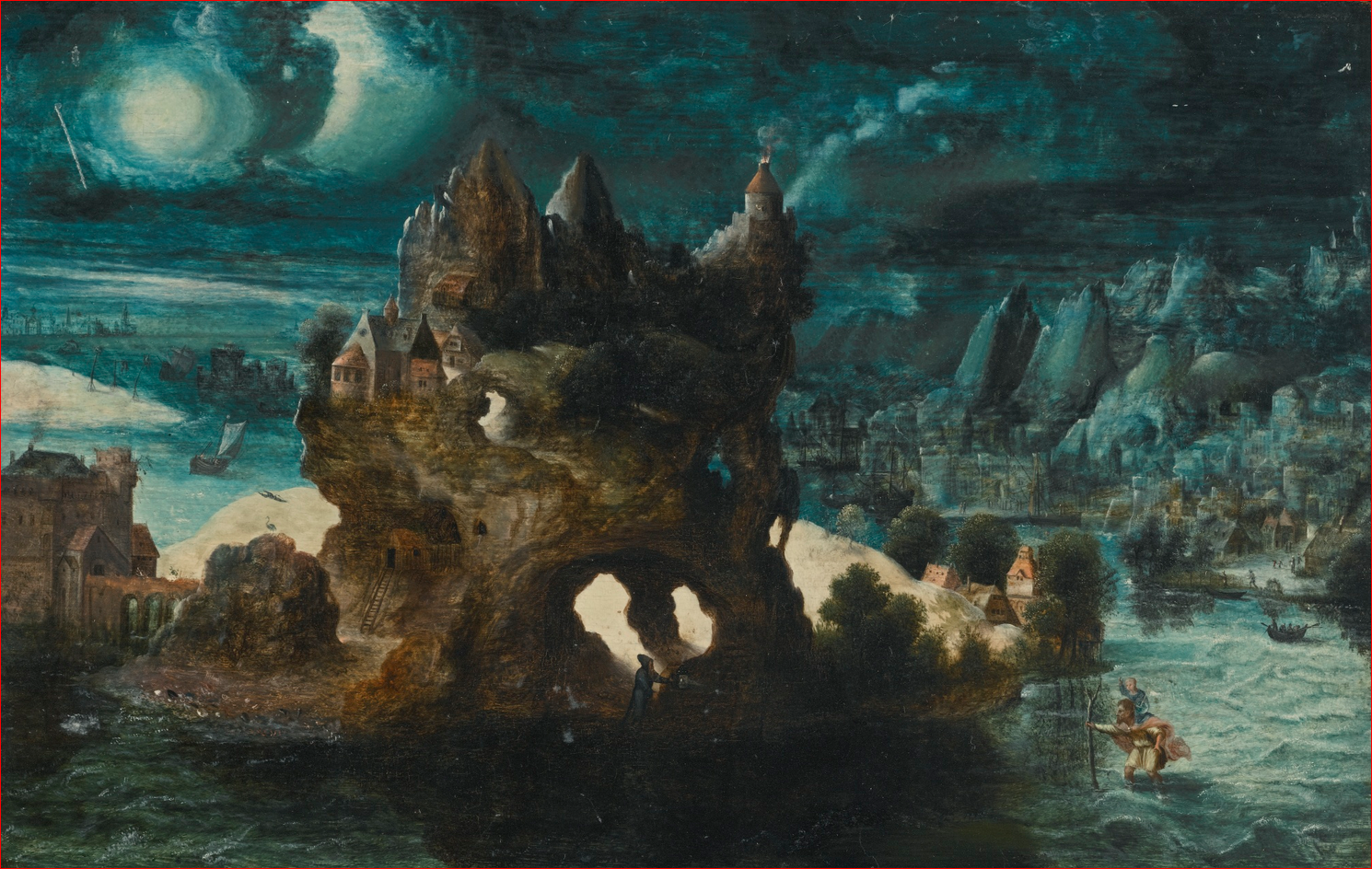
In June 2015, I posted a short note about a damaged "German School, 16th century" painting sold in France with an estimate of just 300 Euro. I didn't post it before the auction because I knew someone who was following the auction and tried to buy it, but eventually lost to another bidder when the painting sold for 6,000 Euro instead.

We thought it was by Herri met de Bles, or at least by someone of his close circle.

I missed it the second time round, but still think it is worthwhile to point it out now. In the December 2015 Old Master sale at Sotheby's, the same painting reappeared, cleaned and heavily restored (and with some seemingly incomplete provenance, lacking the sale of earlier the same year). It was indeed said to be by Herri met de Bles, and estimated at £80,000 to £120,000. It eventually sold for £137,000!

While the condition report by Sotheby's mentions the restorations, it doesn't indicate that these were very, very recent, which seems a significant omission (coupled with the omission of the June 2015 auction). No idea if the current owner was pleased or will be pleased when he finds out about this.

Nice to know that we were right, too bad that my fellow art spotter didn't win it though, as that is one heck of a profit to make in six months (even counting the restoration costs).