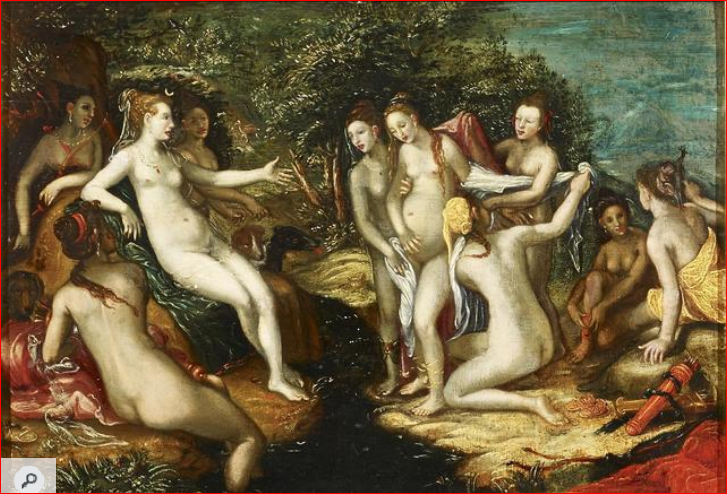
Côte d'Opale, from Boulogne, France, sells on 29 April 2017 a "17th century Flemish School" Diana discovers the pregnancy of Callisto, estimated at 600 to 800 Euro.
According to the description, the panel has an attribution to Paul Bril on the back, but they rightly don't seem to give much credence to this.
The work is actually a copy after a work by Hendrick Goltzius (1558-1617), from the Bonnefanten Museum in Maastricht, the Netherlands (the main museum in the city of Tefaf!). It is a good composition (probably based originally on the painting by Titian of the same subject), but this version is quite mediocre when seen up close. Still, at the estimate it is an attractive buy.
The painting was popularized through an engraving by Jan Saenredam, which may be the direct source for the version for sale.
Showing posts with label Opale. Show all posts
Tuesday, 25 April 2017
Tuesday, 29 November 2016
Jan Josef Horemans the Younger
Côte d'Opale, from France, sells on 10 December 2016 a pair of "Flemish School, 18th century" paintings of workers, estimated at 400 to 600 Euro.
The paintings are in a poor condition but seem to be fairly well painted. The auction house adds that one of them bears a signature Horemans, and I see no reason why that can't be considered to be authentic in this case.
The second painting may be damaged beyond repair, but the first one seems to be to be salvageable with some TLC, and would probably turn into a very nice painting.
The Horemans family (best known are Jan Josef I and II) very often painted an idyllic or theatrical version of people at work in an interior, like surgeons and alchemists, but also cobblers or a shoemaker or a school.To me, it looks like the work of Horemans the Younger (1714-1792), but it is hard to be sure. The younger Horemans was a bit more sentimental and colourful in many cases, while this work has a palette I would more readily associate with Horemans the Elder. But some other aspects make me choose for Younger anyway.
The dog in the second painting can be seen identical in other works by Horemans the younger. So this means at least that it is not some generic work (or pair of works) where someone afterwards added a Horemans signature: it is either a real Horemans, or a complete deliberate attempt to copy or fake it. As the paintings are so well executed, my guess would be that they are real works. Figures like the woman on the right in the second painting, or the man with the hat on the right, are much too good to be the work of a copyist. The dog as well looks intrinsically better in the work for sale than in the better preserved Horemans above.
I haven't found an exact match for the woman so far, but the man to the right can be found almost identical in a Jan Joseph Horemans I from the Hermitage from 1740.
Good paintings by Horemans the Elder often fetch around 4,000 Euro (a pair of compatable size to these fetched 7,500 at Sotheby's in Amsterdam in 2011, and one at Hampel in 2014 was estimated at 12,000€)), but these are obviously in a much worse condition. Still, the estimate is clearly too low and they should be worth around 1,500 Euro. Then spend some money on restoring them, and you end with good and still cheap originals.
Wednesday, 17 February 2016
"Flemish School, late 17th" is by Jan Spanjaert
Côte d'Opale, from France, sells on 27 February 2016 a "Flemish School, late 17th century" still life, estimated at 800 to 1,000 Euro.
The unusual subject, a still life of vegetables and utensils in an otherwise empty barn, is typical for Jan Spanjaert, whose nearly complete known oeuvre seems to exist of these paintings and the same ones with added people. Spanjaert was Dutch, not Flemish, and worked mainly in the first half of the 17th century, so the date is somewhat off at the auction.
The above detail is from a nice Spanjaert sold by Jean Moust, and is very comparable to the one for sale. It features the same implements, placed in the same way individually (although there overall composition is somewhat changed), like the black kettle diagonally on top of the copper one.
The RKD also has a similar work, sold at Christie's in 2007.
The work for sale has a bad crack right across, but otherwise seems to be an interesting work by a minor but typical master of the period, and should be worth closer to 2,000 Euro.
The unusual subject, a still life of vegetables and utensils in an otherwise empty barn, is typical for Jan Spanjaert, whose nearly complete known oeuvre seems to exist of these paintings and the same ones with added people. Spanjaert was Dutch, not Flemish, and worked mainly in the first half of the 17th century, so the date is somewhat off at the auction.
The above detail is from a nice Spanjaert sold by Jean Moust, and is very comparable to the one for sale. It features the same implements, placed in the same way individually (although there overall composition is somewhat changed), like the black kettle diagonally on top of the copper one.
The RKD also has a similar work, sold at Christie's in 2007.
The work for sale has a bad crack right across, but otherwise seems to be an interesting work by a minor but typical master of the period, and should be worth closer to 2,000 Euro.
Sunday, 12 April 2015
Woman with chicken
At Côte d'Opale, an auction house in Boulogne-sur-Mer, they sell on 18 April a "Dutch School, 17th century" portrait of a woman with a chicken, estimated at 1,500 to 2,000 Euro.
I can't find fault with that description, and the estimate seems low, for a painting which needs some TLC but could turn out to be quite special. The painting is done in the loose, nearly expressionistic style favoured by only a few of their portraitists, most famously Frans Hals but also e.g. Rembrandt and Carel Fabritius (his "head of a boy" pictured, from wikigallery.org). While I don't think it is by any of those, it still is a very well painted portrait, where the individuality of the woman and the characteristics of her face are captured with only a few well-placed brushstrokes, and the hands show the roughness of a farmer, not the finesse of the nobility usually portrayed. Could it be by Abraham van Diepenbeeck? His "Portrait of an old Jew" in the Antwerp Museum seems similar.
The painting is damaged and very dirty, so it's a gamble what can be made of it eventually. But it is the kind of gamble that could pay off quite nicely, and it is a much better painting than the usual copies, derivations, and third-rate painters one finds for these prices (at auction and on this blog, in all fairness).
Subscribe to:
Posts (Atom)


