Showing posts with label Koller. Show all posts

Monday, 13 March 2017

For "Campi", read " Ciampi"

Koller West, from Switzerland, sells on 29 March 2017 a "signed F. Campi" farm interior, estimated at 1,400 to 2,300 Euro.

The actual signature and artist is F. Ciampi, a good purely sentimental Romantic artist whose works are quite rare. Sotheby's Amsterdam sold one similar but smaller work in 2008 with an estimate of 4,000 to 6,000 Euro, or nearly three times the current estimate, making this one, which is perhaps slightly less charming and slightly less precise painted, quite cheap.


I was unable to find any information whatsoever on this artist otherwise, not even his first name. Perhaps it simply was the pseudonym for another artist who wanted to hide either how many paintings he produced (avoiding to flood the market) or who didn't want it to be known that next to his "serious" works he also produced this more "commercial" work to make a living. Both weren't unusual in the 19th century, but may make it hard to ever find out who painted these.

Thursday, 10 March 2016

Could this 16th century Venetian portrait be by Titian?

Koller sells on 18 March 2016 a "Venetian, 16th century" "Portrait of a Humanist, probably Giovanni Danna. 1551." "Inscribed and dated lower right: GIOVANNI DANNA E.S. A. D. MDLI. Seal on the reverse: Accademia Clementina Bononiensis. 127.5 x 109.5 cm.", estimated at 3,330 to 5 000 Euro.

Giovanni D'Anna was a Flemish merchant in Venice. He was the son of Maerten van Haanen / Martino d'Anna (1475-1553). Martino was ennobled by the Habsburgs in 1529, and in 1545 became a citizen of Venice (where he had bought the Palazzo Talenti in 1538; this was a Grand Canal facing palace with a façade fresco by Pordenone, as you can see from the picture, they were really wealthy). He had two sons, Giovanni and Daniele. I couldn't find the date of birth for Giovanni (Jan van Haanen), but he apparently died in 1574. He had a son named Paolo d'Anna. Paolo (and another d'Anna named Zuane) also were patrons of the arts, commissioning works from Tintoretto and possibly Titian as well.

The interesting things is that according to Vasari (and others), d'Anna has been portrayed by Titian. This portrait is not known (one contender is shown further in this blog), making it an interesting prospect to find (but probably an interesting one to fake as well).

In 1543, d'Anna had already commissioned an "Ecce Homo" from Titian, and probably a Virgin with Saint Roch and Saint Sebastian as well. The Ecce Homo is now in the Kunsthistorisches Museum in Vienna. It is said to contain the portrait of Giovanni d'Anna, but I don't know which figure is supposed to be him (not the one on the far right, as I first thought: perhaps the one shown above?).


The British Museum has a medal made by Leone Leoni around 1545 with the portrait of Giovanni d'Anna. Is this the same person as the one in the painting, 6 years later? Hard to tell, as the medal is obviously stylized, modeled on Roman emperors, more than being really lifelike. The receding hairline, the Roman nose, the beard: there is nothing here that disproves the connection, but many other portraits have the same characteristics.

There is another portrait which has been speculated to be the Titian portrait of D'Anna (whereabouts unknown to me, presumably Spain). It looks to me less likely to have any Titian involvement though. It doesn't seem to be the same person, but that would only rule out the second one if we are certain that the one for sale is Giovanni d'Anna (and that the inscription isn't a later addition).

I've also found reference to two Titian portraits of members of the d'Anna family in the Musea of Verona, but one was said to have a long white beard and the other was shaven, so this matches neither painting above. How correct these old attributions were is not clear.


The portrait for sale has some very good elements (like the head, pictured higher in this blog post), but also some worryingly inadequate aspects, like the hand pictured here. The details (e.g. of the clothing) are also very sketchy.

On the other hand, the composition is very well done. Perhaps the painting has suffered a lot over the years, with many overpaints; perhaps it is a copy of the original (lost?) Titian portrait of d'Anna; or perhaps it has nothing to do with Titian (who knows if even the inscription is real?). If one compares it with the above Titian portrait of Philips II of Spain, I see no reason to doubt that this one could well be by the same hand. But if it wasn't for the d'Anna connection, I wouldn't spontaneously have thought "a Titian" either...

What's it worth? Depends on how much you have to gamble, or how good you know the works of Titian. If it is real, it is worth a whole lot more; if it is a copy of a lost Titian, it still should be worth more. If it is an anonymous Venetian portrait, the estimate seems about right. If it is a later fake intended to dupe people like me, then it should be ignored.

UPDATE: sold for 4,000 Swiss Francs (the bottom estimate), so no one seems to have really believed that this may have been a Titian. Too bad, I would have loved to have predicted another sleeper...


Wednesday, 9 March 2016

Facescapes

Koller West, from Switzerland, sells on 18 March 2016 a "Flemish, 17th century" pair of landscapes in the form of the face of a woman, estimated at 1,200 to 1,800 Euro. Well, I don't know if they sell it, it is listed at The Saleroom as Koller lot 6430, but the online auction catalogue at Koller jumps from lot 6429 to 6431. Still, it is an interesting piece, so here goes.

This kind of "anthropomorphic" or "mimetic" landscape is typically Flemish from the 16th and early 17th century, and relatively rare, so this is / would have been a very cheap example.

A very, very close example to the one for sale here was sold as a pair at Christie's in 2004: that pair fetched $45,000!

Another pair with the same images can be found in the Royal Museum of Fine Arts in Brussels.

The faces are sometimes over-elaborate, but the paintings are filled with tiny fun details, e.g. the necklace of the woman being made from a flock of sheep. 

Comparing images based on online images is tricky, but these seem to be museum quality pieces that should have been estimated at 20,000 Euro instead of 1,200 Euro. Perhaps that's why they have been removed from the auction catalogue (for now at least)?

Tuesday, 8 March 2016

Women's Day 2016: Michaelina Wautier

Koller sells on 22 March 2016 a "Michaelina Wautier" signed and 1654 dated portrait of Martino Martini, Jesuit missionary in China, estimated at 5,800 to 8,300 Euro.

Nothing wrong with the attribution, I just wanted to highlight a rare painting by one of the few well-known Flemish woman painters of the 17th century. Combined with the Chinese interest, it should easily fetch the estimate and then some. Wautiers (or Wouthiers) very rarely come up for sale, and the most recent one I could find (also at Koller, in 2003) fetched 30,000 Euro. In my opinion the work for sale now is at least as good as that one.

According to Wikipedia, Martino Martini was in Norway in 1653 and in Rome early in 1655, and travelled through Europe, including Amsterdam and Antwerp, inbetween. This would match the date of the portrait exactly.

UPDATE: sold for CHF 480,500! Or some 440,000 Euro. Impressive. I knew the estimate was way too low, but I didn't expect it to soar this high...

Wednesday, 2 March 2016

"Northern Netherlands, 16th century" looks more like a German painting

Koller, from Switzerland, sells in a very interesting auction (with some very unusual works) on 22 March 2016 a "Northern Netherlandish School, 16th century" Flagellation of Christ, estimated at 15,000 to 23,000 Euro.

The iconography was unknown to me, with the tormenters apparently trying to screw the crown of thorns into the head of Christ, but the image looked more German than Dutch, where the paintings are somewhat more rational and subdued in composition in general.

A very similar example is listed as German, late 15th century at the Walters Art Museum.

Another work with the same image comes from the Melk Altar, and is again a German work of the same period, this time by Jörg Breu the Elder and dated 1502.

Other works from the same period with a similar image are attributed to the Master of Attel (Christie's, a pair, sold for £422,000!) and to the Master of Cappenberg.

Finally, even Cranach the Elder has shown the same image.

The above ones all had a four-arm screw instead of the two-arm one in the work for sale, but that type can also be found in German art of the period, like in the above woodcut by Hans Schäufelein from 1507, which is in general closer to the work for sale (also with the kneeling man in the front).

Perhaps the closest example I could find was the work by the Master of the Pflock Altar from 1521, which has the exact same type of screw and otherwise also has enough similarities to show a common influence. It is not by the same author though.

Finally: I never realised it until now, but I suppose the "stick" carried by the man behind the Christ in the above work by Bosch is probably also a screw to tighten the crown of thorns. No idea if this is a commonly known element or my addition to the Bosch research, probably the former though!

None of the above shows the exact same thing as the work for sale (not only does it have a two-arm screw instead of the most common four-arm one, but it also has an upper register with a nun visiting a church (Loreto?)), but it seems clear that it is a work that sits firmly in the German tradition of ca. 1500, and doesn't fit so much in the Dutch tradition (despite the Bosch I have shown, and a few other works with similar elements like a Maarten van Heemskerck). As for the estimate, hard to say. It certainly is a noteworthy work, but Dutch works of the period are rarer and would probably be worth more than a German one.

UPDATE: Not sold.

UPDATE 2: on 16 March 2016 Lempertz sells another work with the same torture device.  This time it's a Flemish work of the 17th century, which is late for this iconography. It's estimated at 1,500 to 2,000 Euro.

And on 18 March one can buy (at another Koller auction) a German, ca. 1500 version with the same device (this time the two-arm version), as one of a pair of paintings together estimated at 3,300 Euro (which seems like a lot to me). Apparently this image isn't that rare, I just didn't notice it until now...

UPDATE 3: again for sale at Koller, with a much reduced estimate of 8,000 to 12,000 Swiss Francs, on 22 September 2017

Monday, 29 February 2016

Antwerp painting at Koller: probably by Vincent Sellaer

Koller, from Switzerland, sells on 22 March 2016 an "Antwerp, 2nd half of the 16th century" Caritas, estimated at 12,500 to 20,000 Euro.

They correctly identify it with an RKD entry where it was described as by "Pseudo-Lombard". Other names dropped in the auction catalogue are Gossaert, Jan Massys, and Frans Floris.

A name strangely absent from that list, but probably the most closely related, is Vincent Sellaer. He has painted multiple Caritases in the same style as this one.

Artcurial sold in 2006 (and again in 2010) a painting from the "Studio of Sellaer" which is another version of the work for sale.

UPDATE: not sold.

Tuesday, 1 September 2015

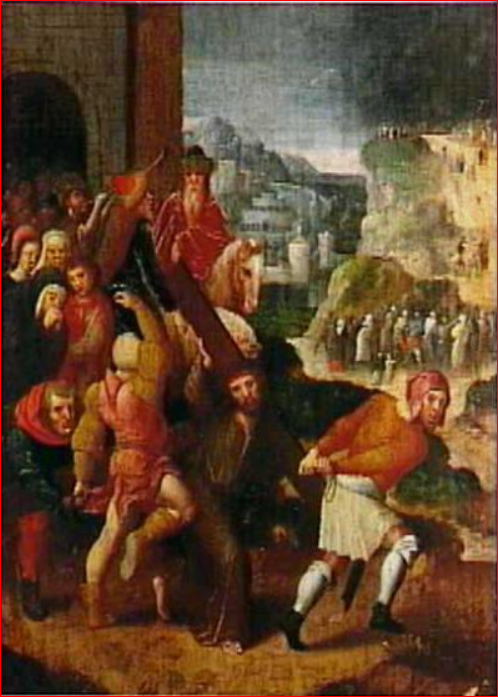
Road to Calvary may be Circle of Marcellus Coffermans

Koller, Swiss auction house, sells on 16 September 2015 a "Flemish School, late 16th / early 17th century" Road to Calvary, a small (38 by 52 cm) oil on panel estimated at 4,000 to 6,000 Swiss Francs (or about the same in Euros).

The picture caught my eye because of the rather erratic movements of some of the characters. It turns out that this can be seen in many Flemish depictions of the Carrying of the Cross from this period.

By far the most closely related picture I could find on the RKD is one by Marcellus Coffermans, active ca. 1520-1578. Although it is even smaller than the one for sale (23 by 19) and varies in details, it is obvious that the two paintings are based on the same model (either one may even be the model), and perhaps even come from the same studio or artist. However, the completely different colours indicate that both may be based on the same engraving or drawing instead. The one for sale seems to be a better picture though (unlike what I usually highlight), even taking into account the somewhat larger scale. Many faces are much better, certainly for the background figures like the women on the left.

If it would turn out to be a work by Coffermans, then it should be worth a lot more than the estimate. As it stands, it is an interesting work of considerable quality which merits further investigation into the origin, and which should easily be worth the estimate. UPDATE: not sold.

Other paintings with similar depictions (a Road to Calvary with one soldier doing a "dancing" attack on Christ, and with either a similar one at the front or with someone pulling the cross with some ropes) are rather common, starting with this one by the German painter Hans Maler, ca. 1500.


The iconography enters the Flemish art with the likes of Pieter Coecke and Barend van Orley, with many anonymous followers over the next 50 years or so. The link between Germany and Flanders may in this case have been Jan Joest Van Calcar, with a similar work around 1500, although the movements are more restrained and realistic here. (You can usually rightclick the images in my blogs to see a larger version!).

UPDATE 2: again for sale at Koller on 18 March 2016 with the extremely wide estimate of 2,000 to 6,000 Swiss Francs.  

UPDATE 3: sold for 3,200 Swiss Francs.

Monday, 31 August 2015

Flight into Egypt, after Maerten de Vos

Koller, from Switzerland, sell on 16 September a "Flemish School, late 16th century" Flight into Egypt, an oil on copper estimated at 950 to 1,900 Euro.

It is a copy after an engraving by Maerten de Vos. A design for it is kept in the Herzog Anton Ulrich Museum in Braunschweig, and is dated ca. 1580.

The engraving was relatively popular, and other paintings after it are known, e.g. the above which follows the original less closely, attributed to Adriaan de Weerdt and dated 1580-1590 (both images and the info come from the RKD).

Typical in copies after engravings is that every artist can choose his own colours, which makes for interesting comparisons sometimes. The one for sale now is probably doomed to remain anonymous, as the quality is adequate but not outstanding enough to point to any individual artist. The estimate seems about right, I can't see this not making 1,000 Euro. UPDATE: sold for 5,000 Swiss Francs or nearly 5,000 Euro, so way above estimate. Seems overpriced to me.

Friday, 21 August 2015

Third time's a charm for this Teniers?

I blogged in March 2015 on a painting which had been sold in January 2015 at Vanderkindere (Brussels) as "Attributed to Cornelis de Vos" for 5,800 Euro, and was offered at Mercier (France) two months later as a "David II Teniers" with an estimate of 50,000 to 60,000 Euro, which was way too much in my opinion.

Apparently it didn't sell at the time, as it is now for sale at Köller, Switzerland, on 18 September 2015, again as a David II Teniers but with an estimate of 25,000 to 35,000 Swiss Francs, or about half the previous estimate (but still a nice profit). The reasons for the new attribution are basically the same as at the Mercier auction (comparison to the Fondation Custodia portraits), but with (as far as I remember) the added argument that the sitter (or at least her husband) was known to be friends or associated with David II Teniers, and with some further provenance. None of the provenance has any sort of attribution though (the inventory of the sitter's will indicates portraits of her and her husband, but no indication who made them or whether this portrait is the same or not).

The monogram (upper left corner, pictured) is now being described as a "DT F" monogram signature, which (again speaking from memory) wasn't mentioned yet at the Mercier sale, and which looks to me a bit as wishful thinking or circular reasoning; I certainly can't see a "DT" in it. The "F" is quite clear, but the first could be nearly everything. The two examples I found of Teniers monograms were a big, round D with a small T inside.

Strangely, and a bit disappointingly, the provenance only lists a 1936 and 1942 entry, and (unlike other entries in that Köller catalogue) omits the two recent auctions, stating instead that it was "Kürzlich in einer Privatsammlung entdeckt" or "recently discovered in a private collection". I believe that auction catalogues should list all available info, not just the favourable bits. Hiding earlier different attributions is not a good practice...

UPDATE: sold for 24,000 Swiss Francs, just below the lower estimate but still a nice profit. I guess that at least some people were convinced that it truly was a Teniers; I still don't like the work though...

Saturday, 28 February 2015

Early Netherlandish portrait at Koller


Koller Auctions is selling a very interesting Early Netherlandish portrait. Estimated at only 3,800 to 5,700 Euro, it is described as "Portrait of a young man" and "School of Burgundy, probably 16th century(?)". I don't know whether they added the question mark because they aren't certain that it isn't a 19th century pastiche, or whether they believe it may even be 15th century.


The first thing that strikes me in the painting is the hat. It is the same hat used in the portrait of Philip the Good by Rogier Van der Weyden, ca. 1450.


Second, the tiny strip of background, just above the shoulders, so typical of Memling. But the overall quality of the portrait, and the anatomy, isn't good enough to be a Memling work (and too modern to be a Van der Weyden, of course).

So, is it some painter we can name? Not really. The identity of the sitter is equally mysterious. But if it is a ca. 1500 painting, with this quality, it should be worth a lot more than the estimate, and should easily fetch 20,000 Euro or more. I'm just a bot worried by the seemingly too obvious hat that is being used, it shouts too loudly "I'm old and Burgundian" perhaps.

UPDATE: apparently it wasn't sold, as it is again for sale on 22 March 2016 at Koller as  "Italy, ca. 1500, after a Flemish model", with an 8,000 to 12,500 Euro estimate (which is higher than the previous one!).

UPDATE: sold for 22,500 Euro, way above estimate! 

Jonah and the Whale, Jan Bruegel or Swiss?


Koller is selling on 25 March 2015 a depiction of the story of Jonah and the Whale, attributed to "Bern, ca. 1660", estimated at 5,700 to 7,600 Euro. UPDATE: not sold.


The restorer of the painting (or the owner at the time) seemed to think it might have been a Jan Brueghel instead, which is obviously quite a different thing.


Perhaps the idea of Brueghel came from a painting like the Christ at Galilee, but it is much better, less naive, than the one for sale here. It is charming in its folk art awkawardness, but the estimate seems a bit steep, and the date perhaps a tad late.