Wendl, from Germany, sells on 2 March 2019 a large selection of Old
Master paintings, often with low estimates. This is my second (and final) selection of lots.
Lot 4065 is a typical Dutch still life with a bling bling cup and some glassware. The painting, estimated at only 240 Euro, is extremely brown, presumably actual old varnish or an attempt to make it look older and more interesting. It has a monogram PCH, as said by the auction house.
This is the monogram of Pieter Claesz (1597-1660), the most important Dutch painter of this type of still life together with Willem Claesz Heda. He is coincidentally also the father of Nicolaes Berchem (Pieter Claesz was born in Berchem, now a part of Antwerp).
The same monogram can for example be found on this work, sold at Sotheby's for £175,000! I have not yet found an explanation for the "H" in the monogram. It almost gives the impression as if he was a brother to Willem Cleasz Heda. Perhaps it was added as a reference to Haarlem, the city he worked in.
The painting isn't good enough to be by Claesz though, he was an extremely detailed and convincing painter, while the work for sale is good, but a bit simplistic in the handling of materials and the reflection of light on it.
Even so, 240 Euro is ridiculously cheap and buying it at 1,000 Euro would be a very reasonable gamble that cleaning will reveal a quite fine painting.
Lot 4320 is a view of a sculptor's studio. At first, I was going to attribute it to Balthasar van den Bossche, who is best known for these scenes (sculptor or painter workshops); but he has a small number of sculptures reappearing in nearly every work, and this one doesn't match his other works in that regard. So, an anonymous late 17th century or early 18th century work, which needs cleaning, but which is again very cheap at the estimate of 180 Euro.
Finally, lot 4336, signed P. Veen and dated 1685(?) is a depiction of John the Baptist estimated at 800 Euro. I hoped it would turn out to be an Otto van Veen with a misread date (perhaps 1625?), but it looks to be a P. Veen after all.
This could be a Pieter Veen (1667-1736), but if so the date is probably misread and should be 1695 or 1698 instead. The RKD shows some 10 paintings by or possibly by Veen, like the one above. Most are better than the one for sale, e.g. the hands in the offered work are very weak. The estimate for this one seems about right, but his works are rare so it is interesting to possibly add one work to his oeuvre.
UPDATE; first sold for 2,200 Euro (240 est.), the second for 1,200 Euro (180 est.), and the final for 900 Euro (800 est.)
Showing posts with label Heda. Show all posts
Tuesday, 26 February 2019
Thursday, 8 June 2017
"Dutch School" may be the work of Gerret Willemsz. Heda
Vanderkindere, from Brussels, sells on 14 May 2017 a "Dutch School, 17th century" still life, estimated at 5,000 to 7,000 Euro.
The work is very close to the famous still lifes of Willem Claesz Heda, but lacks the extreme finesse and brilliance of these. Somehown Heda succeeds in getting his brush strokes exactly right, creating an extremely convincing effect; most followers copy the manners and elements, but don't get the same overall effect even though it is hard to pinpoint which aspects are lacking.
Searching further, I wonder whether this isn't the work of Gerrit (or Gerret) Willemsz. Heda (1625-1649), the son of Willem Heda. Some of his works are very, very similar in composition and execution. The nautilus cup in the above one is identical or nearly identical to the one for sale, but the position has changed just enough that it isn't a simple copy.
The same cup and position also appears in a work by father Willem, but there the difference in execution agin becomes apparent.
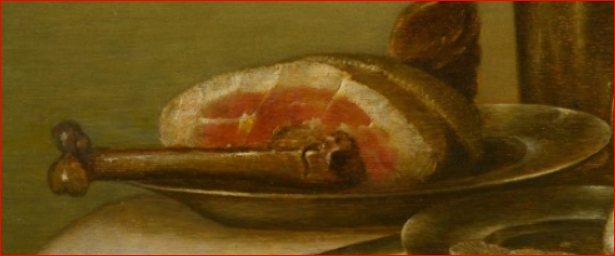
There seems to be one other logical candidate for the artist of this painting: Maerten Boelema de Stomme ("The Silent") (1611-1644), another pupil of Heda, who also painted the same cup, and added a ham that looks remarkably like te one in the work for sale. This work sold for £92,500 at Sotheby's in 2013. To me Boelema seems like a slightly better painter than Gerret Heda (who died very young, it has to be said); and the work for sale feels more like a Heda to me, even though the composition is closer to Boelema (in as far as the compositions of the two differ...)
I estimate this painting at 15,000 to 18,000 Euro.
The work is very close to the famous still lifes of Willem Claesz Heda, but lacks the extreme finesse and brilliance of these. Somehown Heda succeeds in getting his brush strokes exactly right, creating an extremely convincing effect; most followers copy the manners and elements, but don't get the same overall effect even though it is hard to pinpoint which aspects are lacking.
Searching further, I wonder whether this isn't the work of Gerrit (or Gerret) Willemsz. Heda (1625-1649), the son of Willem Heda. Some of his works are very, very similar in composition and execution. The nautilus cup in the above one is identical or nearly identical to the one for sale, but the position has changed just enough that it isn't a simple copy.
The same cup and position also appears in a work by father Willem, but there the difference in execution agin becomes apparent.
There seems to be one other logical candidate for the artist of this painting: Maerten Boelema de Stomme ("The Silent") (1611-1644), another pupil of Heda, who also painted the same cup, and added a ham that looks remarkably like te one in the work for sale. This work sold for £92,500 at Sotheby's in 2013. To me Boelema seems like a slightly better painter than Gerret Heda (who died very young, it has to be said); and the work for sale feels more like a Heda to me, even though the composition is closer to Boelema (in as far as the compositions of the two differ...)
I estimate this painting at 15,000 to 18,000 Euro.
Tuesday, 20 October 2015
German "Memento Mori" copies elements from Willem Heda
Horta, from Brussels, sells on 16 November 2015 a "German School, 17th century" Memento Mori, estimated at 2,500 to 3,500 Euro.
It is a nice provincial work, with an interesting iconography and a long inscription in a form of German, which isn't always easy to decipher or translate.
My dodgy transcription and translation:
"Gleich wie der Rauch v. Staub vschwint
Also thuen alle Menschen Kint
Darumb gedenct ein ieder ebn
Dasser bey Chisto mög ewig lebn"
"Like smoke and dust disappear
so do also all people
therefor remember, all of you,
that with Christ you may live forever"
"Das Glück ist ??? und Kugel ründt
Das Glas ist aus geht kurze Stündt
Der Todt ist nah kurz ist die Zeit
Wan der Han kret ist der dag nich weit"
"Luck is ??? and round as a ball
The glass is empty since a short while
Death is near and short is the time
When the rooster crows, the day is near"
"Gott is warhaftig und gerecht
Dir ligt der Herr und auch sein Knecht
Ihr Welt weisen tretet herbeij
Und sagt wer Herr oder Knecht seij"
"God is true and just
Here lies the lord and his servant
Their ways in the world come near
and says who is lord and who is servant"
Many of the visual elements in the painting are explained by the verses, like the appearance of a rooster (which seems to be rather unusual in memento mori paintings). Other ones, like the plants growing in the skulls, are typical and appear in many of these paintings. I'm not really sure what the winged orb signifies, although wings in general are symbols of swiftness and escaping, like the hourglass. It may be a soap bubble, which is also common in these paintings (but never winged). But more likely it is an element from the poem, about Luck being round like a (cannon?)ball.
The rich cup or tazza on the left is remarkable. It is an element of vanitas (which is often used interchangeably with memento mori), the earthly riches you can't take with you after death. But this specific cup, or one extremely close to it, can be found in a vanitas by Willem Heda (ca. 1593-1682), Dutch still life painter. His painting, from 1628, can be found in the Bredius Museum in The Hague, and probably sets an earliest possible date for the painting for sale.
The cups aren't identical, but it seems likely that it is caused by some awkwardness, some troubles by the German painter to get the changed cup (empty instead of full) right. But it could also be that it is just another cup from the same style (and maker?), giving us a period for the painting but no real link with Heda.
The painting and inscription seems to be authentic and linked (although, as is often the case, the inscription may have been regilded a few times over the ages). The work is interesting, a typical memento mori with a few added elements, not very well painted but good enough to be attractive. The estimate seems to be about right.
UPDATE: some people saw even more in it, and it sold for a whopping 20,000 Euro! I didn't guess the price it would fetch, but at least I was good in spotting the interesting painting in the auction. I hope no one thought after my blog that they were buying a real Willen Heda, as that seems highly unlikely. I'm curious to know what they did see in it though...
It is a nice provincial work, with an interesting iconography and a long inscription in a form of German, which isn't always easy to decipher or translate.
My dodgy transcription and translation:
"Gleich wie der Rauch v. Staub vschwint
Also thuen alle Menschen Kint
Darumb gedenct ein ieder ebn
Dasser bey Chisto mög ewig lebn"
"Like smoke and dust disappear
so do also all people
therefor remember, all of you,
that with Christ you may live forever"
"Das Glück ist ??? und Kugel ründt
Das Glas ist aus geht kurze Stündt
Der Todt ist nah kurz ist die Zeit
Wan der Han kret ist der dag nich weit"
"Luck is ??? and round as a ball
The glass is empty since a short while
Death is near and short is the time
When the rooster crows, the day is near"
"Gott is warhaftig und gerecht
Dir ligt der Herr und auch sein Knecht
Ihr Welt weisen tretet herbeij
Und sagt wer Herr oder Knecht seij"
"God is true and just
Here lies the lord and his servant
Their ways in the world come near
and says who is lord and who is servant"
Many of the visual elements in the painting are explained by the verses, like the appearance of a rooster (which seems to be rather unusual in memento mori paintings). Other ones, like the plants growing in the skulls, are typical and appear in many of these paintings. I'm not really sure what the winged orb signifies, although wings in general are symbols of swiftness and escaping, like the hourglass. It may be a soap bubble, which is also common in these paintings (but never winged). But more likely it is an element from the poem, about Luck being round like a (cannon?)ball.
The rich cup or tazza on the left is remarkable. It is an element of vanitas (which is often used interchangeably with memento mori), the earthly riches you can't take with you after death. But this specific cup, or one extremely close to it, can be found in a vanitas by Willem Heda (ca. 1593-1682), Dutch still life painter. His painting, from 1628, can be found in the Bredius Museum in The Hague, and probably sets an earliest possible date for the painting for sale.
The cups aren't identical, but it seems likely that it is caused by some awkwardness, some troubles by the German painter to get the changed cup (empty instead of full) right. But it could also be that it is just another cup from the same style (and maker?), giving us a period for the painting but no real link with Heda.
The painting and inscription seems to be authentic and linked (although, as is often the case, the inscription may have been regilded a few times over the ages). The work is interesting, a typical memento mori with a few added elements, not very well painted but good enough to be attractive. The estimate seems to be about right.
UPDATE: some people saw even more in it, and it sold for a whopping 20,000 Euro! I didn't guess the price it would fetch, but at least I was good in spotting the interesting painting in the auction. I hope no one thought after my blog that they were buying a real Willen Heda, as that seems highly unlikely. I'm curious to know what they did see in it though...
Subscribe to:
Posts (Atom)