Winterberg, from Germany, sells on 21 October 2017 an "Italian artist, Venetian, ca. 1700" Visitation, a drawing of 39 by 24 cm estimated at 2,400 Euro.
Quite steep for a drawing, but as far as I can tell from the not too big image it looks like this could well be the work of a major artist. The drawing is said to have an annotation "Palma", and Palma Vecchio is an artist who comes to mind when seeing a work like this, as he has made similar frescos, e.g. of the circumcision. But the graceful line of the central figures suggests a later artist.
I have no further information yet on this work, contrary to most of my blog posts, but I thought this work too important to simply ignore it.
Showing posts with label Drawing. Show all posts
Monday, 16 October 2017
Tuesday, 13 June 2017
Drawing is by or after Marcello Venusti
Fauve Paris sells on 17 June 2017 an "Italian School, late 16th century" drawing of Christ and the Samaritan woman, quite large (37 by 50 cm) and estimated at 400 to 600 Euro.
The composition is the same as a work by Marcello Venusti (1512-1579). One good copy of it can be seen in Erddig, Wales, in a National Trust museum / house.
The original appears to be in the Museum of Siena.
The drawing is certainly better than e.g. the Welsh copy, and is not identical to the original either, as it has a landscape orientation instead of a portrait one. As far as I can discern it, it even looks better than the supposed original painting from Siena, which makes me wonder whether it could be a final preparatory drawing by Venusti, instead of a copy by someone else after the fact.
I can't find any comparable drawings, so valuing this is hard. It has some damage, so as an anonymous copy the estimate seems right: if it is by Venusti though, the value should be at least 2,000 to 3,000 Euro.
UPDATE: a reader pointed out that the painting (and presumably the drawing) are not originally by Venusti, but are copies after (an engraving after) Michelangelo! This version is from the British Museum. This explains the better quality of the drawing, and removes the link to Venusti. Thanks for the update!
The composition is the same as a work by Marcello Venusti (1512-1579). One good copy of it can be seen in Erddig, Wales, in a National Trust museum / house.
The original appears to be in the Museum of Siena.
The drawing is certainly better than e.g. the Welsh copy, and is not identical to the original either, as it has a landscape orientation instead of a portrait one. As far as I can discern it, it even looks better than the supposed original painting from Siena, which makes me wonder whether it could be a final preparatory drawing by Venusti, instead of a copy by someone else after the fact.
I can't find any comparable drawings, so valuing this is hard. It has some damage, so as an anonymous copy the estimate seems right: if it is by Venusti though, the value should be at least 2,000 to 3,000 Euro.
UPDATE: a reader pointed out that the painting (and presumably the drawing) are not originally by Venusti, but are copies after (an engraving after) Michelangelo! This version is from the British Museum. This explains the better quality of the drawing, and removes the link to Venusti. Thanks for the update!
Monday, 12 June 2017
"Early 20th century Italian school" a very early Cubist / Futurist drawing?
Joron Derem, from France, sells on 23 June 2017 an "Italian School, early 20th century" study for the movie "Attila - I Nibelunghi", estimated at 800 to 1,200 Euro.
It is a striking image, but sadly I can find very limited information about the movie. The signature on the drawing is hard to read, and the image provided by the auction house is just a fraction too small to get a better idea of what it says.
First, the movie. It is an adaptation of the Wagner opera, written by Mario Bernacchi and produced by Milano Films. And that's about it... It is the first movie adaptation ever of the story, as far as I can tell, so important in that regard. As usual with movies at the time, it is very short (one reel, about 10 minutes or so?). The film is preserved in at least 2 copies (which is quite a success for movies of the period, many are largely or completely lost), and I have been able to find 2 frames of it online here, but these don't look anything extraordinary.
The drawing itself to me looks inspired by Cubism / Futurism, which wouldn't be impossible in Milan in 1910 (where the Futurist Movement was founded in 1909), but certainly very early and almost certainly done by a "real" Futurist, not someone later inspired by them. The "signature" on the work is either the first word (Apuerotonto?), or the word before 1910 (Cari?), or it isn't signed at all. Neither the image nor my Italian are good enough to decide this any more definitively. "Cari" may simply be "Circa", evidence that it was only described afterwards.
Futurist painters include Mario Carli (but he was a writer, not an artist), and Carlo Carra, but I don't think it is their sugnature or (like I said) that it is signed at all, which would make this an unsigned but very early Italian proto-Cubist / Futurist drawing. Truly Futirst films only appeared between 1916 and 1919 and are much more experimental than this 1910 movie (as evidenced by the subject and the two frames, and the fact that it hasn't received more attention), but that doesn't mean that they can't have hired some true local artists to design the costumes and so on for them.
Basically, a lot of this is speculation and needs further research by specialists, but there is a reasonable chance that this is a very early Cubist-influenced Italian drawing, which would make it a rather exceptional find and probably worth a lot more than the estimate.
It is a striking image, but sadly I can find very limited information about the movie. The signature on the drawing is hard to read, and the image provided by the auction house is just a fraction too small to get a better idea of what it says.
First, the movie. It is an adaptation of the Wagner opera, written by Mario Bernacchi and produced by Milano Films. And that's about it... It is the first movie adaptation ever of the story, as far as I can tell, so important in that regard. As usual with movies at the time, it is very short (one reel, about 10 minutes or so?). The film is preserved in at least 2 copies (which is quite a success for movies of the period, many are largely or completely lost), and I have been able to find 2 frames of it online here, but these don't look anything extraordinary.
The drawing itself to me looks inspired by Cubism / Futurism, which wouldn't be impossible in Milan in 1910 (where the Futurist Movement was founded in 1909), but certainly very early and almost certainly done by a "real" Futurist, not someone later inspired by them. The "signature" on the work is either the first word (Apuerotonto?), or the word before 1910 (Cari?), or it isn't signed at all. Neither the image nor my Italian are good enough to decide this any more definitively. "Cari" may simply be "Circa", evidence that it was only described afterwards.
Futurist painters include Mario Carli (but he was a writer, not an artist), and Carlo Carra, but I don't think it is their sugnature or (like I said) that it is signed at all, which would make this an unsigned but very early Italian proto-Cubist / Futurist drawing. Truly Futirst films only appeared between 1916 and 1919 and are much more experimental than this 1910 movie (as evidenced by the subject and the two frames, and the fact that it hasn't received more attention), but that doesn't mean that they can't have hired some true local artists to design the costumes and so on for them.
Basically, a lot of this is speculation and needs further research by specialists, but there is a reasonable chance that this is a very early Cubist-influenced Italian drawing, which would make it a rather exceptional find and probably worth a lot more than the estimate.
Monday, 24 October 2016
Prunier "Workshop of Raphael" drawing
Prunier, France, sells on 13 November 2016 in their very interesting auction of Medieval and Renaissance art as lot 120 an "Italian School, after Raphael" Saint George and the Dragon, a drawing of 23 by 31cm estimated at 6,000 to 8,000 Euro.
I don't really understand why they call it "Italian School, after Raphael" but then go on to list three eminent critics who all agree that it is "Workshop of Raphael, early 16th century". Paul Joannides is an art history professor at Cambridge and has in 1983 published the book "The Drawings of Raphael", so clearly an expert. Konrad Oberhuber died in 2007, but is described at the Dictionary of Art Historians as a Raphael expert (he was director of the Albertina). "Bodart" is presumably Diane Bodart, Assistant Professor of Italian Renaissance Art History at Columbia University.
The drawing is based on Raphaels painting of the same subject. It dates from 1504, has about the same dimensions (31 by 27), and is kept in the Louvre. While the painting is larger vertically (and doesn't have the cut-off hooves for the horse), the drawing is wider and shows all of the dragon, not the somewhat awkward one of the painting.
It also has some differences compared to the painting, e.g. the tail of the horse, and the skull and bones on the ground. It would be interesting to see X-ray pictures of the Louvre painting to compare them.
The drawing given in Wikipedia as the preparation for this work is obviously for a different painting, the version now kept in the National Gallery in Washington. Still, it is interesting as comparison here.
Much more interesting is the drawing in the Uffizi. This is the same composition as the one for sale here, including the skull, the tail of the horse, and so on. The Uffizi version seems earlier, more searching, while the one for sale is more finalizing things, or simply copying the Uffizi version (though in any case a very good copy). The drawing is clearly not copied after the painting.
I'm no expert in Raphael or drawings, but when some of the most eminent Raphael experts claim it is from his Workshop, we have a link with a known Raphael painting and drawing, and the drawing for sale has a lot of quality and is in good condition, then the estimate seems very conservative to me.
Thursday, 2 April 2015
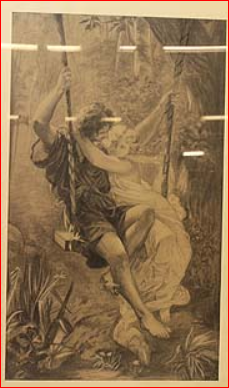
Drawing of Pierre August Cot, "Springtime"
At Effecta, in Sweden, they sell on 6 April 2015 a charcoal drawing, unknown artist, indistinctly signed, ca. 1880, estimated at 107 Euro.
It is an apparently quite good drawing after the once-famous "Springtime" painting by Pierre August Cot from 1873, now proudly displayed in the Met. It's the kind of mainting many people love and many critics used to loathe (although the last few decades the appreciation seems to have improved again for the best of these Victorian paintings). There is always a small chance that the drawing is by Cot (made before or after the painting), but it is unlikely and the work was reproduced numerous times in the years after it was first exhibited. You can't go wrong with it for 100 Euro though. UPDATE: sold for 91 Euro.
Monday, 16 March 2015
After Simon Vouet
At Brussels Art Auctions, 31 March 2015, they sell a drawing as "Anonymous, 17th or 18th century", "The Circumcision" estimated at 300 to 500. With drawings of this kind, there is always the chance that it is a design by some famous artist for a painting, and the composition and so on was quite accomplished, so worth looking further.
In this case, it is a reversed drawing of Simon Vouet's "The Presentation in the Temple". It most likely isn't a drawing by Vouet though, but a drawing after him, and probably after an etching, considering the reversion of the work (or a preparation for a "correct", non-reversed engraving of course). Probably worth no more or less than the estimate (too bad about the crease or line through the middle of the drawing though). UPDATE: sold for 380 Euro, as expected.
Subscribe to:
Posts (Atom)


.jpg)