Showing posts with label Dirk Bouts. Show all posts

Thursday, 7 February 2019

Pandolfini part 2: Flemish Entombment

Pandolfini, from Italy, sells on 26 February 2019 a "Flemish School, 16th century" Entombment, estimated at 2,000 to 3,000 Euro.

The work seems, if one goes back far enough, to be based on a prototype by Dirk Bouts from ca. 1450, now in the National Gallery. The faded colouring is because this is a very rare surviving early painting on canvas instead of on panel.

But a closer parallel is with a work by the Master of Hoogstraten, now in the Royal Museum of Fine Arts of Antwerp. This anonymous Master was active around 1500, and is named after an altarpiece from Hoogstraten, a regional center in the province of Antwerp with a beautiful grand church. This work is a piece of that altarpiece of the Seven Sorrows of Mary.

It seems as if the work for sale is still later and further removed from the Bouts original; the Hoogstraten version keeps the Bouts' right side (the Magdalene and the man), while the Lamentation in the background also reminds me of the Lamentation by Bouts from the National Gallery of Prague. But the position of the Christ, and his hands, are different from the Bouts and closer to the work for sale, as is the man on the left and the posture of the Virgin.


But the work for sale is not by or after the Master of Hoogstraten, sadly, it is a copy after an engraving by Antonie Wierix of a design by Marten de Vos from ca. 1585, as found at the Rijksmuseum. It is a fairly faithful copy, but excludes the extra elements of the Passion in the front, and the (somewhat greyed out) figure above and to the right of Mary, and the church in the background.

The best part of the work for sale, apart from the composition which isn't original, is the very fine colouring, which gives the whole a very pleasing appearance. But the execution lacks some finesse, the faces are a bit rough. All in all, the painting (which may well be early 17th century instead of 16th) is probably worth the estimate, but don't expect to buy something truly original.

UPDATE: sold for 2,750 Euro.

Friday, 9 November 2018

"Attributed to Van der Weyden": can this be a youth work by Bouts?

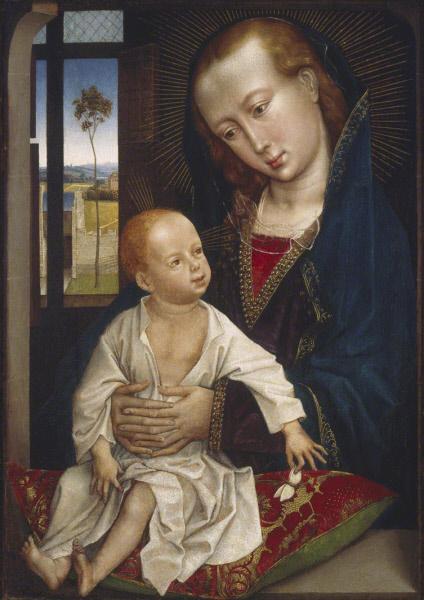
Deutsch, from Austria, sells on 4 December 2018 an "Attributed to Rogier Van der Weyden" Virgin and Child, an oil on panel estimated at 2,800 to 5,500 Euro. The combination of "attributed to Van der Weyden" and a 2,800 Euro estimate makes me believe that one or the other is wrong...

The composition is by Van der Weyden, as can be seen in this workshop version in the Art Institute of Chicago. The one for sale is, apart from the background, an extremely close copy of the Chicago one. Only the face of the virgin is less well executed, and the condition of the work (while still remarkably well preserved for a 500 years old painting) is somewhat lacking, although a removal of the yellowed varnish may solve most of this.

I can't find any examples of Van der Weyden himself using such a background in a Virgin and Child. A similar window and landscape is used by a Follower of van der Weyden in the Saint Louis Art Museum.


Even more remarkable are the similarities with a Dirk Bouts Virgin and Child in the National Gallery.Not only does the window have the same general appearance as the other two examples, the crisscrossed windows at the top seem to have the exact same pattern of coloured elements round the border.

Which leaves me rather puzzled. Is this an early Dirk Bouts, who is supposed to have been a pupil of Van der Weyden? A version from the workshop of Van Der Weyden executed by Bouts, who later in his own work reused elements he invented then, like the window? The work isn't good enough to be a mature Bouts (or a Van der Weyden), but it is close enough in quality to be a work of Bouts as an apprentice, a pupil.

Or is it a work by someone who copied a Van der Weyden composition but added a Bouts window to it? That seems strange, certainly if it is contemporary (late 19th and 20th century forgers are more known to combine elements to create "new" works or new copies). Of course, it may also be a copy after a lost (or to me unknown) Van der Weyden or Bouts.

I would love it to be by Bouts, but I know that I sometimes get carried away when I am duped by a good fake. It certainly seems to be worth the gamble at the very low estimate. If it turns out to be the best-case scenario, the value is immense. If it is a good follower of Van der Weyden and Bouts, from around 1500, then it still is worth 25,000 Euro (well, the value depends also on what the cleaning would reveal, if the painting is even better below the yellowing, it only gets more valuable).

UPDATE: it sold at the time for 10,000 Euro. I since have become more wary of Deutsch, which has an unlikely rich offering for low prices time and time again, as if they have some unlimited supply somehow. 


Monday, 23 April 2018

What's the link between the 1440/50 Lempertz painting and Dirk Bouts?

Lempertz, from Germany, sells on a "Netherlandish Master, ca. 1440/1450" Pieta, a very small (20 by 15 cm) oil on panel estimated at 6,000 to 8,000 Euro.

I already tweeted about this work, but it probably deserves the full blog treatment.

From the period 1440/1450, very few paintings survive, most by masters like Van Eyck and Van der Weyden. Others active then include Hugo Van der Goes and from about 1450 on Dirk Bouts. Contrary to what one might expect, few of those have a gold-painted background, most have some form of landscape, interior, ... unlike Italian or German paintings from the period. Such golden backgrounds seem to be more popular in the later 15th century in Flanders, with people like the Master of the Gold Brocade.

The painting for sale most closely resembles the work of Dirk (Dieric) Bouts and his followers, including two of his sons. The face of Christ and the position of the hands of Mary, with the intertwined fingers, both resemble a Lamentation by Bouts from the Louvre, dated to circa 1460.

Both have Christ as a dead human, not some God in a suspended state. The work for sale takes this even further though, with the grey-blue lips and greyish body colour. The Virgin in that version also isn't some young, beautiful, mourning woman, but an older, grief-stricken mother.

Such realism is not common for depictions of Mary and Jesus, who were gods or godlike, not human like everyone else. The artistic quality though, while certainly not bad, isn't up to par with the composition, so perhaps it is a copy after an older and better work?

The only way I see to place it in 1440/1450 is to see it as the oldest known painting by Dieric Bouts, a somewhat clumsy prototype for his later work like the above Lamentation. In that case, it should be worth a lot (a huge lot even) more than the estimation.

If it is (as is of course more likely) a follower of Bouts, someone like Dirk Bouts II, then the estimate is probably right, but the date is off. by some 40 years at least.

UPDATE: sold for 9,920 Euro, it will be interesting to see if anything further on this work will appear.


Sunday, 8 February 2015

Circle of Dirk Bouts, "Coronation of the Virgin"


A painting of the "Coronation of the Virgin", attributed to the Circle of Dirk Bouts, is for sale at Vanderkindere on 10 February 2015. While far removed from the quality of an actual Bouts, it is a charming picture with some quality, and in a decent state of conservation. The influence of Bouts is obvious in the overall composition, the elongated figures and elements (obvious in the detail pictures of the heads and hands)


I couldn't find any examples of a composition this one may be based on directly. It combines elements from different compositions, similar to these two from the circle of or after Dirk Bouts (pictures courtesy of the RKD)

Estimated at 10,000 to 15,000 Euro, this seems more than enough, but the picture is interesting and rare enough to highlight it here. UPDATE: it sold for 16,500 Euro, so slightly above the highest estimate.