Showing posts with label Auxerre. Show all posts

Friday, 29 September 2017

Very cheap set of 4 unusual 1520 altar piece wings, or 19th century pastiches?


Auxerre enchères, from France, sells a "German School, ca. 1520" set of four scnes from the early life of Christ, with four saints on the back. Sized 95 by 47 cm each, they are together estimated at 3,000 to 4,000 Euro.

I have been looking on and off at these for some weeks now, and haven't yet found anything comparable. My gut instinct tells me these are 19th century works, probably worth the estimate anyway but very incorrectly described.

If, however, these are really from about 1520, then the estimate is way too low. So I'm puzzled both at the works themselves and by the description and estimate. The description is done by the respectable Cabinet Turquin, who do many attributions for smaller French auction house (i.e. everything but Drouot), and usually do a good job.

For starters, the works don't seem German to me. The saints have French names, not German ones, like the above St. Grégoire.
The other three are Hieronisme, Ambroise and Augustin, i.e. four of the major church fathers (Gregory, Jerome, Ambrose and Augustinus). These are the outer sides of the wings, the sides usually visible when the polyptych is closed.

The inner wings show the presentation in the temple, the annunciation, the nativity and the adoration of the shepherds. They are painted in a highly unusual colour pattern, gold and white with a few touches of colour only. I have not been able to find any other triptych or polyptych with these colours or anything resembling it.

Something big (at least 1 by 1 meter) must have formed the central panel here (assuming that these four were the only wings, and we aren't missing a lot ot of other panels as in e.g. the Ghent Altarpiece). While I have no evidence to support this, I would expect the central piece to be not a painting, but a wooden relief, creating a retable from perhaps Antwerp (the center of this kind of artworks in this period).

The paintings are not of the highest artistic quality, it is not as if some unknown masterpiece is being discovered here; but even so finding four wings from this period and in this style would be quite an interesting and valuable thing.

The main reason is that the wood carvings of these retables often have the same colour effect as these paintings.

The end result is normally something like the above, with painted wings and carved central panels. Note how the carved panels have superficially the same effect as the painted panels for sale here: largely brown or gold, with white accents for flesh parts. See also how the retables have four wings at the bottom, again similar to what we have here.

I have looked through the catalogue of the 1993 Antwerp exhibition of such retables, but I haven't found any with gold-painted wings though.

UPDATE: sold for 16,500 Euro, four times the high estimate!

Thursday, 28 September 2017

"German" trompe-l'oeil is by Dutch or Flemish artist N. P. Libberworst

Auxerre enchères, from France, sells on 1 October 2017 an "18th century German school" trompe-l'oeil, estimated at 150 to 200 Euro.

I always love this type of paintings, so I took a closer look. It is a well-painted but somewhat damaged example, with a central panel reminiscent of David Teniers (and on its own better than many "style of Teniers" works which go for 400 or 500 Euro).

The auction house kindly shows a close-up of the text in the lower right corner, which makes it possible to decipher and translate it. The text is in Dutch, not in German.

"Ich onderschreven bekent(?) ontfangen
te hebben van Sr. P. Lebberworst de somme
van dertig gulden handgeld. Dit Lever(?)
van groote partie tweedousand actien (???)
in winder(?) Bergen desen 16 janrij 176?
£30 [diagonally left bottom]
L. De Gruttere"

I, the signee, declare to have received
from Signor P. Lebberworst the sum
of 30 guilders cash money. This deliver
of large group two thousand eighteen
in windy Bergen this 16 january 176x
30 Guilders
L .De Gruttere

A grutter is a grocer, but also a small-minded person. Libberworst may mean Liverwurst.

An artist called N. P. Libberworst has produced a trompe-l'oeil sold at Sotheby's in 2001 for £1,440. The description was "Trompe l'oeil of a picture of a Dutch tavern interior, together with playing cards and a letter, pinned to a wooden wall", and the dimensions were 42 by 47. The dimensions of this one are 43 by 50, so I wonder whether this is the same work or a very similar one. 

In any case; the current estimate is very low.

UPDATE: sold for  1,950 Euro or ten times the upper estimate!

"French School" are two drawings by Ottavio Leoni


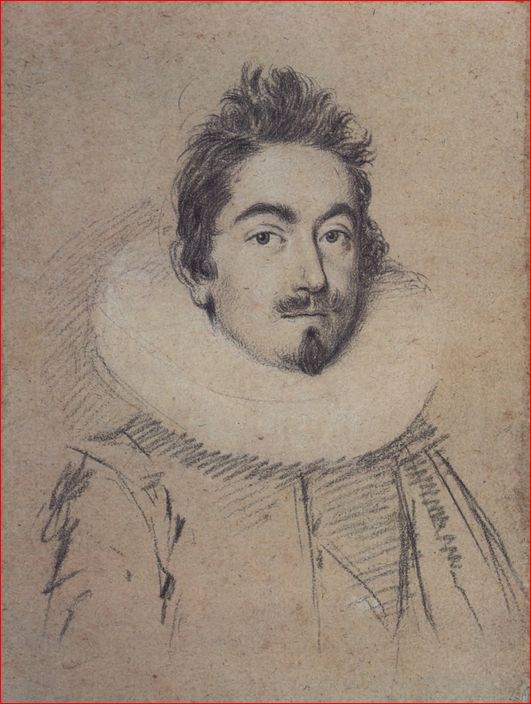
Auxerre enchères, from France, sells on 1 October 2017 two "French School, early 17th century" drawings, estimated at 1,000 to 1,200 Euro each: a portrait of a young man, and a portrait of a lady.

Both works are dated, but in Italian, not in French, which might have been an indication that they were not "Frecnh school" but Italian. The man is dated "i 24 dicembre 1618", the woman "i 35 Aprile 1619". Since, even in those days, April didn't have 35 days, I presume "i 24" and "i 35" are sequential numbers, or else I am misreading something. As the "1"s in the years are also dotted, it may well be "124" and "135".


The drawings are very good and seem to fit the date perfectly, so I have little doubt that they are original works of art by a known master of the period. But in general attributing such portrait drawings is pretty hard unless you have another bit to search on, like the identity of the sitters.

This time I was lucky though, and I found a lot of other drawings of similar style and quality which use the same dating and numbering system (and handwriting). The other drawings are all of similar dimensions as well.

Drawing from the Lille catalogue
Ottavio Leoni (1578-1630) is an Italian artist best known for his portrait drawings. An exhibition catalogue from the Museum in Lille has some more information on this artist, and explains "Most of Leoni's portrait drawings are inscribed with the month and year in which they were executed, as well as a number. These numbers are sequential, with the series beginning in 1615 and ending in 1629". It further explains that most of his pre-1620 drawings were in black chalk only, with post-1620 drawings also using red chalk.

This book on Bernini also discusses Leoni, describing his portraits as an "extraordinary series of drawings" and Leoni as "unequaled in sketch portraits"

Portraits which seal the attribution include:

*this 1620 portrait, number 154, which has the same mark (a reversed P, some watermark perhaps?) to the right of the head (which is very similar to the sitter of the work for sale), and which has at the bottom the same mark of an O with a cross or X below it
*Number 115, from July 1618 (exact same way of writing numbers and date, and of course exact same style of drawing)
*Number 157, April 1620, from the Met: this one explains that the name of the sitter is noted on the back of the drawing, so perhaps the same is true for the two for sale here?

Antiques and Fine Art Magazine make it clear that Number 137 is dated April 1619, which matches exactly with our number 135 from the same month.

In total, there were some 400 numbered drawings, which regularly appear on the art market (and what a fabulous collection target to reassemble as many of these as possible!). The prices vary, Sotheby's sold one in 2015 for £10,000, and one for $25,000 in 2008. A portrait from early 1618 was sold at Christie's Paris in 2014 for 4,750 Euro.

The very cheapest I have found for a Leoni with the number and date was $2,500, but usually these fetch around 5,000 Euro each. And if you are really lucky and can find the identification on the back, and it turns out to be someone really important, then the sky is the limit

UPDATE: not sold, perhaps not enough people recognised this? Perhaps I should have gone for them myself...

UPDATE 2: apparently there was an error at the auction site originally, as it now says that they were sold for 12,000 Euro and 14,000 Euro, which is much more logical.

Wednesday, 27 September 2017

"Loth and his daughters" featuring Gabrielle d'Estrées

Auxerre enchères, from France, sells on 1 October 2017 a "17th century school" Lot and his daughters, a relatively large canvas (108 by 138 cm) estimated at 1200 to 1500 Euro.


Neither the subject nor the artistic merits are particularly remarkable, but for one aspect: the nude daughter of Lot is most likely a portrait of Gabrielle d'Estrées (1573-1599), mistress and later fiancée of the French king Henri IV (or of course her very similar looking sister). The hair, the earring, and of course the bare breasts and the position of the upper torso and right arm, and the way the hand pinches the nipple, are also very reminiscent of the famous d'Estrées painting.

The work for sale is probably later and painted by a less able hand, but it is still fascinating to see how such an iconic work was revisited in later, unrelated works.

UPDATE: not sold.