Monday, 13 June 2016

Marriage contract

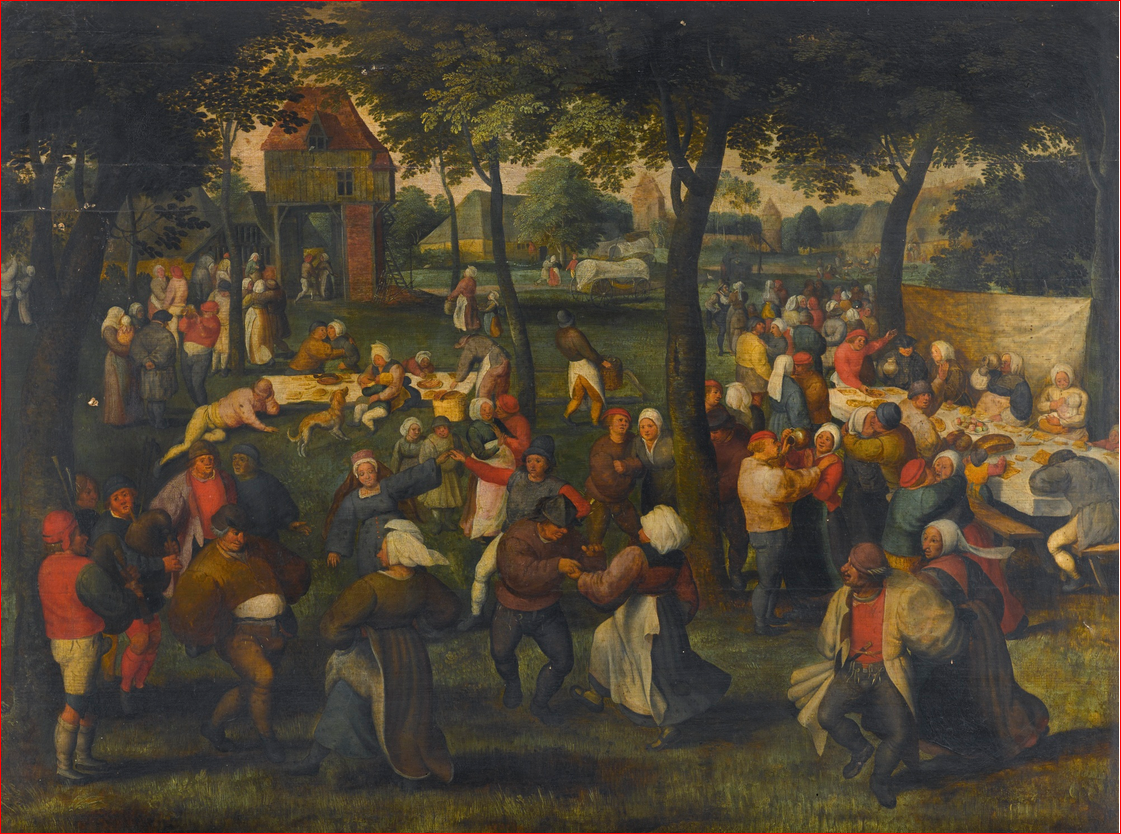
Mercier, from France, sells on 26 June 2016 a "Flemish School, 17th century" Marriage contract, a large canvas (74 by 132cm) estimated at 3,000 to 4,000 Euro. The site from Mercier seems to be down, so I linked it to interenchères (where the link doesn't work any longer after the auction has finished, which is annoying).

It is a good example of a typical Flemish subject, and the central element is close to a work by Marten van Cleve (1527-1581) sold at Sotheby's in 2015 for £185,000. Before a cloth or tapestry, the bride (crowned) is seated between two other women, with on the left of them (from our point of view that is) a man who is presumably an official, as he seems to be in charge of the marriage contract. Meanwhile people from the village are bringing gifts for the new couple, and a bagpipe player brings a festive note.

The same event can be seen in Pieter Bruegel's "Peasant Wedding" and "The wedding dance", but in those cases the wedding of the title is more or less hidden in the background. And of course when the weather is bad, you party indoors! In the Brueghel paintings, something hangs above the head of the bride, the significance of this is not clear to me though. The Brueghel the Younger work at the bottom is again closer to the Van Cleve.

Note also how similar elements return in Flemish paintings of the marriage at Cana; the bride, crowned (and sometimes with things suspended above her head) is seated in front of a tapestry or the like, flanked by two elder women. An example by Ambrosius Francken I is shown here, but e.g. Marten van Cleve has done the same.

The work for sale (which may be late 16th century instead of 17th century) is a fairly attractive work but a far cry from the works of someone like Van Cleve or of course Bruegel. However, historically it is very interesting as a depiction of a major day in the lives of everyday people and villages.

Note that Sotheby's has two further village marriages by Marten van Cleve in its upcoming Old Masters' sale. The first one seems to be less well-painted than the Cleve shown above, I would list it as a Follower instead. The age of the boards the work is painted on suggests that it is contemporary to Cleve though, so either it is by him but has lost some details over the ages (overcleaning), or it just is a lesser work. The second one shows an image from later in the feast, not really comparable anymore to the early stage of the wedding shown in the work for sale. Both are estimated at £100,000 though, the one I highlight is a bit cheaper.

UPDATE: the Mercier work is now (26 June 2017) again for sale at Millon instead, with a somewhat lower estimate of 2,000 to 3,000 Euro, so I guess it didn't sell last year. 

Friday, 10 June 2016

"Flemish School" Tower of Babel: a huge Hendrik van Cleve III?

Retiro Subastas, from Madrid, Spain, sells on 15 June 2016 a huge (154 by 232cm!) "Flemish School, 17th century" Construction of the Tower of Babel estimated at 20,000 Euro.

The auction house points to the many other versions of this story painted in Flanders in the late 16th and early 17th century by artists like Pieter Bruegel, Tobias Verhaecht, Frans Francken and Lucas van Valckenborch.

This specific type though, with a square foot of the tower pointing at the viewer, and a round tower where the first floor seems  to bulge upwards (highly exaggerated perspective with the vanishing point between the square floors and the round floors), can be traced back to one painter, Hendrick van Cleve III (Antwerp, 1525-1595), the most famous of the four Hendrick Van Cleves. He was the brother of Marten van Cleve, who will appear by coincidence on this blog next week. This version, from the Kroller-Muller museum in the Netherlands, measures 41 by 47 cm.

The example in the previous paragraph is clearly superior to the one for sale, but other variants attributed to Cleve are rather comparable to the one we have here. The above black-and-white photo is a version sold at Tajan, Paris in 2001 (found on RKD). The second, rather ornagey example also shows many of the same characteristics and similar figures in the foreground.

Most of these examples are significantly smaller than the one for sale though, and one would expect a version this large to be more detailed. Still, a work of this considerable quality, huge size, popular topic, and with a possible artist (or by a close follower) should easily fetch the estimate. All other versions which were sold over the last few years and which were associated with Cleve (from by him to followers) fetched about 20,000 Euro or a lot more, and none of those I checked even comes close to the size of this one.

Note also the one for sale at Sotheby's on 16 June 2016, again a somewhat better but much smaller one with many identical features, especially the strange perspective in the Tower, but also the bridge on the right, or the position of the King or main figure in the foreground.

UPDATE: this work is now for sale at Hampel, 5 July 2017, with the attribution "Dutch Painter, 17th century" and an estimate of 15,000 to 25,000 Euro. I don't know whether it sold last time and the seller won't get the expected profit, or whether it didn't sell and this is a well-deserved second try in a perhaps better auciton house for this kind of thing. They didn't recognise or accept my Hendrick van Cleve III attribution though ;-)


Thursday, 9 June 2016

E. Guitton(?) is Edouard Quitton

Vanderkindere, from Belgium, sells on 21 June 2016 a "Guitton(?), E., late 19th / early 20th century" farmyard scene, a small work (19 by 26) estimated at 150 to 200 Euro.

It is a work by Edouard Quitton, a somewhat forgotten Belgian painter from the second half of the 19th century, whom I already discussed in one of my first blog posts, from January 2015. This painting now isn't very important, it just amused me to see an artist already featured here misread in an auction in his own country. The work featured in Januray 2015 was a lot more impressive though.

A very similar, slightly larger work can be found at Kelleher Fine Art.

The work is probably worth a bit more than estimated, 600 to 800 Euro I would guess, certainly to a Quitton collector.

UPDATE: sold for 150 Euro, cheap!

Wednesday, 8 June 2016

"Healing of the Blind" is "Elymas struck blind"

Dickhaut, from Maastricht in the Netherlands, sells on 13 June 2016 a "Flemish School, 17th century" Healing of the Blind, a large oil on canvas (92 by 153 cm) estimated at 1,000 to 2,5000 Euro (a rather wide estimate). It is an online auction, one can bid from 10 June 2016 until 13 June 2016 21.00u CET.

The painting is not really similar to other "Healing of the Blind" depictions, as there is not Christ to be seen, but centrally we have a man on a throne with "SPQR", the sign of Rome. It turns out that the story is the exact opposite of the supposed subject, as it depicts "Elymas the sorcerer struck blind before Sergius Paulus". Perhaps the most famous painting of this story is the one by Raphael (pictured, from the Victoria&Albert). 

The one for sale seems to be loosely based on this Raphael (in reverse, so probably after an engraving like the above).

The work for sale comes from the collection of the Ursuline nuns in Venray, and used to be on loan to the Bonnefantenmuseum in Maastricht. This provenance can be deduced from the RKD but isn't given at the auction site, sadly. The estimate is probably about right: the quality of the painting is the typical mediocre Flemish work of the period, churned out by the thousands, but the subject is highly unusual. 

UPDATE: sold for 850 Euro. 

UPDATE 2: Now again for sale at Hargesheimer, in Germany, on 24 September 2016, with an estimate of only 400 Euro, which is cheap (and a serious loss for the seller). It is simply described as "German/Dutch master, 1st half 17th c." and "Bible scene". No provenance is given.

NIce example of the "Portrait Historié"

Kastern sells on 11 June 2016 an "Old Dutch Master, ca. 1620-1630" portrait of a family in historical context, estimated at 3,000 Euro.

It is a relatively rare work of the "portrait historié" type, the family portrait in an unrealistic, normally historic or mythological setting. It follows most of the typical elements, like having the elders seated (the most important position) and the children standing. There are 10 children shown, and seven additional figures in the background (perhaps children which had already died: other paintings of this type show these are floating heads with wings or tiny angels above the portrait). Sometimes in these paintings the clothes are also pseudo-historical, but here they are more contemporary. The use of this type and historical clothing was apparently due to the wish of the sitters to have a painting that didn't look old-fashioned in a few years time, when the fashion of clothing had changed.

According to the auction description, the historical background could be the Biblical conflict between Israel and Egypt, which was a predecessor (in the view of the Dutch) of the conflict between the Netherlands and Spain. I have to say that I see no trace of anything pointing towards Israel or Egypt here, but I may be missing some clues here.

The painting isn't by the hand of a master, but is painted well enough. It contains elements of the still life (the table with the typical small white bread and the Bokal, the large bulbous vessel in the middle), and also shows some unexpected elements of everyday life of the rich in this period, like the doll in the arms of the girl on the left.

The most comparable example I could find online was the above "Gathering of the Manna", a 1648 family portrait by Dirck Metius (from the RKD). Here as well we have the diagonal top left - bottom right composition, with the family in front of some tents. It only shows a general similarity though, painter and probably date are clearly different.

Tuesday, 7 June 2016

View of Antwerp

Bukowski's, from Sweden, sells on 12 June 2016 a "Dutch School, 18th century" view of a city with strollers, estimated at 30,000 SEK (3,250 Euro).

It is a view of the Meir, at the time the main street of Antwerp (and now the main shopping street, the second most expensive street in the Belgian version of Monopoly). The large tower in the background is the spire of the Antwerp Cathedral (the second, identical spire has never been finished). The cityscape is nearly identical to some works by Erasmus de Bie (Antwerp, 1629-1675; example from the collection of the Rockoxhuis pictured first, example sold at Sotheby's in 2002 for £35,000 second) but is not by him and, looking at the clothing, should probably be dated slightly later (early 18th century).

It isn't a good painting, artistically, but historically and culturally these views of Antwerp are important and very popular, and if some people recognise the view it should easily fetch the estimate. Better versions, e.g. by Frans de Momper (a reverse view of the Meir, example sold at Dorotheum pictured), can go for 50,000 Euro. Other painters like Alexander van Bredael also painted nearly the same view, but all are better than what is for sale here.

The most comparable version is probably the one from the Royal Museum of Fine Arts in Antwerp, which is also anonymous and dated to the 18th century (picture via Balat).

UPDATE: not sold, highest bid was only a miserable 783 Euro. 

Interesting "Collection Lucinis" in Stockholm

Over the course of a few days this week (9 to 11 June 2016), Magasin 5 (from Stockholm) sells the so-called "Lucinis Collection", a series of 162 mainly 17th- and 18th-century Western European paintings of reasonable quality and interest. Many are copies or works by followers (and/or damaged paintings), but all seem authentic and many have enough charm and quality to be interesting. I'll just discuss a few here.

A Dutch school painting of a horse, is probably the most popular so far, with as of writing 32 bids going for more than double the estimate. It is dated 1667 and monogrammed HR. It reminds me a bit of Philips Wouwerman, but is much less anatomically correct, more evocative, and looks to me more English than Dutch. I can't find a possible artist for it, but a few others probably did (or simply like the painting of course).

Perhaps the most valuable is a work by Willem Van Aelst (Dutch, 1627-1683), a very well executed still life of dead game. Estimated at 850 Euro only, it has only received 5 bids so far and with the highest being 430 Euro. The work has some damage, but this should be fairly easy to restore. It is unusual to fine a dead bird by Van Aelst without any decor, but the quality of the painting is good enough to attribute it firmly to him anyway (and the big black field around the bird makes it more modern looking than many still lifes otherwise). Should be worth some 2,000 Euro I guess.

Perhaps the least well described is the "19th century Italian School" Salomé with the head of John the Baptist, estimated at 325 Euro and currently with 4 bids at 185 Euro. The gruesome depiction (even more so than the already bloody story makes necessary) looks like a (copy after a) 16th century Flemish work instead.

Examples of similar depictions can be found with Adriaen Key (ca. 1575, pictured, from the Rouen Museum). Also the ca. 1630 anonymous Antwerp work is similar in general conception. I couldn't find any 19th century Italian works in this vein. The general style of the work for sale also more closely matches the second-rate painters active in Antwerp in the 17th century.

A very nice work is this "Italian School, 18th century" Mystical Marriage, estimated at 430 Euro and currently with three bids at 260 Euro. It is a copy after Correggio (bottom picture), and while being somewhat rosy and weaker in execution, it still is an attractive painting with a low price.

Finally, there's a work attributed to Gillis Mostaert, an Agony in the Garden. It is highly unusual in showing a defeated, despairing Christ, without any support by angels. Normally we see him either questioning, pleading, crying out, or being supported by angels, but never like this. It seems also like a mix-up between the scene of Christ on the Cold Stone (part of the Ecce Homo story) and the Gethsemane scene depicted here. I guess that the composition didn't become popular because, while people liked a work depicting Christ in physical pain (as a human), they didn't like one of him being in psychical pain (which made him not only human in the flesh, but also in the mind, which was not befitting for a son of God).

Estimated at 1,100 Euro, so far only 175 Euro has been bid. This one should end a lot higher, as it clearly is an Antwerp painting from around 1600-1650, a work of considerable quality and originality, perhaps based on an unknown work by Mostaert or someone from the Francken family.

UPDATE: sold for 2,800 Euro, still not too much for this interesting work.