Wednesday, 20 January 2016

"Follower of Rembrandt" portrait: is it Saskia? And can we identify the painter?

Doyle, from New York, sells on 27 January 2016 a "Follower of Rembrandt" portrait of a woman, estimated at $3,000 to $5,000.

It is a very nice portrait, much better than the usual Rembrandt-style paintings one sees, and for a very reasonable price for this quality. It's not a hidden Rembrandt probably, the painting is a bit too flat when seen in detail, not painted lively enough; but it is a very competent, striking image nevertheless.

First question it raises; is it Saskia, Rembrandts wife and muse? The above portrait of Saskia by Carel Fabritius could well be the same woman, but it's hard to be sure.  

Searching among the pupils of Rembrandt to find possible matches, I noticed different possible matches, like Aert de Gelder, Leveck or Samuel van Hoogstraten. Perhaps the most likely candidate is Isaac de Jouderville. He uses less of the flou artistique so beloved by many pupils of Rembrandt, as can be seen in the portrait pictured above.

Other pupils also made similar works, but their style is less close to the one for sale. For instance the above portrait is by Willem Drost, who seems to have a much looser touch of the pencil. Other works by Drost come closer to the one for sale though, these artists didn't stick to one fixed style sadly (for us, now, I mean).

I don't think, based solely on the picture on the website, that it can be attributed to Jouderville or any other painter  (perhaps by a real specialist in these portraits, certainly not by me). But it is a very good example of this style and should be worth a lot more.

UPDATE: sold for $11,250, more than three times the estimate: nice to see that the bidders for once agree with me ;-)

Monday, 18 January 2016

Flemish "religious scene" is a Death of Saint Lawrence after Titian

Bellmans, from the UK, sells on 19 January 2016 a "Flemish School, 18th century" "religious scene", estimated at £200 to £300.

It clearly is a "Death of Saint Lawrence", with the typical barbecue used for this martyrdom, but it took some searching to find the origin (or at least one origin) of this painting.

A first clue was a work sold at Christie's Amsterdam in 2005 as a "Manner of Rubens", which contained in reverse the same angels, man with the flag, and similar central figures.


No Rubens' work that formed the basis for this painting turned up though, but further research showed it to be a faithful though largely reversed copy of a work by Titian (the angels on the top are strangely not reversed in the Christie's work) from the Escorial.

The reverse inscription on the work for sale (part of the "last words" of Lawrence) is a clear indication that this work is based on an engraving of the original. Where the added parts come from is not immediately clear. It is a cheap and strange work, but doesn't have much artistic quality.

UPDATE: sold for £550 or more than double the estimate.

Tuesday, 12 January 2016

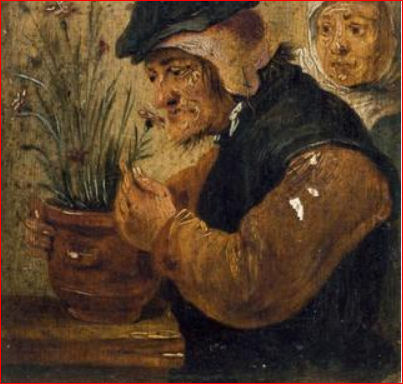
Two of the five "Senses", after Teniers


Binoche et Giquello sell, through Drouot, on 15 January 2016 two paintings from the "Atelier of David Teniers" estimated at 400 to 600 Euro.

While the first one is correctly described as an "allegory of smell", the second is apparently not recognised as the accompanying "allegory of touch". It seems a bit optimistic to put this in the Teniers atelier, even though that had a rather large production of varying quality: but as two old works after Teniers, the estimate seems on the conservative side.

The "Touch" is a copy after the above Teniers (from the Guildhall Art Gallery in London), but without the decor and with the glee on the face of the old woman replaced by a more concerned expression (probably due to the lack of skill of the copier). The differences in colour and details may indicate a few stations between the original and the copy, not some work straight from the workshop.

I couldn't find a version of the "smell" that was equally close to the one for sale, but paintings like the above show the similarity with the works of Teniers anyway. It is quite possible that an original series of the five senses with the same woman in them existed, and that the "smell" for sale here is a reminder of how the original may have looked. 

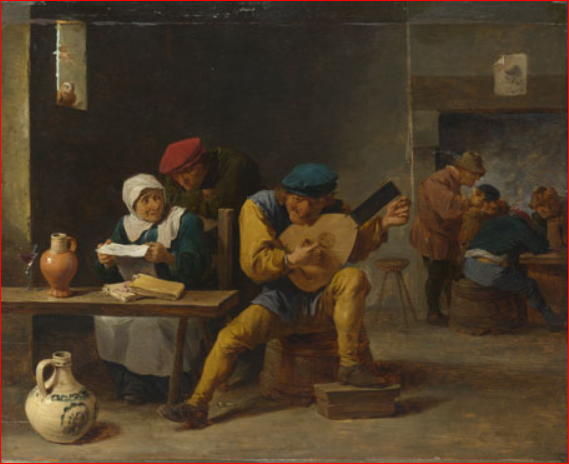
One can wonder if other Teniers' paintings, like the above two from the National Gallery featuring a very similar older woman, aren't also part of series of the senses (in this case, taste and hearing?). The above two are not connected in the National Gallery website (even though they came from the same collection at the same time and have similar dimensions), and are given dates ten years apart, but it is obvious that they (or their originals at least, if they are workshop copies) belong together from the many identical elements in them; this makes it more likely that they were part of a series of course, and it would be nice to find the other three senses from the series.

Monday, 11 January 2016

Sleepers and what happens next: the Sotheby Babel

Sotheby's has in its Old Master sale a "Flemish School, 17th Century" Tower of Babel, estimated at $200,000 to $300,000.

It's a very nice example, not easily placed in the works of a known artist or even closely related to most of the other similar Flemish Babel towers.

It was last sold in October 2014 at Nagel, German auction house. They had estimated it at only 15,000 Euro, but fierce bidding saw it soar to 210,000 Euro. A real sleeper, but slightly more than a year later, it only gets the same estimate as what it sold for two years ago, and without the benefit of being "fresh to the market" (Sotheby's omits the provenance and auction history with a reason, of course). It will be interesting to see if it will sell and if it will make another profit.

UPDATE: sold for $418,000, so about double the previous price and incomparable to the original 15,000 Euro estimate of October 2014!

Wednesday, 6 January 2016

Supper at Emmaus reuses elements from Rubens, but is it really 17th century?

Vanderkindere, Belgium, sells on 19 January 2016 an "Antwerp School, second quarter of the 17th century" Supper at Emmaus, a large panel painting (106 by 151) estimated at 5,000 to 7,000 Euro.

The central figure of Jesus and the old woman behind him are copied from a well-known Rubens painting of the same subject (image from the RKD). Other elements, like the man pouring a drink on the left, also seem very familiar, with elements reminiscent of Bloemaert or Wolffort. I wonder if this isn't a much later pastiche (the woman on the far left seems more like a 19th century painting to me) instead of an original Antwerp painting close to Rubens' period.

If original, it is easily worth the estimate, but I don't really trust this one.

UPDATE: sold for 5,000 Euro, the bottom estimate.

Tuesday, 5 January 2016

"In style of Vermeer" looks like a weak Quiringh van Brekelenkam

Leonhardt, German auction house, sells on 16 January 2016 a "17th century, in style of Vermeer" panel painting of a lacemaking woman in an interior, estimated at 2,000 to 2,500 Euro.

It looks close to some works by Quiringh van Brekelenkam, a lesser-known Dutch master of the interior, whose best works fetch 100,000 Euro and more but who also painted quite a lot of mediocre works in the same style (or many works are incorrectly attributed to him?) This work definitely belongs to the mediocre category, not to his masterpieces, but it's nice to put a name to a work (no matter if it is "by" or "after").

The closest resemblance can be found in the above interior, sold at Sotheby's New York in 2011 for $158,500. From the window to the left, with the one opened panel, through the lace maker, the white "tapestry"(?) behind her, right through to the fireplace on the right, the similarities are plain to see. The interior in the one for sale is a poorer house, although it has quite a few books.

The above from the Rijksmuseum also contains a few very similar elements, like the chair, the tapestry, the bird cage, the windows, and of course the same shape of the lacemaking tool.

Looking at yet more Van Brekelenkam paintings with similar interiors, I can see that the white tapestry is supposed to be a map, but I can't see whether it is recognisable in the work for sale (it would make it clearly more valuable, as it would appeal to map collectors as well).

The more mediocre Van Brekelenkam can be seen in works like the above "woman scaling fish", or the many works at auction that are sold for a few thousand euros or simply bought in.

The work for sale is cheap, but even as a Van Brekelenkam it won't be worth much more. But I always like to attribute works!

UPDATE: sold for 1,300 Euro, not a lot for this.

Monday, 4 January 2016

"Painter unknown" at Bruun Rasmussen is a naive copy after Francken or Caullery

In a few moments, Bruun Rasmussen of Denmark will sell an "unknown painter, 17th-18th century" panel with the Crucufixion, estimated at 1,600 to 2,000 Euro.

It is a naive copy with variations of a Crucifixion by Frans Francken the Younger, now in a private collection.

Other elements come from a similar painting which also used to be attributed to Francken, but now, according to the RKD, comes from the Caullery Studios.

An internet search finds other very similar Caullery compositions, so that may be more correct. The above, sold at Christie's in 1998, is a very comparable example (e.g. the group in the bottom right corner is quasi identical, as are the three Marys). The current one is definitely not by either artist or studio though, as the quality really isn't good enough.

UPDATE: not sold.