Stahl, from Germany, offers on 29 April a "Bruges, ca. 1550" Adoration of the Magi, estimated at 4,800 Euro.
It is a (fragment of a) copy after a composition I have already discussed a few times, most recently in February 2017 (then for an auction at Hargesheimer).
This is clearly the same composition, which was made in many copies of varying quality. Thoe one for sale isn't good enough to be by Coecke, but it still is an attractive, old Flemish painting (though not from Bruges probably) for a very reasonable price.
Friday, 7 April 2017
Thursday, 6 April 2017
"17th century Dutch School" still life
Horta, from Brussels, sells on 24 April 2017 (in an auction which has already given me some other blog posts) a "Dutch School, 17th century" still life with lobster, estimated at 3,000 to 4,000 Euro.
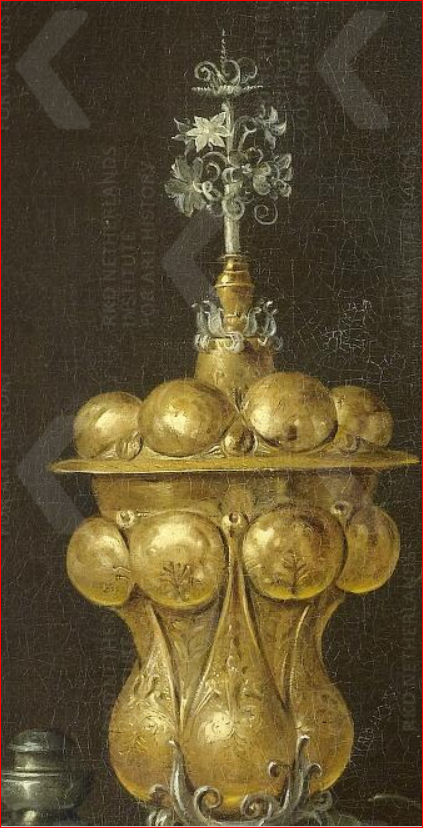
The painting ,while not brilliant, was a lot better than most anonymous still lifes, and featured a "buckelpokal" or "pronkbeker", an elaborate gilded or golden cup, often with bulbous elements, and usually with a sculpted ornament on the top (often in silver). I already discussed another still life with such a cup in a post from October 2015.
The cup in the work for sale is quite distinctive, with what appears like a crowned thistle at the top. Perhaps this points to some connection with Scotland? In any case, looking at other lobster still lifes, I wa slucky enough to find the same or a very similar cup in some works by members of the Mertens family.
Then we have Cornelis Mertens, who may or may not be the same artist, but definitely is closely related. Cornelis was a pupil in 1644, a master in the Antwerp Guild of Saint Luke by 1656, and died in 1698. We know that he painted still lifes, but only works signed W. Mertens are known, none by C. Mertens.
The painting for sale most closely resembles elements from the works of Wouter Mertens, but seems to lack his very high quality. Either the work has deteriorated over the ages (restorable or not), or the work is by a skilled follower, most likely Thomas Mertens. Some examples of similarities with the Wouter Mertens shown above can be seen in the cup, but also the way the peach is presented, the way the skin of the lemon is painted, and the use of the background (with a curtain on the right and a cord for the curtain on the left).
Especially the cup is a definig factor in my opinion. Such pokals were very expensive and all were one-off show pieces. I have not encountered examples of the same cup appearing in the work of unrelated artists, although it may of course have happened. This one is quite distinctive, not so much the lower, golden part (although the double row of globes and then underneath and between it the elongated forms are obviously the same), but especially the upper, silver bit. Very often this was either a sculpture (Saint Michael or Saint George seems to have been popular), or a geometric form. A more natural, floral form like the thistle(?) here is more unusual, and this specific one seems to be unique.
It can be compared to an example from the Victoria and Albert Museum, made ca. 1620. It has the same pattern below, and a similar but not identical decoration at the top. This type was apparently mainly made in Nurnberg, Germany.
Other Mertens works feature the very same cup: this work, found through RKD and sold at Piasa in 2010 for 20,000€, again has the nearly exact same cup.
A W. Mertens from the Heinz Collection in Washington, which I could only find in this pdf by Lorenzetti and with some very poor colour photos online, again has a similar cup, and a lobster and basket which are very similar to the one on the work here.
Some works by Thomas Mertens have the same elements, and are in execution closer to the work for sale here, so I would suggest, despite the apparent lack of a signature, that this is a work by Thomas Mertens. As such, it should be worth about 10,000€, maybe more if it can be cleaned or restored to its full glory.
UPDATE: sold for 3,400 Euro only.
The painting ,while not brilliant, was a lot better than most anonymous still lifes, and featured a "buckelpokal" or "pronkbeker", an elaborate gilded or golden cup, often with bulbous elements, and usually with a sculpted ornament on the top (often in silver). I already discussed another still life with such a cup in a post from October 2015.
The cup in the work for sale is quite distinctive, with what appears like a crowned thistle at the top. Perhaps this points to some connection with Scotland? In any case, looking at other lobster still lifes, I wa slucky enough to find the same or a very similar cup in some works by members of the Mertens family.
Wouter Mertens, sold at Sotheby's in 2006 for $385,000
There are two or three Mertenses who painted still lifes in the second half of the 17th century. The first is Wouter Mertens, who signed W. Mertens and probably was from (or at least trained in) Antwerp. The majority of the handful of signed works by him are still ifes with a lobster and fruit.Then we have Cornelis Mertens, who may or may not be the same artist, but definitely is closely related. Cornelis was a pupil in 1644, a master in the Antwerp Guild of Saint Luke by 1656, and died in 1698. We know that he painted still lifes, but only works signed W. Mertens are known, none by C. Mertens.
Thomas Mertens, sold at Sotheby's in 2015 for $43,000
Thomas Mertens (or J. Van Son), sold at Lempertz, 2016, est. 40.000€
This brings us to the link between the two (apart from the last name of course): Thomas Mertens. Thomas was probably the son of Cornelis, but his works closely resemble these from Wouter Mertens, and copy multiple elements from them. His oldest known work is from 1666.The painting for sale most closely resembles elements from the works of Wouter Mertens, but seems to lack his very high quality. Either the work has deteriorated over the ages (restorable or not), or the work is by a skilled follower, most likely Thomas Mertens. Some examples of similarities with the Wouter Mertens shown above can be seen in the cup, but also the way the peach is presented, the way the skin of the lemon is painted, and the use of the background (with a curtain on the right and a cord for the curtain on the left).
Especially the cup is a definig factor in my opinion. Such pokals were very expensive and all were one-off show pieces. I have not encountered examples of the same cup appearing in the work of unrelated artists, although it may of course have happened. This one is quite distinctive, not so much the lower, golden part (although the double row of globes and then underneath and between it the elongated forms are obviously the same), but especially the upper, silver bit. Very often this was either a sculpture (Saint Michael or Saint George seems to have been popular), or a geometric form. A more natural, floral form like the thistle(?) here is more unusual, and this specific one seems to be unique.
It can be compared to an example from the Victoria and Albert Museum, made ca. 1620. It has the same pattern below, and a similar but not identical decoration at the top. This type was apparently mainly made in Nurnberg, Germany.
A W. Mertens from the Heinz Collection in Washington, which I could only find in this pdf by Lorenzetti and with some very poor colour photos online, again has a similar cup, and a lobster and basket which are very similar to the one on the work here.
Some works by Thomas Mertens have the same elements, and are in execution closer to the work for sale here, so I would suggest, despite the apparent lack of a signature, that this is a work by Thomas Mertens. As such, it should be worth about 10,000€, maybe more if it can be cleaned or restored to its full glory.
UPDATE: sold for 3,400 Euro only.
Tuesday, 4 April 2017
"18th century Dutch school battle scene" is Siege of Antwerp
Horta, from Belgium, sells on 24 April 2017 an "18th century Dutch School" battle scene, estimated at 6,000 to 8,000 Euro.
The painting is rather naive, and purely artistically not worth the estimate by far, but it gets interesting nevertheless because the city in the background seems to be a rather correct depiction of Antwerp ca. 1600. This would make it a depiction of the 1584-1585 siege of the city by the Spanish troops. Whether the painting really is Dutch 18th century is hard to tell, 17th century seems more likely.
The huge central tower, with the small tower just in front of it, is the Antwerp Cathedral, still today the most impressive landmark of the city.
This image is a reverse view, as I wasn't able to easily find an old image taken from about the same spot (this painting is taken from the south, the image above from the North, but most old paintings are taken from the West, across the harbor, which still is the best position to look at Antwerp).
This map gives an aerial view from about the same place as the work for sale.
Why the soldiers on the right seem to be shooting a group of people returning to the city, or why the people returning are still calmly going on instead of running for their lives, is rather unclear.
UPDATE: a reader of the blog kindly sent me a link to a file at RKD which I missed, but which confirms the " reminds somewhat of the works of Pieter Meulener" statement I made above: the work for sale is a copy of or variation of that painting, which was sold at Piasa (France) in 1997 for 130,000 FRF (near to 20,000 Euro). It depicts the Entrance of the Cardinal-Infant Ferdinand in Antwerp, which means that the people shooting at the "retreating troops" which baffled me, are probably soldiers firing blanks as a honorary salute. The Entrance happened in 1635, so the painting in any case is later than that! So, right city, right painter, wrong occasion; I can live with that ;-)
Other copies of the work sometimes appear at auction: the above example is very rudimentary though. A version was sold at Tajan in 1998 for 85,000 French Francs, or some 12,000 Euro; another version was offered in 2004 at the same house, but didn't make its 30,000 Euro estimate.
UPDATE 2: sold for 4,600 Euro, clearly below estimate
The painting is rather naive, and purely artistically not worth the estimate by far, but it gets interesting nevertheless because the city in the background seems to be a rather correct depiction of Antwerp ca. 1600. This would make it a depiction of the 1584-1585 siege of the city by the Spanish troops. Whether the painting really is Dutch 18th century is hard to tell, 17th century seems more likely.
The huge central tower, with the small tower just in front of it, is the Antwerp Cathedral, still today the most impressive landmark of the city.
This image is a reverse view, as I wasn't able to easily find an old image taken from about the same spot (this painting is taken from the south, the image above from the North, but most old paintings are taken from the West, across the harbor, which still is the best position to look at Antwerp).
This map gives an aerial view from about the same place as the work for sale.
Why the soldiers on the right seem to be shooting a group of people returning to the city, or why the people returning are still calmly going on instead of running for their lives, is rather unclear.
Pieter Meulener, Siege of Antwerp
The style of the work reminds somewhat of the works of Pieter Meulener and the like, but isn't good enough to really be attributed to any known painter. For a work depicting a generic battle, the price is too high: for an old (though probably not contemporary) depiction of the Battle of Antwerp though, it may well be justified; views of Antwerp sometimes fetch prices much higher than the artistic merit would justify.UPDATE: a reader of the blog kindly sent me a link to a file at RKD which I missed, but which confirms the " reminds somewhat of the works of Pieter Meulener" statement I made above: the work for sale is a copy of or variation of that painting, which was sold at Piasa (France) in 1997 for 130,000 FRF (near to 20,000 Euro). It depicts the Entrance of the Cardinal-Infant Ferdinand in Antwerp, which means that the people shooting at the "retreating troops" which baffled me, are probably soldiers firing blanks as a honorary salute. The Entrance happened in 1635, so the painting in any case is later than that! So, right city, right painter, wrong occasion; I can live with that ;-)
Other copies of the work sometimes appear at auction: the above example is very rudimentary though. A version was sold at Tajan in 1998 for 85,000 French Francs, or some 12,000 Euro; another version was offered in 2004 at the same house, but didn't make its 30,000 Euro estimate.
UPDATE 2: sold for 4,600 Euro, clearly below estimate
Monday, 3 April 2017
"Cats and Crayfish": Julius Adam?
Horta, from Brussels, sells on 24 April 2017 a "Belgian School, 19th century" painting of cats and crayfish, estimated at 1,800 to 2,200 Euro.
The work is very similar to some works by Julius Adam (1852-1913), perhaps the greatest German animalier of the 19th century, and certainly the most famous German cat painter. Many of his paintings are more sweet, gentle kittens, closer to the typical German porcelain painting art of the time, but some of his best works are vibrant, full of energy and mischief.
One work with the same theme, but much gentler, was sold at Dorotheum in 2016 for 11,000 Euro.
But the most similar is this one of "two young cats playing with a basket of crayfish". If it wasn't for this one (still in a private collection, as far as I can tell), I would be hard-pressed to defend the link with Adam apart from the obvious very high quality of the work for sale.
Most of his works are signed though, and this work seems to lack any signature, which is a pity. If it could definitely be attributed to Adam, it should be worth around 10,000 Euro. As an anonymous work (German or Belgian, doesn't matter), it should still easily fetch the estimate as it is a very good painting, capturing the essence and power of the cats perfectly.
UPDATE: sold for 1,600 Euro, seems cheap!
UPDATE 2: again for sale at Horta on 23 January 2018, still as an anonymous Belgian 19th century work, with an estimate of 1200 to 1500 Euro only. If I were the seller, I wouldn't have offered it again at the same auction house (where you only get the same bidders mostly) but somewhere else to improve its chances. Still, I believe this to be worth more as it is a very good work, decorative but not sentimental lifeless tripe.
The work is very similar to some works by Julius Adam (1852-1913), perhaps the greatest German animalier of the 19th century, and certainly the most famous German cat painter. Many of his paintings are more sweet, gentle kittens, closer to the typical German porcelain painting art of the time, but some of his best works are vibrant, full of energy and mischief.
One work with the same theme, but much gentler, was sold at Dorotheum in 2016 for 11,000 Euro.
But the most similar is this one of "two young cats playing with a basket of crayfish". If it wasn't for this one (still in a private collection, as far as I can tell), I would be hard-pressed to defend the link with Adam apart from the obvious very high quality of the work for sale.
Most of his works are signed though, and this work seems to lack any signature, which is a pity. If it could definitely be attributed to Adam, it should be worth around 10,000 Euro. As an anonymous work (German or Belgian, doesn't matter), it should still easily fetch the estimate as it is a very good painting, capturing the essence and power of the cats perfectly.
UPDATE: sold for 1,600 Euro, seems cheap!
UPDATE 2: again for sale at Horta on 23 January 2018, still as an anonymous Belgian 19th century work, with an estimate of 1200 to 1500 Euro only. If I were the seller, I wouldn't have offered it again at the same auction house (where you only get the same bidders mostly) but somewhere else to improve its chances. Still, I believe this to be worth more as it is a very good work, decorative but not sentimental lifeless tripe.
"Antwerp School, 19th century" is copy after Landseer
Horta, from Brussels, sells on 24 April 2017 an "Antwerp School, 19th century, bears signature Verlat" Monkey and Cat scene, estimated at 1,000 to 1,500 Euro.
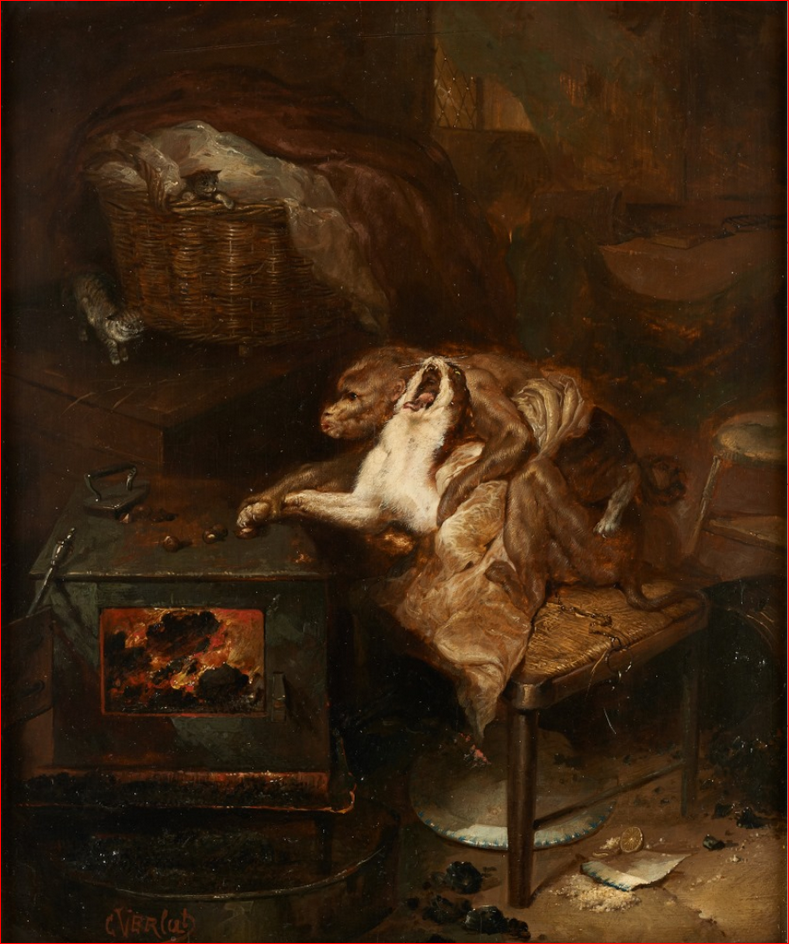
The painting has a signature C. Verlat, for Charles Verlat (1824-1890), one of the better Belgian painters of the 19th century, who painted monkey scenes quite often. The signature is clearly apocriphal though (hence the "bears signature" auction catalogue instead of a "signed by" description).
This work shows a rather sadistic scene, with a monkey grabbing the paw of a cat to get some chestnuts from a hot fire. Two kittens are looking at the scene with dismay. The scene comes from a fable made famous by French author Lafontaine (1679) but known from older examples. It was also popular in Britain and is the origin of the expression "cat's paw". There are many depictions of the story, most a lot less cruel than this one, with the monkey simply convincing the cat to grab the chestnuts, but not forcing it to do so.
This composition is originally by Sir Edwyn Landseer (1802-1873), and this early work by him (1824) is kept in the Minneapolis Institute of Art.
The main differences, apart from the brilliance of the finished work by Landsheer, is that in his work the monkey has a red jacket, and that a broken glass in the original has been transformed int a sliced lemon in the copy.
Whether the painting for sale is taken directly from the original or from one of the engraved copies after it is unclear. If it is based on an engraving, it would explain the smal differences, but then the copyist would have guessed the colours remarkably well.
The work for sale most likely will remain anonymous, but is a fairly good copy of a great painting, though not the most friendly painting to hang on the wall above the dinner table probably. It should easily fetch the estimate.
UPDATE: sold for 700 Euro, results at the auction seem all to have been rather low
The painting has a signature C. Verlat, for Charles Verlat (1824-1890), one of the better Belgian painters of the 19th century, who painted monkey scenes quite often. The signature is clearly apocriphal though (hence the "bears signature" auction catalogue instead of a "signed by" description).
This work shows a rather sadistic scene, with a monkey grabbing the paw of a cat to get some chestnuts from a hot fire. Two kittens are looking at the scene with dismay. The scene comes from a fable made famous by French author Lafontaine (1679) but known from older examples. It was also popular in Britain and is the origin of the expression "cat's paw". There are many depictions of the story, most a lot less cruel than this one, with the monkey simply convincing the cat to grab the chestnuts, but not forcing it to do so.
This composition is originally by Sir Edwyn Landseer (1802-1873), and this early work by him (1824) is kept in the Minneapolis Institute of Art.
The main differences, apart from the brilliance of the finished work by Landsheer, is that in his work the monkey has a red jacket, and that a broken glass in the original has been transformed int a sliced lemon in the copy.
Whether the painting for sale is taken directly from the original or from one of the engraved copies after it is unclear. If it is based on an engraving, it would explain the smal differences, but then the copyist would have guessed the colours remarkably well.
The work for sale most likely will remain anonymous, but is a fairly good copy of a great painting, though not the most friendly painting to hang on the wall above the dinner table probably. It should easily fetch the estimate.
UPDATE: sold for 700 Euro, results at the auction seem all to have been rather low
Wednesday, 29 March 2017
Vertumnus and Pomona
Hampel, from Germany, sells on 30 March 2017 an "Attributed to Jasper van der Laanen" Vertumnus and Pomona, estimated at 12,000 to 18,000 Euro.
It is not clear what the attribution to Jasper van der Lanen (1585-1634) is based on. The composition is known from multiple versions, usually painted somewhat better than this version which is very attractive as a whole, but falls a bit apart when watched up close. The original is by Abraham Govaerts (1589-1626), who was a good friend of van der Lanen. It is still in a private collection. Seen side by side, the difference in quality is amazing. It isn't unlikely that Lanen has painted some Govaerts compositions, and he wasn't the best painter of figures, but this version is inferior to his work and could better be described simply as a Follower of Govaerts. The estimate is too high as well, 5,000 to 6,000 would be better.
Why a £400 set of Old Master Drawings went for £4,000 instead
I regularly encounter interesting prospects, paintings or drawings which have been missed by the auctioneer and are severely undervalued. Soemtimes I list them here, often I share them with one of my contacts to try to buy them. Usually, this doesn't work out as I am not the only one noticing these, and others are less cautious in their estimates.
The latest one was yesterday, 28 March 2017, at Sotheby's. Finding a hidden gem at a small auction is nice, but finding one missed by the Sotheby experts is of course even nicer!
In a collection of "Sixteen Old Master drawings", estimated at £400 to £600, three drawings in particular caught my attention.
The first was an Italian nude, showing great skill, but very heavily damaged, and which I in the end didn't research any further, as it probably was a drawing after one of the great Renaissance artists anyway.
The second was a Flemish drawing in the style of the Antwerp masters of the 17th century, showing considerable skill (but somewhat damaged). It turned out to be a copy after a Van Dyck engraving, depicting Jan Wildens.
But the third one was the one that made for me this lot very interesting and underestimated. A very good and funny drawing of a scene from Don Quixote. It was signed with a "D" upper left, and "Dietri... 1756" lower right.
Some searching led me to another drawing, from the British Museum, from the same year, also from Don Quixote, which was clearly by the same hand and which was given to Christian Wilhelm Ernst Dietrich (also known as Dietricy) (1712-1774), versatile German artist. His drawings usually aren't extremely valuable, but then again they often are preparatory sketches, not the highly attractive finished work we see here.
I can't find any evidence that there ever was a published Don Quixote with these drawings, which would really be the icing on the cake. But even so, having two drawings of the same subject, with the same design of the character (including armour, shield, weapon, donkey, ...) and the same attribution (one by the BM, one on the drawing) makes it fairly certain that this is a genuine Dietrich drawing, and a very good one at that.
So my guess is that this drawing alone is the reason that this lot went for 10 times the estimate, and I hope that whoever bought it truly enjoys it as it is a small gem.
The latest one was yesterday, 28 March 2017, at Sotheby's. Finding a hidden gem at a small auction is nice, but finding one missed by the Sotheby experts is of course even nicer!
In a collection of "Sixteen Old Master drawings", estimated at £400 to £600, three drawings in particular caught my attention.
The first was an Italian nude, showing great skill, but very heavily damaged, and which I in the end didn't research any further, as it probably was a drawing after one of the great Renaissance artists anyway.
The second was a Flemish drawing in the style of the Antwerp masters of the 17th century, showing considerable skill (but somewhat damaged). It turned out to be a copy after a Van Dyck engraving, depicting Jan Wildens.
But the third one was the one that made for me this lot very interesting and underestimated. A very good and funny drawing of a scene from Don Quixote. It was signed with a "D" upper left, and "Dietri... 1756" lower right.
Some searching led me to another drawing, from the British Museum, from the same year, also from Don Quixote, which was clearly by the same hand and which was given to Christian Wilhelm Ernst Dietrich (also known as Dietricy) (1712-1774), versatile German artist. His drawings usually aren't extremely valuable, but then again they often are preparatory sketches, not the highly attractive finished work we see here.
I can't find any evidence that there ever was a published Don Quixote with these drawings, which would really be the icing on the cake. But even so, having two drawings of the same subject, with the same design of the character (including armour, shield, weapon, donkey, ...) and the same attribution (one by the BM, one on the drawing) makes it fairly certain that this is a genuine Dietrich drawing, and a very good one at that.
So my guess is that this drawing alone is the reason that this lot went for 10 times the estimate, and I hope that whoever bought it truly enjoys it as it is a small gem.
Subscribe to:
Posts (Atom)