Wednesday, 30 October 2019

"English School, 18th century" looks to be by Johann Baptist Bouttats

Jackson's, from the United States, sells on 19 November 2019 an "English School, 18th century" naval scene, estimated at $300 to $500.

The painting is "Indistinguishably signed and dated 1745 lower left", but luckily they provide a decent image of the siganture and date.

It looks to me as if it says "J. B. Bo...tt... 174 (1?)". The most logical name is probably Johann Baptiste Bouttats (1680s-1743), last major painter from the Bouttats family, who migrated to England (Hull) in the 1720s. 


Different marine scenes from his hand are known. While they are comparable in general, they seem to be generally more detailed; considering that this work comes from his very final years, while his better works were ten or more years older, this may be understandable. 

As a signed, attractive work (that needs cleaning)  by a known artist, it should be worth 10 times the estimate probably.

Thursday, 24 October 2019

Leonaert Bramer: reconstructing a drawing book


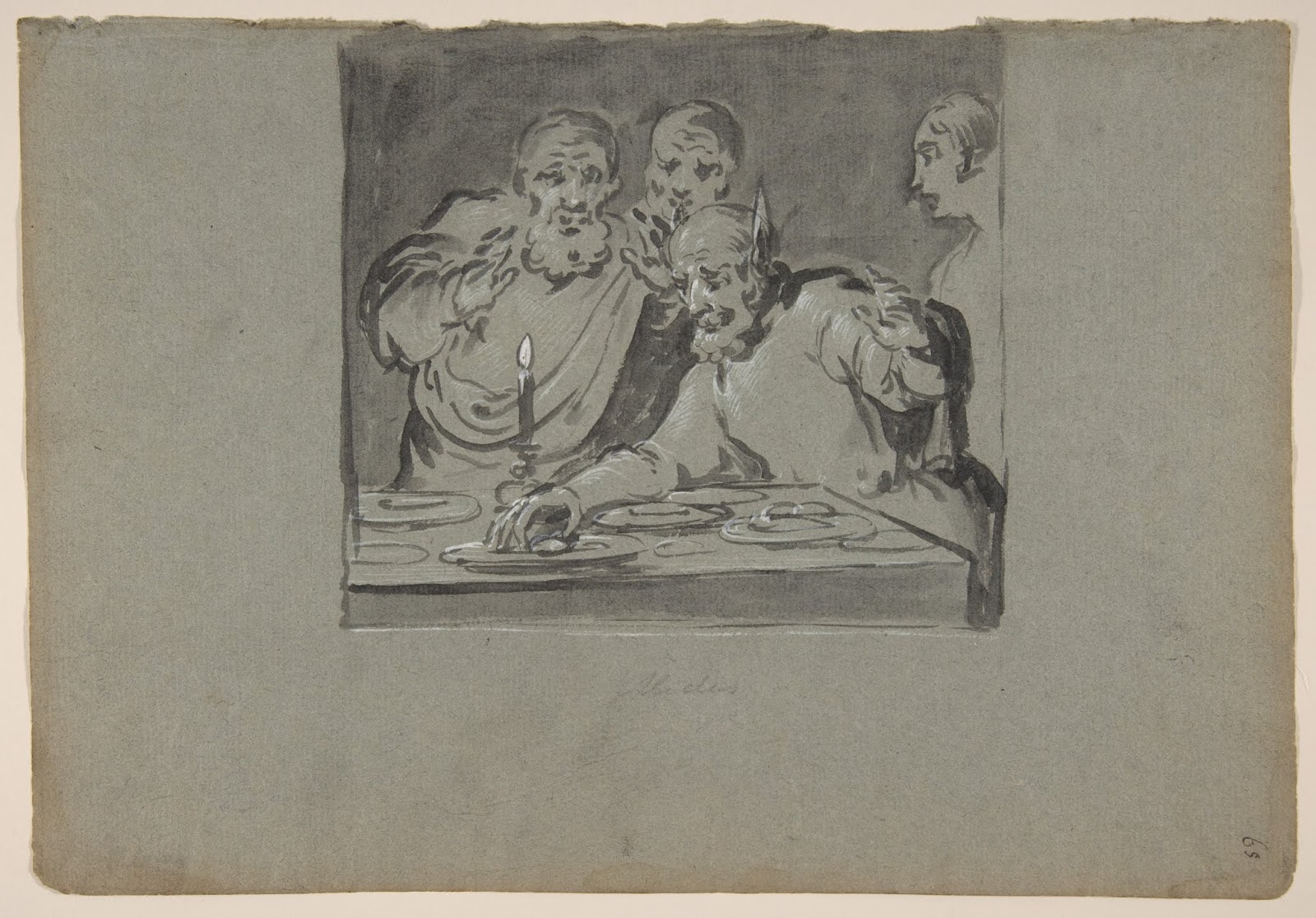
The Münstersches Kunst- und Auktionhaus, from Germany, sells on 26 October 2019 a 'Leonhard Bramer" Ceres drawing, estimated at 1,800 Euro.

It turns out to be one of the 80 drawings of the "Hofstede de Groot album", a book of drawings by Leonaert Bramer (1596-1674, Dutch) which was kept together until 1984, when the album was sold at Bassenge but the new owner then dismantled and sold some or all pages individually (which is a shame). The RKD lists 12 of the drawings, and some others can be found online.

This seems to be the front page or frontispice of the book, judging from the inscription (only partly given at the auction site): "Doet is mijn teckeni(?) boeck", rather poor Dutch for "This is my book of drawings".

Other drawings from the book include:

The Wedding at Cana, offered at Sotheby's in 2008 with an estimate of £3,500 to £5,000, apparently unsold; then in 2014 for sale with Foolscap (an important specialist in Old Master drawings), and from there sold to a private collector in Switzerland.


Jael and Sisera, Aeneas and Anchises, Abraham and the 3 angels, Musicians, King Midas: all from the Met museum.

Drawings found at the RKD website:


Musicians, private collection
Christ among the doctors, Saint Peter, The Garden of Gethsemane, People eating, the Annunciation, Christ and Kajafas: all at Bassenge between 2012 and 2015

Backgammon players, on the art market in Frankfurt in 1989

The Magi, private collection

There was at least one other work from the series for sale at Bassenge in 2014, but not listed on the RKD site: another depiction of musicians.

Which makes at least 16 (now 17) drawings from the original 80 which have since found their way to either museums or other auctions. To reassamble this book would be a massive undertaking (costly and slow), but buying the first page may be a good start :-)

Wednesday, 23 October 2019

1508 dated Flemish Virgin and Child is copy after Van der Weyden

Neumeister, from Germany, sells on 24 October 2019 a "Flemish(?)" Virgin and Child, dated 1508, estimated at 4,000 to 4,500 Euro.

Despite the old attribution on the back to Lucas Cranach, it is a copy after Rogier Van der Weyden, the Virgin and Child from the Museum of Fine Arts, Houston.

Although well painted, it is less attractive than the original, both because of the condition and because Mary looks rather unhappy instead of loving. Even so, it should have no problem making the estimate, also because this specific Van der Weyden composition has rather few known copies compared to some of his more popular works.

UPDATE: sold for 38,100 Euro (costs included)! 

Monday, 21 October 2019

Very large Ark of Noach is copy after Jan van Londerseel engraving

Galerie Moderne, from Belgium, sells on 11 November 2019 a large (132 by 225 cm!) "Anonymous, 17th century" Ark of Noach, estimated at 7,000 to 10,000 Euro.

While the size and age certainly explain the estimation, the quality is less than one would expect in such a large painting. Usually, only the good painters painted large paintings, as the people who could afford such huge paintings and had the room to hang them went for established names, not for some amateur. Perhaps it was intended for a provincial church, which had the space to hang such large work, but not the means or knowledge to go for a better painter.

This one is a copy after an engraving from ca. 1680, designed by Jan Van Londerseele (about whom very little is known) and published as part of an illustrated Bible by the Visscher family (probably Nicolaes II Visscher). The engraving was an impressive 38 by 52 cm, but the painting expands it considerably still (information on the engraving, and image, from the Rijksmuseum). The composition is nearly the same, except some small differences (e.g. the right-most woman is placed slightly different, and the work is made larger next to her); but the painting is not good enough to be the original of the engraving (which would have made it a good find of course), even though it is reversed compared to the printed work. It may be that it is based directly on the original, assuming that this was first a painting and not immediately a drawing made especially for the engraving.

As it stands, it will have trouble fetching the estimate, as it is simply too big for many houses, and not good enough to attract many bidders.

Thursday, 17 October 2019

"Flemish School" is probably a Cornelis Ketel

De Vuyst, from Belgium, sells on 19 October 2019 a "Flemish School, 2nd half 16th century" Allegory (1577), estimated at 10,000 to 14,000 Euro.

Because I already wrote about another version of this work in 2016, I could quite easily find both the subject and the probable artist. It is a depiction of the Riddle of Nijmegen (which I explained at length in the older post), and the artist is most likely Cornelis Ketel (1548-1616). His previously known version of this composition is dated 1576 and is owned by the museum Valkhof, in Nijmegen. The only problem with that attribution is that he was active in London in those years (both versions), and the painting is clearly aimed at a Dutch-speaking audience.

Comparing the 1576 version with this new, 1577 dated one clearly show the same hand, but the version for sale is even better, and in a better condition (and has a tiled floor, which makes it a bit more lively).

Values of Ketel paintings (which are relatively common) differ wildly, but I guess that this one should be worth closer to 40,000 Euro if people realise what is being offered here. It does look to be somewhat shortened on the right side though, which is a pity.

UPDATE: sold for 15,000 Euro, wouldn't surprise me if it reappeared with the right attribution and description and double the value somewhere next year.

Wednesday, 9 October 2019

A bas-relief after Rubens

Vanderkindere, from Belgium, sells on 15 October 2019 a "Flemish School, late 17th century" ivory bas-relief of the Judgment of Paris, estimated at 4,000 to 6,000 Euro.

The composition is remarkable, since it is taken from a painting by Rubens now in the Prado! It seems rather unusual to find such a work, already valuable at the time, which copies a painting instead of being an original composition. Something for the demanding Rubens' collector who wants something beyond their original paintings or drawings ;-) It is based on the (at the time) lesser known of the two versions of this story painted by Rubens, the other version was much more widely distributed through engravings. Why and how this one was chosen is unclear.

Oh, and the hand coloured engraving attributed to Wierick Somers seems to be some misunderstanding: this set of engravings, coming from the "Théatre de la cruauté" by Richard Verstegen, is usually attributed to Johannes Wierix (an engraver), and not to Wierick Somers (same period, but a goldsmith).

UPDATE: sold for 6,400 Euro.

Thursday, 19 September 2019

Nice auction at Neumeister, including a Brueghel the Younger which is a Grimmer instead

Neumeister, from Germany, sells on 25 September 2019 a fine collection of Old Master paintings.

Lot 94 is an "Antwerp, Early 16th century" Man of Sorrows (or Christ and the Instruments of the Passion), estimated at 4,000 to 6,000 Euro. It is painted by an accomplished artist, even though it may be based on an engraving (though I haven't found one with this composition).

On the middle left, next to his shoulder, I think I have found a monogram, "PA". It is cleverly hidden in the decoration, but as these are the only letters anywhere, and they clearly aren't "PAX" or some such, I wonder if they may be a monogram for the artist? But it doesn't really look like Pieter Aertsen I think, and I doubt that Pieter Coecke van Aelst would use PA. Others may have a better idea (e.g. the way the flesh of the left arm is painted seems to be very artist-specific). It should easily sell at the estimate, and may go a lot higher if some people have an idea of the actual artist.


Lot 109, Saint Paul with the viper by "Dutch school, 17th century" (est. 2,500 to 3,000 Euro) is a copy after an engraving by Harmen Jansz Muller from ca. 1590, after a design by Dirck Barendsz, as found at the Rijksmuseum site. Considering that the charm of the painting is all derived from the composition of the engraving, and the actual artistic merits of the painting are very small, it might struggle to reach the estimate.

Lot 119 is the most interesting of these, a "Workshop of Pieter Brueghel the Younger" allegory of Spring, estimated at 25,000 to 30,000 Euro.

Other versions of this work are known, and in 2013 one was sold at Sotheby's for $2,285,000!

A full set of the four seasons was sold at Christie's in 2016 for £6,466,500.

But the description of that version brings the cat out of the bag: the one for sale here is most likely not from the workshop of Pieter Brueghel the Younger, but from the workshop of Abel Grimmer. The Brueghel versions all have some characteristics not found in the Grimmer ones, and vice versa.

Private collection


In the Brueghel ones, you can see that they are planting flowers, there are two sheep close to the river, and there is a row of houses across the river.

The Grimmer ones, on the other hand, follow the original engraving after Pieter Brueghel the Elder much closer. This was made in 1570 by Pieter Van der Heyden (example from the Met Museum).


A signed 1607 copy (i.e. older than the Pieter Brueghel the Younger versions) is kept in the Royal Museum of Fine Arts in Antwerp (together with the remainder of the series). It is clearly a lot closer to the one for sale than the Brueghel ones: no flowers are planted, no loose sheep, but on the other hand you get a small boat on the water, the houses behind the river are replaced with some stand, the gate behind the workers (smack in the middle of the painting) is longer to the left, the large pigeon tower isn't red at the bottom but yellowish white, ...

A full set of the four seasons by Grimmer was sold at Lempertz in 2018 for 285,000 Euro. This one seems to be a bit further removed from the original, as some details become weird or are missing (the boat on the river, which will pass the stand in some festive manner, is replaced with a swan; the shovel in the front gets a strange angle; the pigeon tower becomes a generic tower...) suggesting that this may be the work of a follower of Grimmer and not directly a work by Grimmer; the work for sale seems closer to his original though.

As such, I would estimate it at 50,000 Euro.

UPDATE: The Man of Sorrows sold for a very nice 35,560€, the Saint Paul for 2858€, and the Grimmer for 120,650€, impressive!