Horta, from Belgium, sells on 25 February 2019 a "Flemish School, 17th century" Saint Cecilia, estimated at 7,000 to 10,000 Euro.
I have already at length commented on this work when it was for sale at Carlo Bonte in May 2017, so I'll not dwell on the presumed authorship of Gérard de la Vallée again.But at the time, I didn't pay attention to the different paintings and texts visible in the work, even though that is often one of the most interesting aspects of such works.
On the left, we have a few books on the table, including one opened music book, but this is too blurry to make out any further. Above it, the pedestal of the table organ has an inscription which is impossible to decipher, but where individual characters can be read. I presume that, if it is supposed to be a real inscription, it contains a date (a chronograph?) or an indication of a Bible verse, as it seems to have too many Roman numeral characters in it for a standard text. It starts, I think, with "X LURII" (or LURN?), and the first line again ends with X and has an L in it. The second line seems to read "X D V N D L L ..."? It could be that the Xs are just decoration at the start and end of the lines though. Even so, I have no idea what it is supposed to say (a dedication? The name of the organ builder? The signature of the painter? Random letters?)
The wings of the organ show the resurrected Christ defeating death, and a crucifixion. Above the crucifixion is a text I again can't decipher, even though it looks to be a "real" text. The top is "N S G(?)", second line is "M S I(?) O)", third line is "H ? T T", fourth line is very unclear but seems to end with an A, and I think there is a final fifth line as well. The two paintings are rather typical Flemish productions of the first half of the 17th century, with a crucifixion reminiscent of the compositions of Rubens or Jordaens (though with a less muscled Jesus).
The large painting at the back shows angels playing music. Again, I couldn't find a clear origin for this work, but it seems to be inspired by work by Rubens, Frans Francken or even Peeter de Witte. The cello or bass playing angel on the right seems a rather common theme. With Rubens, it is on the left, but that's because it is a modello, and the finished tapestry has the instrument on the right. The Francken III (with Cornelis de Bailleur) is remarkable as it is also a Saint Cecilia, with the saint in a rather similar position; but here the musician angels are not depicted on a painting, but as really there.
The work for sale also has a rather nondescript common Virgin and Child sculpture in the back, then a sleeping figure which from a distance looked like a sleeping child Jesus but on closer inspection may be another figure as well, a Cupid or an unidentified woman, and on the right a more interesting portrait of a couple with a dove, presumably a wedding portrait.
All in all, no recognisable works, but a variety of subjects and styles, which all seem to date to around 1630 or slightly later.
UPDATE: sold for 5,000 Euro.
Monday, 18 February 2019
Saturday, 16 February 2019
Follower of the Master of the Parrot
Kendzia, from Germany, sells on 23 February 2019 a "Flemish Master, 16th century" Death of Lucretia, estimated at 4,000 Euro.
They don't indicate an artist, but refer to two similar works, in Malta and in Burg Gnandstein.
The version from the National Museum of Malta is shown at Europeana. It is nearly identical to the work for sale, but larger.
The version from the Burg Gnandstein castle, shown on museum digital: Deutschland, lacks the background scene, but that page has more interesting information on the artist, said to be the Master of the Parrot; they date it to c. 1520.
Bizarrely, the best version, and probably the original for this composition, is not mentioned on any of this sites: the Master of the Parrot from the Prado. It is very close to the Gnandstein version, but better. It has more subtlety in nearly evey aspect of the work, most visibly in the shadows and in the hair.
The version for sale is clearly inspired by the Malta version or by a common ancestor (it may well be that there existed an original Master of the Parrot version with the background added), but the figure is painted in a different style, not with the almost statuesque paleness of the other three, but with "real" colours (I have inserted the head of the Prado version for comparison). While it isn't good enough to be by the Master, it still is a very fine work, with some damage though, but finely detailed. The estimate seems cautious.
UPDATE: sold for 7,500 Euro.
They don't indicate an artist, but refer to two similar works, in Malta and in Burg Gnandstein.
The version from the National Museum of Malta is shown at Europeana. It is nearly identical to the work for sale, but larger.
The version from the Burg Gnandstein castle, shown on museum digital: Deutschland, lacks the background scene, but that page has more interesting information on the artist, said to be the Master of the Parrot; they date it to c. 1520.
Bizarrely, the best version, and probably the original for this composition, is not mentioned on any of this sites: the Master of the Parrot from the Prado. It is very close to the Gnandstein version, but better. It has more subtlety in nearly evey aspect of the work, most visibly in the shadows and in the hair.
The version for sale is clearly inspired by the Malta version or by a common ancestor (it may well be that there existed an original Master of the Parrot version with the background added), but the figure is painted in a different style, not with the almost statuesque paleness of the other three, but with "real" colours (I have inserted the head of the Prado version for comparison). While it isn't good enough to be by the Master, it still is a very fine work, with some damage though, but finely detailed. The estimate seems cautious.
UPDATE: sold for 7,500 Euro.
Friday, 15 February 2019
Geldorp Gortzius
Vanderkindere, from Belgium, sells on 19 february 2019 an "attributed to Geldorp Gortzius" Family praying before the meal, estimated at 4,000 to 6,000 Euro.
The attribution should probably be read as "follower of Gortzius", as the painting closely resembles a true Gortzius from the Landesmuseum in Bonn (found at RKD). Many elements of the two works are nearly identical, from the position of the parents and some children to the see-through to the kitchen and the position of the maid in it on the right, but the execution of the one for sale is more clumsy, though still attractive.
What I find most interesting in such paintings are the details, which tell a lot about life then. Not everyday life, as such paintings were only possible for the more wealthy families, and e.g. the clothing and tableware shows their best, not their everyday stuff; but still an interesting view behind the screens, which one usually only reads about (e.g. in the 17th century inventories transcribed by Erik Duverger).
At the back: above the chimney, hangs a painting (a typical place for paintings in Flemish houses of the period). It shows a landscape in the style of Tobias Verhaecht or someone similar. It is a purely decorative work, not a religious or moralistic one, which makes this painting different from the Gortzius one, which shows a much more devote family, with a painting of a crucifixion and an appearance of the holy ghost.
On the left, one can see the favourite wall decoration of the period, a kind of tapestry which may be embossed leather. On it is added a moralistic text, which probably wasn't present in the actual room but is added as a kind of motto. It is very hard to decipher, at least from the photo at the auction site (but perhaps also in reality), but here goes.
"[E]enen beet m[...]rden gefe
is beter al schijne [...]at gemi[?] is
Dan een huijs vol spijse bij even[?]
[...]"
Most of this is rather speculative, but it seems to be a variation on a Solomonian proverb (chapter XVII), given in old translations as "Eene droge bete, ende ruste daer by, is beter, dan een huys vol van geslachte beesten, met twist" or "beter is eenen drooghen bete met blijscappen, dan een huys vol gheslaghender beesten met kijuagien"
In English this Bible verse is translated as "Better a dry crust with peace and quiet than a house full of feasting, with strife" or " Better is a dry morsel, and quietness therewith, than an house full of sacrifices with strife."
Which seems like an appropriate text to accompany a painting of a meal!
The same scene, with Bible verse at the bottom, is depicted in an engraving by Crispijn van de Passe from 1589, after a design by Maerten de Vos (found at the Rijksmuseum site). The image is also somewhat comparable to the two works above, with the see-through to the kitchen, and (like in the work for sale) a dog and a cat in the front. But in many other aspects the two other works are much closer to each other and separate from this one, so it is highly unlikely that they were both based on this engraving. This work is called "Concordia" or "The good household".
UPDATE: sold for 5,200 Euro.
The attribution should probably be read as "follower of Gortzius", as the painting closely resembles a true Gortzius from the Landesmuseum in Bonn (found at RKD). Many elements of the two works are nearly identical, from the position of the parents and some children to the see-through to the kitchen and the position of the maid in it on the right, but the execution of the one for sale is more clumsy, though still attractive.
What I find most interesting in such paintings are the details, which tell a lot about life then. Not everyday life, as such paintings were only possible for the more wealthy families, and e.g. the clothing and tableware shows their best, not their everyday stuff; but still an interesting view behind the screens, which one usually only reads about (e.g. in the 17th century inventories transcribed by Erik Duverger).
At the back: above the chimney, hangs a painting (a typical place for paintings in Flemish houses of the period). It shows a landscape in the style of Tobias Verhaecht or someone similar. It is a purely decorative work, not a religious or moralistic one, which makes this painting different from the Gortzius one, which shows a much more devote family, with a painting of a crucifixion and an appearance of the holy ghost.
On the left, one can see the favourite wall decoration of the period, a kind of tapestry which may be embossed leather. On it is added a moralistic text, which probably wasn't present in the actual room but is added as a kind of motto. It is very hard to decipher, at least from the photo at the auction site (but perhaps also in reality), but here goes.
"[E]enen beet m[...]rden gefe
is beter al schijne [...]at gemi[?] is
Dan een huijs vol spijse bij even[?]
[...]"
Most of this is rather speculative, but it seems to be a variation on a Solomonian proverb (chapter XVII), given in old translations as "Eene droge bete, ende ruste daer by, is beter, dan een huys vol van geslachte beesten, met twist" or "beter is eenen drooghen bete met blijscappen, dan een huys vol gheslaghender beesten met kijuagien"
In English this Bible verse is translated as "Better a dry crust with peace and quiet than a house full of feasting, with strife" or " Better is a dry morsel, and quietness therewith, than an house full of sacrifices with strife."
Which seems like an appropriate text to accompany a painting of a meal!
The same scene, with Bible verse at the bottom, is depicted in an engraving by Crispijn van de Passe from 1589, after a design by Maerten de Vos (found at the Rijksmuseum site). The image is also somewhat comparable to the two works above, with the see-through to the kitchen, and (like in the work for sale) a dog and a cat in the front. But in many other aspects the two other works are much closer to each other and separate from this one, so it is highly unlikely that they were both based on this engraving. This work is called "Concordia" or "The good household".
UPDATE: sold for 5,200 Euro.
Thursday, 14 February 2019
"Sienese Master, 15th century": circle of il Sassetta?
Nagel, from Germany, sells on 28 February 2019 as lot 701 an "Italian" Madonna estimated at 1,500 Euro.
The description indicates that the back of the painting has an inscription identifying it as a 15th century Sienese Master, showing a Madonna from an Annunciation, and that it was owned by "J. A. Ramboux" who they identify with Johann Anton Ramboux (1790-1866), a major early collector of Sienese art.
The painting to me looks convincing, so it may be an original as described on the back. In that case, it should be worth a lot more, perhaps closer to 10,000 Euro, as a good, attractive example of the common paintings in Siena and surroundings for about 100 years.
The closest artist I have found so far is Stefano di Giovanni, named Il Sassetta, who lived from ca. 1390 to ca. 1450 in Siena. His Madonnas have similar folds in the clothing, similar poses (though the hand position here is unique, even if the hands are the worst part of the painting), similar headdress... The way the face is painted also is quite similar.
There are, always assuming it is an original and not a 19th century fake, probably even better matches to be found by people specialized in this period and region, but it may give an idea about where to look!
UPDATE: sold for 55,000 Euro! Way more than even I expected.
The description indicates that the back of the painting has an inscription identifying it as a 15th century Sienese Master, showing a Madonna from an Annunciation, and that it was owned by "J. A. Ramboux" who they identify with Johann Anton Ramboux (1790-1866), a major early collector of Sienese art.
The painting to me looks convincing, so it may be an original as described on the back. In that case, it should be worth a lot more, perhaps closer to 10,000 Euro, as a good, attractive example of the common paintings in Siena and surroundings for about 100 years.
The closest artist I have found so far is Stefano di Giovanni, named Il Sassetta, who lived from ca. 1390 to ca. 1450 in Siena. His Madonnas have similar folds in the clothing, similar poses (though the hand position here is unique, even if the hands are the worst part of the painting), similar headdress... The way the face is painted also is quite similar.
There are, always assuming it is an original and not a 19th century fake, probably even better matches to be found by people specialized in this period and region, but it may give an idea about where to look!
UPDATE: sold for 55,000 Euro! Way more than even I expected.
Wednesday, 13 February 2019
"17th century Flemish School": a Hieronymus Francken III?
"Européenne de ventes", from Bourg-en-Bresse in France (the city of the wonderful Monastère de Brou), sells on 21 February 2019 a "Flemish School, 17th century" Christ carrying the cross, an oil on copper of 36 by 28 cm estimated at, well, no idea, they don't give an estimate.
The auction house, which seems to handle fine art not too often and doesn't have an up-to-date website (getting the work to you if you can't be at the auction in person may be harder or more expensive!), provides many pictures, but not one with a really good view of the work as a whole. Even so, it is clear that the work is painted skillfully and is in good condition overall.
Gallerie Barrez, from Paris, sold the above work as "attributed to Hieronymus Francken III". To me, the colours, and overall look, are very similar, so I presume that the one for sale now may also be attributed tentatively to him, or to the rather similar Ambrosius Francken II.
The work, as can be seen in the above details, is really a lot better than most Francken copies (but still far from a Frans Francken II original), and should be worth 2,000 to 3,000 Euro at least.
Francken II, Lille Museum of Fine Arts
It is one of the better copies of a well-known Francken composition. This one doesn't have the more subdued colours of Frans Francken II, the sometimes pale blues and browns one often sees in his work.The auction house, which seems to handle fine art not too often and doesn't have an up-to-date website (getting the work to you if you can't be at the auction in person may be harder or more expensive!), provides many pictures, but not one with a really good view of the work as a whole. Even so, it is clear that the work is painted skillfully and is in good condition overall.
Gallerie Barrez, from Paris, sold the above work as "attributed to Hieronymus Francken III". To me, the colours, and overall look, are very similar, so I presume that the one for sale now may also be attributed tentatively to him, or to the rather similar Ambrosius Francken II.
The work, as can be seen in the above details, is really a lot better than most Francken copies (but still far from a Frans Francken II original), and should be worth 2,000 to 3,000 Euro at least.
Monday, 11 February 2019
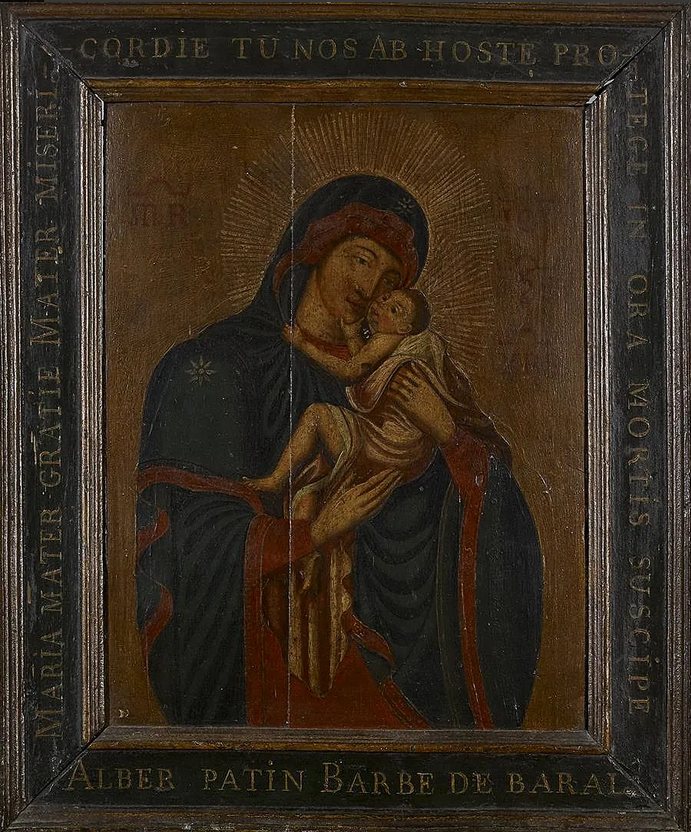
Researching some provenance for another Cambrai Madonna
Debacker & Richmond, from France (despite the Flemish and English name), sells on 2 March 2019 a"Flemish School, in the Italo-Byzantine Style of the 14th century" Virgin and Child, estimated at 500 to 700 Euro.
It is another version of the "Cambrai Madonna", an important painting I already discussed a few months ago.
This is a devotional image, hung in a Church with the names of the benefactors at the bottom. In this case, "Alber Patin Barbe de Baral". And this made it possible to find some provenance and thus history for this painting.
It is another version of the "Cambrai Madonna", an important painting I already discussed a few months ago.
This is a devotional image, hung in a Church with the names of the benefactors at the bottom. In this case, "Alber Patin Barbe de Baral". And this made it possible to find some provenance and thus history for this painting.
Amazingly enough, it is not Flemish but comes from Cambrai, the city that also houses the original Cambrai Madonna. The work for sale was owned at one time by Immanuel Oscar Menahem Deutsch (1829-1873), a German Jew who worked in the British Museum for much of his career. In his "Literary Remains", published in 1874, we find a reference to a work dedicated by Albert Patin and Barbe de Baralle, which he dates to the early 17th century. According to Deutsch, the Patin family was an important family in Cambrai, often in judiciary functions.
Genealogy sites (which should often be taken with a grain of salt) indicate that Albert Patin, married to Barbe Baralle and father of Chrestienne Patin, died before 1620: which would mean that this painting as well dates at the latest to 1620, making it quite interesting.
It probably isn't worth much more than the estimate, but it is good to have a clear origin in space and time.
Friday, 8 February 2019
Pandolfini part 4: not after Van der Valckert but after Goltzius
Pandolfini, from Italy, sells on 26 February 2019 a "Dutch School, 17th century" Laughing fool, estimated at 5,000 to 7,000 Euro.
They place it close to Werner van den Valckert (1580-1627), who has indeed engraved several very similar images.
However, this specific one is not after Van den Valckert but after an engraving by Jan Saenredam after Hendrick Goltzius, from ca. 1595 (first state via the Museum of Fine Arts in Houston, third state via the British Museum). It seems logical that this image also was the inspiration for Van den Valckert.
The text on the first state simply says "It's just for laughs".
It is an intriguing image, moralistic but in a way which appeals to modern buyers as well, and will probably have no trouble fetching the estimate.
UPDATE: sold for 6,250 Euro.
UPDATE 2: now for sale with Jean Moust for 14,500 Euro, as "attributed to Van der Valckert"
They place it close to Werner van den Valckert (1580-1627), who has indeed engraved several very similar images.
However, this specific one is not after Van den Valckert but after an engraving by Jan Saenredam after Hendrick Goltzius, from ca. 1595 (first state via the Museum of Fine Arts in Houston, third state via the British Museum). It seems logical that this image also was the inspiration for Van den Valckert.
The text on the first state simply says "It's just for laughs".
It is an intriguing image, moralistic but in a way which appeals to modern buyers as well, and will probably have no trouble fetching the estimate.
UPDATE: sold for 6,250 Euro.
UPDATE 2: now for sale with Jean Moust for 14,500 Euro, as "attributed to Van der Valckert"
Subscribe to:
Posts (Atom)